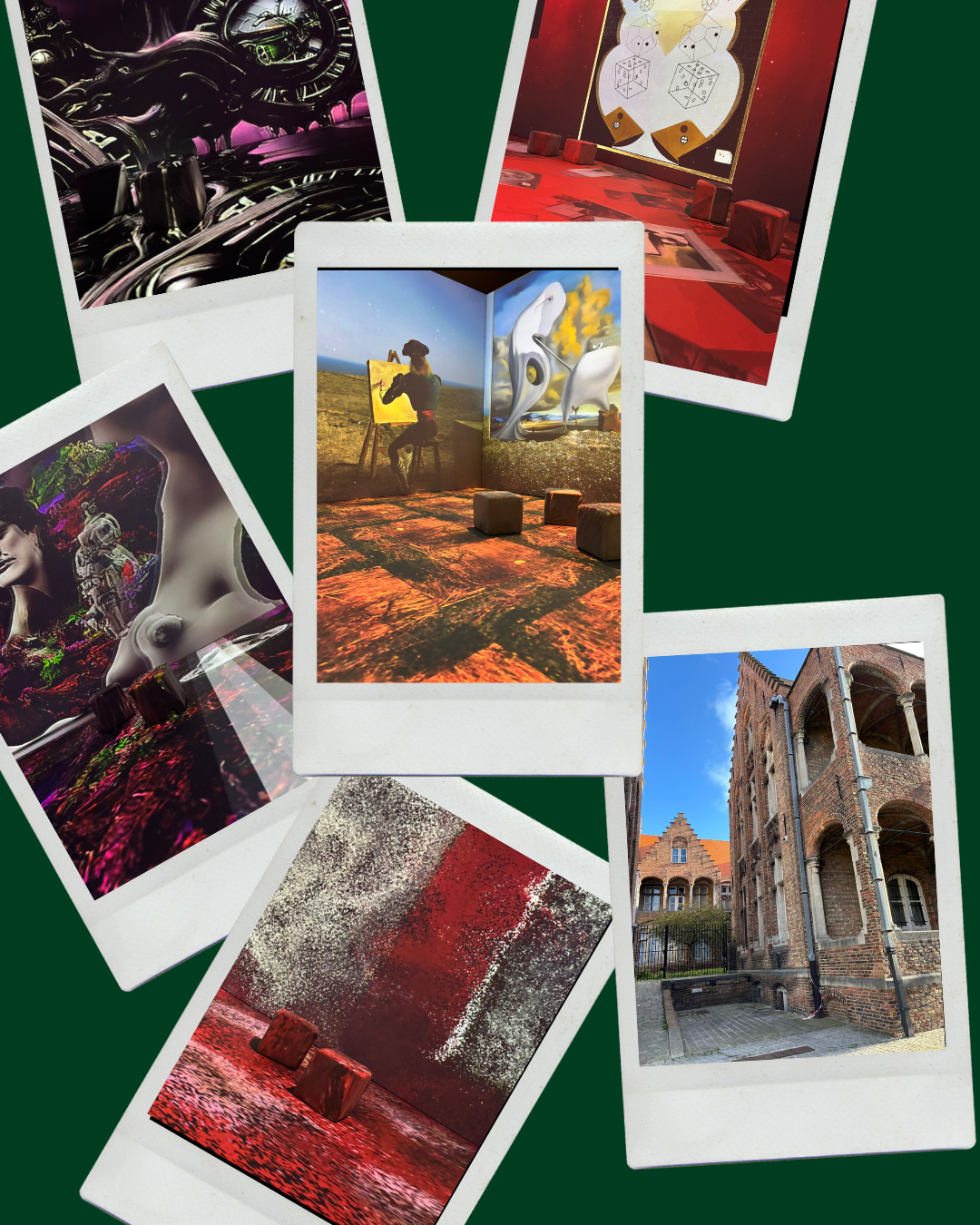
Photos by Melis Seven
30 November 2025
Dear Reader,
As we are slowly approaching the jolly Christmas spirit, I can’t help but feel nostalgic for beautiful, crisp fall. This fall, I found myself wandering in Bruges, a city that seems to hold autumn in its hands all year long. With its medieval streets that take you back in time to the 15th century, and its quiet canals, reflecting the calm, amber light of the season, the city is the perfect description of nostalgia wrapped up in a blanket.
It was in this timeless atmosphere that I visited Dalí Cybernetics, a digital exhibition tucked inside the historical Oud-Sint Jan site. Standing in a city that is lovingly frozen in the 15th century, I couldn’t ignore the striking contrast. Dalí’s world of floating forms, distortions, and technological curiosity, had suddenly taken root in the very heart of Bruges.
Salvador Dalí, long before digital art became an art genre of its own, was in awe of technology.
You read that correctly, Dalí pioneered immersive visual arts. He celebrated the birth of mass culture and technology. In the 1970s, Dalí experimented with holography, creating images that seemed to float in space (Polyhedron and Basketball 1972). For him, technical reproducibility was not a threat, but it was an opportunity to abandon the outdated and create art true to its time.
Inside the exhibition, his hallucinations and surreal universe comes alive on every wall in the projection room. We see his paintings float and metamorphose before our eyes. Inside just four walls, boundaries between reality and illusion dissolve. You try to recognize and hold on to the familiar, but everything keeps shifting. While the room succeeds in creating a sense of hallucination, fractured faces and different landscapes blur together, making it difficult for you to keep track of what's happening.
The metaverse room deepens this sensation. With VR glasses on, I stepped onto a virtual ship, perhaps the one from the Ship with Butterfly Sails (1937), and sailed through Dalí’s sea of imagination. I drifted past melting clocks (The Persistence of Memory, 1931), under the slender legs of The Elephants, 1948, and when I turned around, I was faced with the resemblances of magical eggs (Metamorphosis of Narcissus, 1937) that felt so tangible that I was tempted to touch. I couldn’t help but take my VR glasses off and make sure I wasn’t crashing into walls.
But then comes the Bruges dilemma. When I walked back outside, I returned instantly to cobblestones, horse carriages, and the chiming of church bells. The city’s stillness is so powerful that it feels as if the whole digital dream evaporated in the blink of an eye. Bruges’s medieval atmosphere is enchanting, but it also pulls you back into reality a little too quickly.
As winter approaches, I can’t help but wonder if Bruges, as beautiful and timeless as it is, is the right setting for an encounter like this.
I want to end by asking you, dear reader, a question: Can a city rooted so deeply in the past truly serve as a stage for the future of digital art?
From Bruges, with love
Melis
You might also enjoy. . .