Furnishing a Woman’s Mind: Isamu Noguchi’s Vision for Martha Graham’s Stage Worlds

Portrait of Martha Graham and Bertram Ross, as Clytemenestra and Orestes. 1961. Carl Von Vechten. Copyright: Library of Congress
7 November 2025
Martha Graham (1894-1991) is one of the best-known and most revered figures of 20th century American dance, with a distinct style and transformative major works that have long outlived her. While Graham frequently collaborated with dancers in her company, and with notable artists like composer Aaron Copland, perhaps her most instrumental collaborator was designer and sculptor Isamu Noguchi, who, in his partnership with Graham, helped to cement her signature visual language.
Martha Graham, born in Allegheny City, Pennsylvania, in 1894, began her lifelong dance practice upon moving to Santa Barbara, California, with her family as a teenager. There, she trained at the Denishawn School of Dancing and Related Arts before following the creative pulse of the dance world to Greenwich Village in New York City. Throughout the 1920s, Graham worked to establish herself as a dancer and choreographer, and founded her own company in 1926. As she rose to prominence, her style evolved into one that focused on her pioneering technique of contraction and release — wherein the musculature of the body is engaged to emphasize the juxtaposition between a rigid movement that curls in on itself and a freer motion that expands the body outwards with a sense of weightlessness — establishing a sharp, rigorous postmodern style, breaking from the traditions of her early dance training.
It was in the artistic milieu of Greenwich Village that Martha Graham met Isamu Noguchi (1904-1988), the Japanese-American sculptor who would become her longtime collaborator. They had many friends and collaborators in common, including Noguchi’s sister, Ailes Gilmour, who was a dancer in Graham’s company. Noguchi, who had been brought up both in Japan and in several corners of the United States, had been trained as a sculptor at New York’s Leonardo da Vinci School of Art. At the time that he and Graham first encountered one another, Noguchi was making a living by sculpting busts, and it was for a showing of these works in 1930 that he created a series of busts of Graham, and their artistic entanglement began.
It wasn’t until 1935, however, that Noguchi began working directly with Graham as her scenic designer. Their first collaboration was for Graham’s piece Frontier (1935) which featured a split-rail fence as its scenic centerpiece amidst a spare stage, conjuring the vast horizon of the American plains. Later, as Graham’s pieces became increasingly non-linear and psychological, Noguchi’s designs followed suit. As dance critic and scholar Deborah Jowitt wrote in her biography of Graham, “beginning in 1946 her dances seldom unfurled along a timeline in a specific place, and Noguchi’s sculptures became the furnishings of a woman’s mind.” This evolution is evident in the differences between early collaborations, like Frontier, and later ones, like Embattled Garden (1958), a personal favorite design of Noguchi’s.
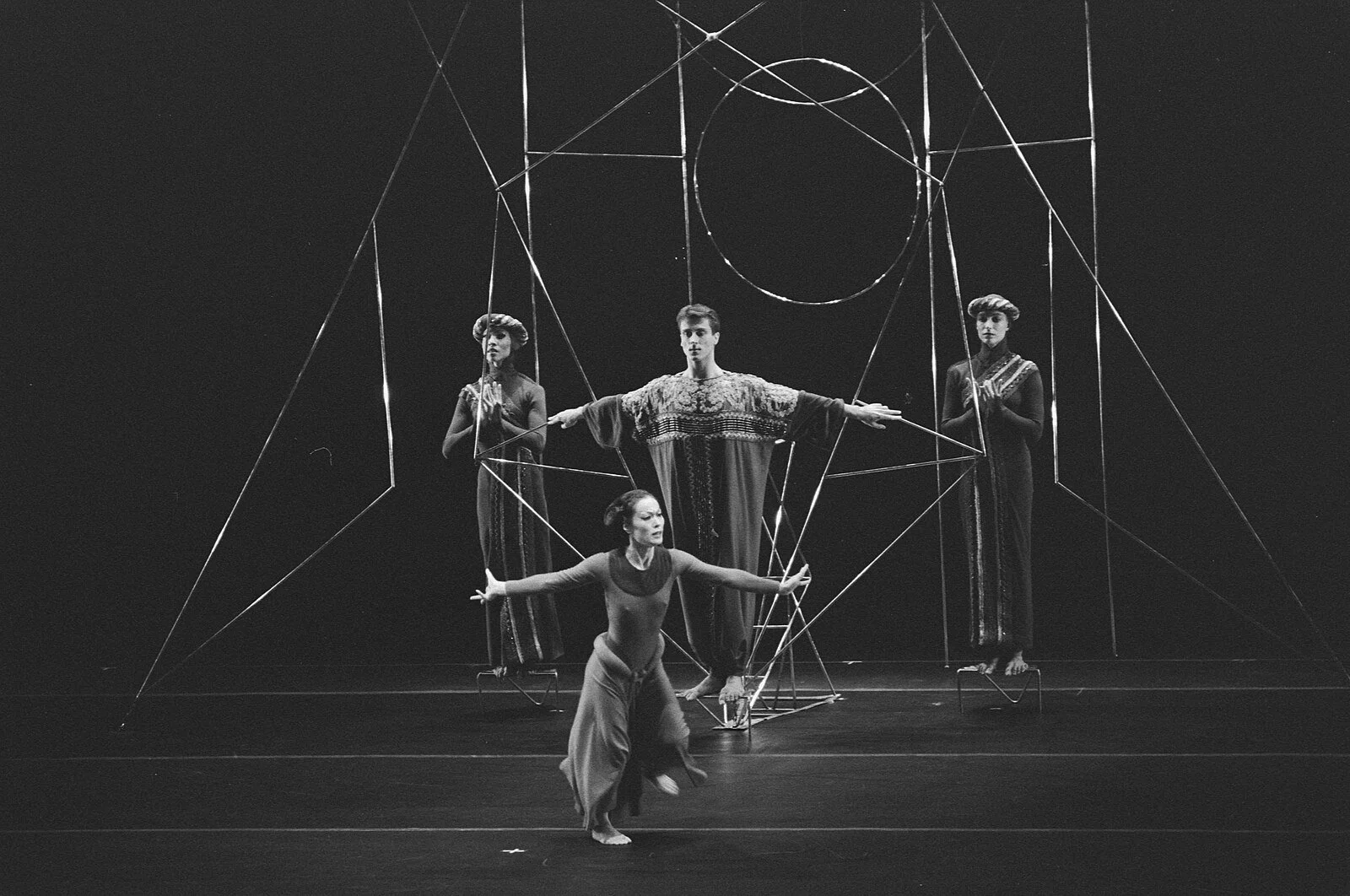
Martha Graham Dance Company rehearses Seraphic Dialogue in Muziektheater. April 21, 1988. Photo by Rob Bogaerts. Copyright: Nationaal Archief
Of their collaborative process, Noguchi himself said: “In our work together, it is Martha who comes to me with the idea, the theme, the myth upon which the piece is based. The form is then my projection of these ideas. [...] She uses [props] as extensions of her own anatomy.” This image of extended anatomy is a common one in accounts of how Graham and Noguchi’s work fit together. Graham’s scale was often operatic, and her references were classical. Noguchi’s stage designs were peculiar, geometric, and grounding when juxtaposed against the high drama that characterized Graham’s major works.
Noguchi’s designs are still used for Graham repertory pieces today, and many of his most iconic scenic elements for Graham’s work can be viewed at the Noguchi Museum in Queens, New York. Each had a bold and singular vision, and by working together, they not only furthered their individual experimentations, they cemented a joint aesthetic in the annals of postmodern dance.