‘West Meets East’… ? Shankar, Menuhin, and Indian Classical Music in the West
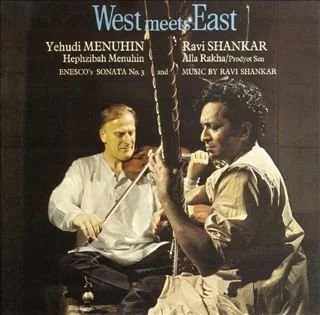
West Meets East. Album cover.
5 December 2025
In 1967, sitarist Ravi Shankar and violinist Yehudi Menuhin, arguably two of the world’s most accomplished musicians on their respective instruments, recorded an album together called “West Meets East.” The work was rooted in a principle of cross-cultural musical exchange: it features both musicians performing Shankar’s own compositions in the Indian classical tradition, as well as Menuhin playing George Enescu’s violin sonata. The album was an enormous success. It topped the classical charts for eighteen consecutive weeks and won the Grammy for Best Chamber Performance. The two musicians remained lifelong friends, and the spirit of mutual musical learning remained an important foundation of their relationship.
When Shankar and Menuhin met in 1952, Indian classical music was not hugely popular in the West. India gained independence from British occupation in 1947, but the legacy of colonialism lived on in how Western audiences engaged with Indian culture: many believed that its music was not as sophisticated or "developed" as that of the Western art canon, and so dismissed it altogether. Unlike many of his contemporaries, Menuhin developed a true and genuine passion for Indian classical music. He was enthralled by its improvisational tradition and complex system of ragas, and recognised its practitioners for the talented virtuosi that they were – even when their language was initially unfamiliar.
A great change occurred in the mid-1960s, however. George Harrison, guitarist of The Beatles, travelled to India in 1966to learn the sitar with Shankar, and his trip sparked a broader fascination with the Indian classical tradition in the Euro-American popular music world. While Harrison was, like Menuhin, a life-long devotee, this wider burst in popularity was only a passing fashion. Within the 1960s countercultural hippie movement, many engaged with Hinduism and Buddhism for the possibility of reaching new states of consciousness through spirituality – an experience some also tried to find while experimenting with psychedelic drugs. In this context, Indian classical music fulfilled for many a similar function to trance music, and once the countercultural wave passed, their interest waned too. Harrison and Menuhin’s devotion is therefore framed in a wider context of Westerners making superficial use of another culture’s philosophy, traditions and music to better explain and understand themselves.
Even Menuhin cannot be removed from this equation entirely. No musical exchange happens in a vacuum; we can still see traces of uneven power dynamics, especially given the lasting impacts of colonialism in India. Even the title of the album invites certain connotations: “West Meets East” – rather than “East Meets West,” or “West and East Meet Each Other.” The name implies that its intended audience is Western, and establishes a direction of flow: Westerners travelling outwards to “discover” or “meet” a “new” tradition, insert themselves into it, and bring it home for Western consumption.
So, where is the line between learning about another culture’s tradition, and using it for one’s own benefit? When does interest become cultural appropriation – borrowing from another culture without acknowledging it, removing it from its original context, and exploiting it for one’s own gain? There is likely no definite answer. We might find power imbalances and problems with Menuhin’s approach (and we certainly can with 1960s counterculture), but ultimately, he was deeply committed to what he saw as the phenomenal power and beauty of the Indian classical tradition. His desire to share it with Western audiences came from a place of admiration and love; this is no doubt the attitude we must take if we are to respectfully learn from one another and share music in a way that is fair, honest, and productive.