Danae Venson, Composer and Graduate, The Juilliard School: “Words were failing to describe what I felt, so I began to teach myself how to write music.”
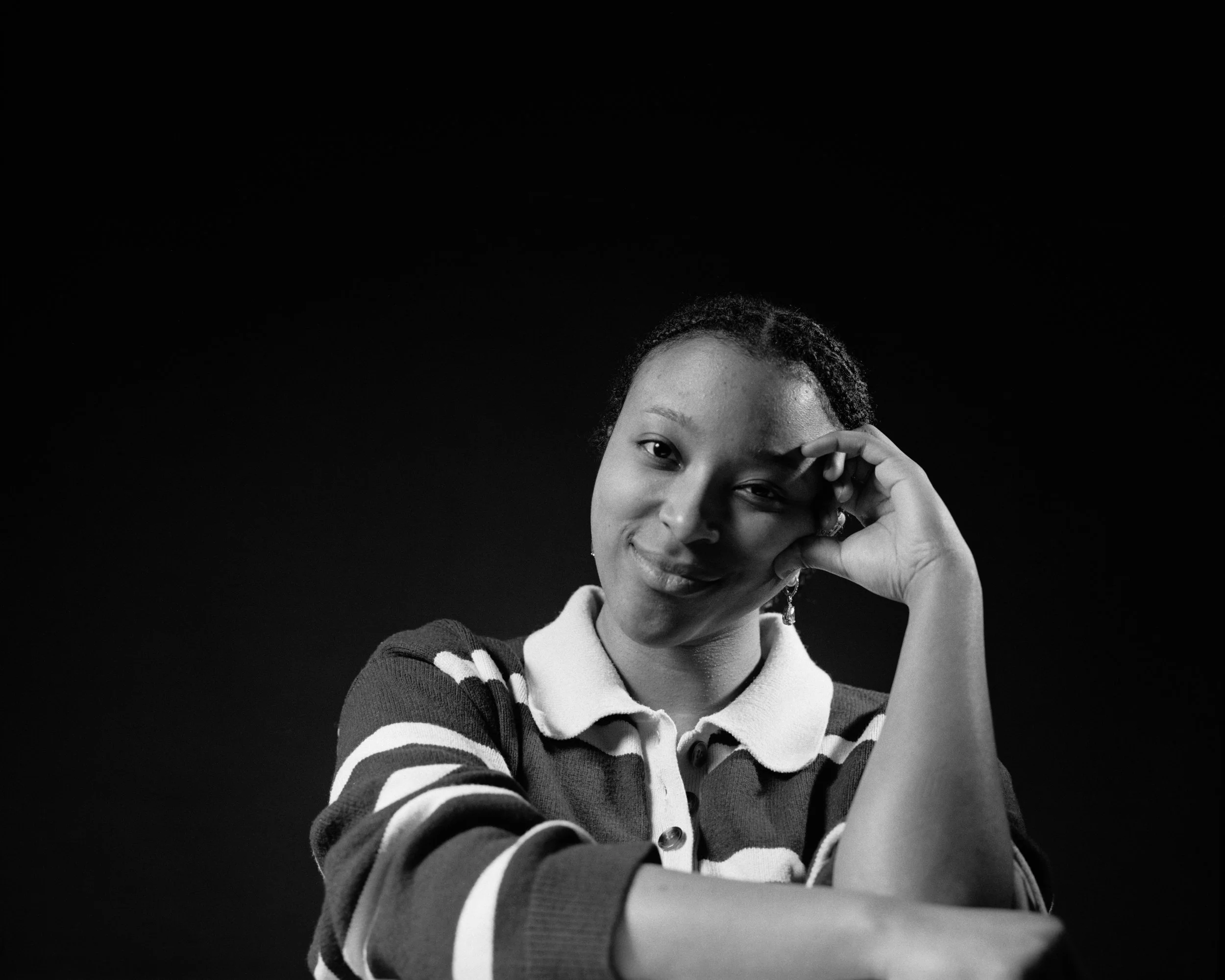
Danae Venson. Photo by Tiffany Johnson
7 November 2025
Danae Vension is a composer and multi-instrumentalist form Houston, Texas. Last summer, she completed her Bachelor of Music with academic honours from The Juilliard School under the combined guidance of Dr. Amy Beth Kirsten and Valerie Coleman. TWoA talked to Danae about her musical journey, the power of music to express what no words can describe and much more.
What is your earliest musical memory?
My earliest, favorite memory is singing in church when I was about three or four. That was my first time standing in front of a bunch of people and singing by myself. I was singing a solo, and my hands were so small that I was holding the microphone with both hands. My father is a church musician and a multi- instrumentalist. He was the church’s music director, and when I sang, he accompanied me on the keyboard. I was singing “I lift up my hands” by Israel Houghton, I still remember all the words.
When did you start learning your first instrument?
The first one was voice, and later I started playing piano in church. I started having classical lessons around twelve, but it didn't last long, because I also picked up violin in middle school. I was given the ultimatum: “Either you're going to do violin lessons or piano lessons. We're not going to pay for both.” I chose violin lessons. I played violin all throughout middle school and high school and returned to piano to play jazz piano in my junior year of high school. I started composing during Covid. During my first year of college, I learned how to play the harp. Those are the instruments I've spent the most time with, but I also learned how to play the guitar and other stringed instruments. I grew up in a family of percussionists, so I learned how to play the drum set and things like that as well.
How did you start composing?
I have always been a songwriter and a poet. I’ve always been creating music, but I never wrote it down on music paper because my father didn't learn how to read music. I learned how to read music because of my lessons. I had a lot of time to myself during Covid; it was also a very traumatizing time as Black American because of what we were seeing. To paint the picture: you are stuck in one spot, and every time you're on social media, you're seeing really upsetting, disturbing images and videos. The president at the time was fanning the fire and making a lot of things much worse. I was very emotionally vulnerable, and I really needed something to express myself differently than with words. Poetry and songwriting had been something that was natural to me, but now words were failing to describe what I felt, so I began to teach myself how to write music on the lines and spaces to develop a language for myself that was not with words.
This was 2020. Can you explain a bit more what you were going through at the time as a young Black American?
The American Black experience includes having to witness a lot of terrible things. I remember being in third grade and seeing Trayvon Martin's story on the news: the seventeen-year-old Black American was shot by a member of a local community watch who thought Trayvon looked suspicious. Trayvon was just walking back from a store to his father’s fiancée’s house. As a Black American, I had to understand that the world sees me differently, and that the world will treat someone who looks like me differently. This was already the baseline. Then, in 2020, Black American George Floyd was murdered by a white police officer in Minneapolis during an arrest made after a store clerk suspected Floyd of using a counterfeit twenty-dollar bill. One of the police officers knelt on Floyd’s back and neck for over nine minutes. Floyd suffocated.
This wasn't different in the fact that police brutality is a thing. It wasn't different in the fact that racial violence or racism is a thing, but it was different in the fact that everyone was home because of Covid, and everyone was seeing this long video of someone having the life literally squeezed out of them in real time. Racial violence is something we should not get used to. Violence in general is not something we should get used to. I remember I could only watch about three seconds of the video, because it had popped up, like they always do. I could only watch three seconds of it; I was just so devastated. I remember sitting in silence for a good 10 minutes. My first inclination after that was to start writing something. I remember pulling up some musical software and trying to build a piece. That was the time I had made a connection that this is the only thing that really works for me at this point. For me, when words fail, music is something that can really be a medium for that expression that needs to come out.
I was seventeen years old; I was a junior in high school.
When did you decide that you wanted to make music your career?
I actually do not remember. Since I was a child, I have always seen myself as a musician. It was my interest in Nina Simone that led me to Juilliard. When I was about eleven, I saw a Netflix documentary on Nina Simone. She did not graduate from Juilliard, but she was there. That was the first time I had heard of Julliard as a big institution. I made up my mind that I wanted to go there. At the time, I had no idea what I wanted to study there, but I had my mind on that school. When I was about seventeen, I would spend all day and all night trying to teach myself how to compose. I had lessons in the summer and in the fall of 2020, I listened to a lot of classical music. I applied to Juilliard in 2020, and I auditioned in 2021, but I did not get in that year. I went to Mannes School of Music instead for one year, I studied with Joan LaBarbara. I met some fabulous people who I am still very close to, but Mannes wasn’t the place for me, so I auditioned to Juilliard again, and the second time I got in.
What does an audition for composition at Juilliard look like?
Both times I auditioned, it was over zoom because of Covid.You have five different interviews with the faculty; they talk about your music. They review your music before you meet them, so it’s a pretty interesting type of situation. It's not like you get in front of them and you play. They're making judgments on your music in private. You have five of these interviews, each is fifteen minutes. They examine you as a person, and to get a good idea of your musical profile.
What advice would you give to a young musician who is interested in composing?
The most important thing when you're trying to compose and you have some ideas, is to just go with the flow. Every time I start something, it I feel like it doesn't start immediately with a melody. Try to work in the world of an idea a little bit. Try to improvise in that world. Try to explore a melody a little bit more. Don't immediately just try to put it pen to paper. Patience and intuition are the most important things. When I'm writing, I'm always going with the flow. I never remember how I come up with ideas. I just do and I'm patient with myself while I'm doing it.
You’ve just graduated and are now composing outside an educational framework. What has changed?
I feel like I have less pressure now. In school, you have weekly lessons, so you have to bring something to your teacher. Whenever I sit down, and I know that my deadline is months away, I feel like it's a little bit more purposeful, because I'm having more time to spend with the art.
What does your composition process look like?
I have synesthesia, which means I associate colors with music. Things can sound blue, they can sound yellow, they can sound pink. Before I write, I like to make a world or a scene. I might say: “I'm seeing a lot of blue. I'm seeing water. What does water sound like?” I like to go to Pinterest and get a bunch of images of things that I see in my brain. I like to make playlists. Like making a film, you have your images, you have your music, and I sit on that for maybe a week or two, trying to let ideas come into my mind, sleeping on things and writing things down and being inspired by words, by art. I'm a very visual person. When I feel I have gathered enough inspiration, I start sitting at the piano, noodling around and figuring things out. From there, I start to write, but the music is always changing. I like to get ideas out, and then I just surgically change things. I might have an idea, but a week later, I might think something else sounds better. If it’s about a single line instrument, I sing things into existence and write them down and later decide whether something should go up or down. It’s like designing a line.
So, the first step is gathering inspiration, understanding a work before it even comes into fruition. The second is improvising, and then going through things and making changes, making sure that the flow works.
What does your life as a young composer who just graduated look like?
When I was straight out of school, I had two pieces that were due around the same time. That meant work, work, work. It was a little bit stressful. Now I am working on something that is due next year. I'm still in the inspiration phase. It feels good to have time, because for my last piece, I did not have a lot of time, and during Juilliard, it felt like I didn't have a lot of time, especially because I had a lot of classes. I'm an overachiever; I try to do more than my best. I ended up graduating with academic honors from Juilliard. I was doing class, my art and trying to be my best at both. Now that school has been taken out of the equation, I’m enjoying my life and being a human being, having enough time to smell the roses and the lilies. I think that makes me a better artist: I have the technicality, the skills which were worked on and chiseled and manicured during Juilliard. Now I am able to apply that to life and to just work on my art, because I love to do it.
What academic classes did you take while at Juilliard?
We had to take liberal arts classes at Juilliard, they can range from ethics, reading and talking about certain philosophers and writing essays, reading novels and books. I took a poetry class, a contemporary art class, writing. I got academic honors because I would go to Columbia University as well. There's an exchange program between Juilliard and Columbia, so I would go back and forth. I took a class on Marxist philosophy, that was one of the honors classes where I had to write and read a lot. The other class I took for honors was called “Arts in the Third Reich.” These classes took a lot of reading and writing and a lot of understanding. I'm very grateful that those classes at Juilliard and at Columbia could apply to my music. One of the classes I took at Columbia was jazz fictions. We read a lot of literature inspired by the Harlem Renaissance and the jazz movement – you learn how literature can be musically affected and how people adapt certain rhythms. Reading and writing has inspired me, because there are so many things to be inspired by. There are so many brilliant minds in the world that you can draw from.
You draw inspiration from jazz and gospel music and hope to include other non-classical influences in your music. Does this happen consciously or subconsciously?
Since I think of music more in terms of color than genre, I tend to just automatically blend things together. If something gives the same timbre as something else, then I tend just mix, for example, jazz and gospel and some classical music. I feel a lot of composers are in conversations with each other, it helps me design and build my own style. All of the experiences I had feed into this: my approach to the piano is classical music, jazz and church music all combined in one. When I play, it reflects all of those experiences. It's being inspired by the way my dad played at home, by certain classical pianists, by Nina Simone.
I want to write, to make the music I want to listen to. When I started writing music, someone said to me, that you need to envision yourself at a concert. What type of music do you want to hear? That was some of the best advice I've gotten. Sometimes, in conservatory, you forget that: you become someone who wants to please your teachers or your family, you don't want to do something that's too crazy, because what is your mom going to say about it? You don't want to do something that's too choral, because your teacher might not like that. Right now, it's just me wanting to make what I want to listen to.
On your website, you have a very beautiful butterfly on top of your signature. What is the significance of the butterfly?
The butterfly looks like my initials, but it is also a symbol of change for me. How do we respond to change? Do we keep our dreams? Do we maintain our sensibilities? How do we navigate change or are we the type of person who doesn’t like change at all? While I don't like change because it means that I'm moving into unfamiliar waters, I'm trying to be more of a person who adapts to change, who maintains the dream. Even when you're discouraged, when things don't go your way, you still bring your personhood with you, your love, your dreams.