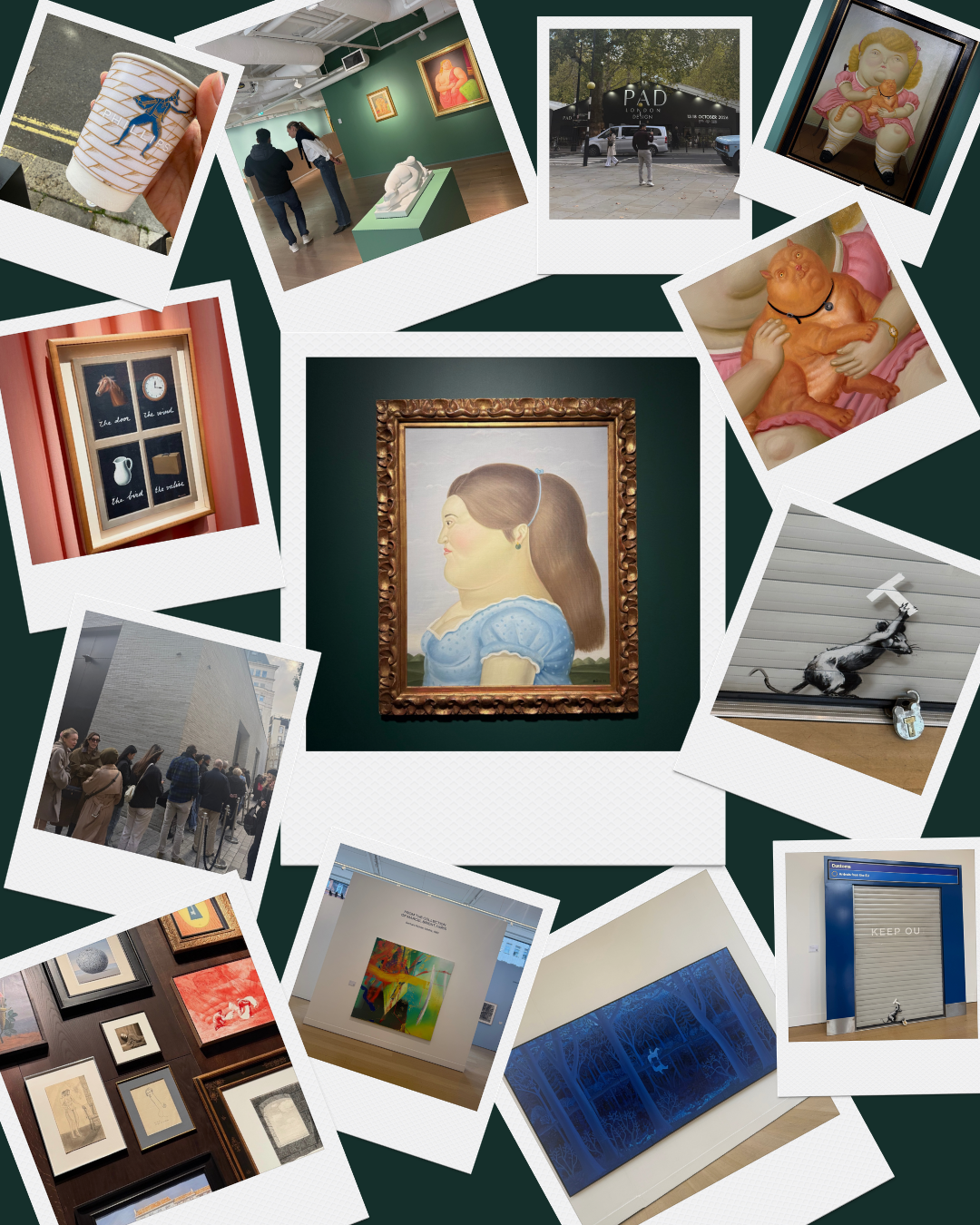
Mix of photos by Maya Stoilova.
My dearest artlings,
October's been a blur. I don't remember how it started, and I couldn't tell you how it's going. All I see are flashes of events – or PDFs – and cocktails, champagne flutes, paintings, more flutes, and people, too many people. Their chatter buzzes in my ears like permanent tinnitus, and my social battery is about as dead as the artists I like. I can’t do this anymore.
And yet here I am, in Mayfair, no more than fifteen hours after leaving Frieze last night. My eye bags droop down to my cheeks, and I can hardly put one foot in front of the other. I’m dizzy, nauseous, and exhausted – three qualities that, at this time of year, all but prove my belonging to London’s art world. You see why we need eight months to recover before the June auctions.
At least the worst is behind us, and I can have the weekend to myself. As in, see the most publicised show of the season: Gagosian’s This Is Still Not a Pipe: The Afterlife of Magritte. Bringing together Magritte originals with works by artists he influenced, including Allison Katz, Anna Weyant and Joseph Yaeger, the exhibition attracted a fifty-metre-long queue on opening day. Little did I know I’d show up almost a month later to find the same line curving around Gagosian’s white façade like one of Magritte’s signature melting shapes. I waited a good forty minutes.
Was it worth it? Perhaps.
The rooms were big and dark, with heavy curtains that must have cost a gallerina’s annual salary. Other than Anna Weyan’s My Pony (2019), highlights included The Scent of the Abyss (1928), once owned by the founder of Surealiam himself, the French poet André Breton, and The Philosopher’s Lamp (1936), a witty self-portrait in which Magritte’s nose curves into a pipe. Then there was Blood Will Tell (1948), with cabinets springing from a tree trunk, and The Dominion of Light (1961). But the gallery was too crowded for me to enjoy it properly. After a week of art, even Magritte’s best works were beginning to look like canvases in yet another exhibition.
Stepping out, I passed PAD, the collectible design fair, in Berkeley Square and headed into an auction house to see the Collection of Marcel Brient, due at Phillips’ auction the following week. A massive Gerhard Richter greeted me, followed by Banksy’s Keep OU T (2019). At least the little rat at its bottom made me smile.
A few steps later – bam – a Ben Sledsens. His style seems a mix of Magritte and Henri Rousseau, only a tad more contemporary. With its blue lake, blue trees stretching beyond the frame, and white horse carrying a female rider, it could almost have been a Magritte. A swanky Russian couple eyed it beside me, whispering about their latest purchase – at Frieze, no less. The woman’s voice was firm, even raspy, softening only when she turned to her companion. Russian speech had been all around me that week: at Frieze, at openings, at collectors’ previews. Yet everyone in the London art world seems convinced we’ve lost the Russian collectors: the war in Ukraine and its concomitant sanctions have supposedly driven them away from Western Europe and towards the Middle East. But had they really left, or were the Russians I kept encountering long-established London residents, with others simply buying more discreetly, through different galleries and markets.
A sour matcha and a shrug later, I bounced up New Bond Street to Opera Gallery. It had a show dedicated to the man after whom I plan to name a very fat cat: Fernando Botero. Titled In Praise of an Amplified World, the exhibition brought together over twenty pieces and nearly six decades of his work.
Like me, Botero had a weakness for the Old Masters; yet, he developed a style entirely his own, inflating everything from people to fruit. In 1957, while painting a mandolin, he made its central opening unusually small. Suddenly the instrument looked enormous. Thus began Boterismo: the artist’s lifelong practice of inflating forms, playing with flatness and proportion, and presenting figures as stoic and emotionless, regardless of the surrounding action.
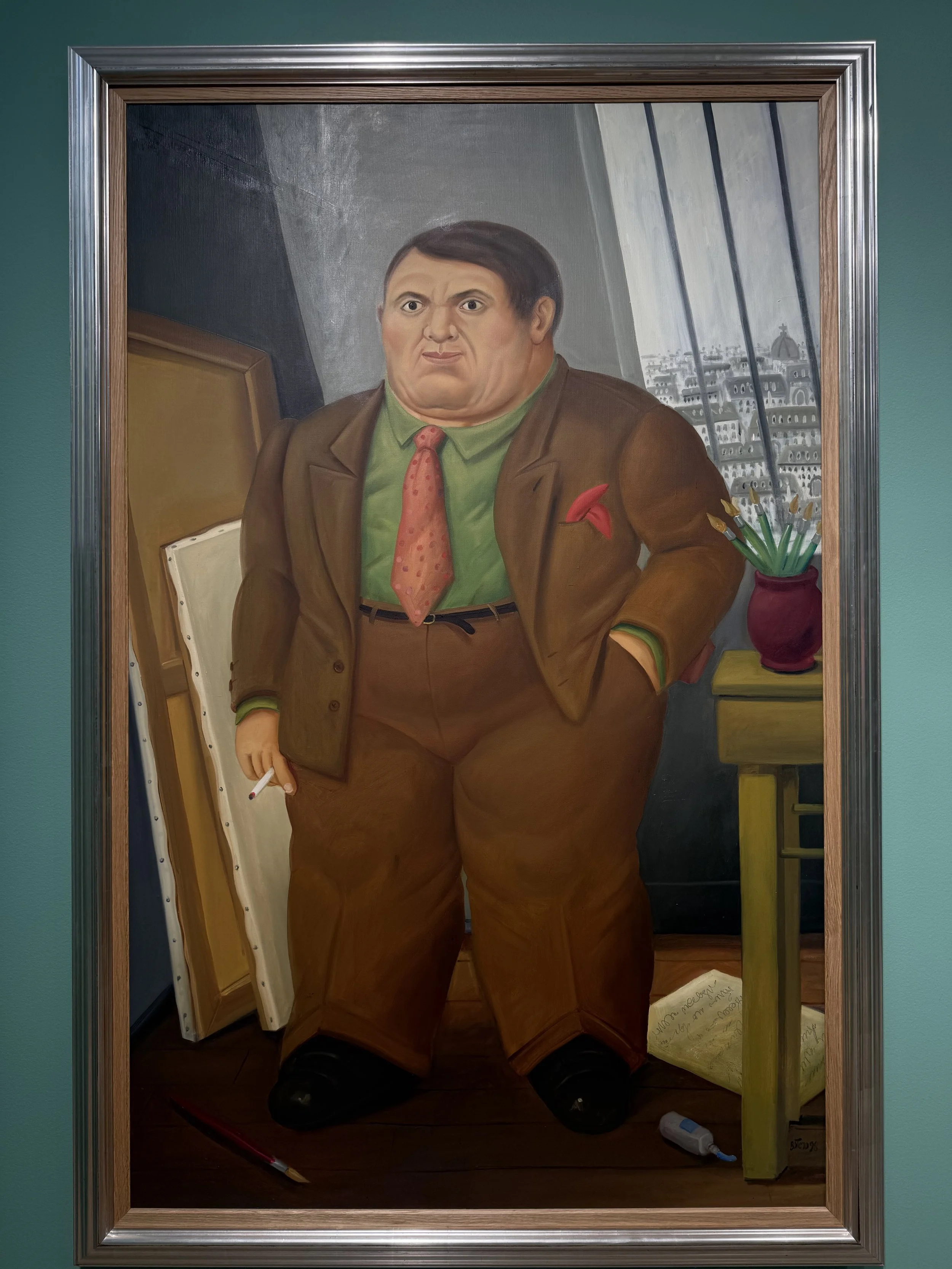
Fernando Botero, Portrait of Pablo Picasso, 1988. © Maya Stoilova
Looking at the results, I wanted one. Or a few. My birthday is coming up, I later reminded my boyfriend. A little out of budget, he winked.
But back to the exhibition. Its highlights, apart from the fat cat featured in Girl with Cat (1989), were Girl in Profile (1983) and Nudo, Donna in abito rosso (2013). Depicting women in poses typical for the canon, these canvases reminded me of Botero’s years studying Renaissance painting in Italy, particularly Piero della Francesca. Then, upstairs, there was a painting with a group of devilish figures. One wore a plague-doctor-like beaked mask, and another held what looked suspiciously like the Ukrainian flag. Was that a coincidence? Maybe. Whatever Botero intended, it reminded me that there is more to his work than oversized people and fat cats.
It’s easy to laugh him off, and critics have often dismissed his work as kitsch. But Botero was not to be underestimated; he grew up with little exposure to art, and he largely taught himself to paint. He also developed an indisputable understanding of art history, and had social, political, and cultural concerns on his mind – rather more than fat cats. Even so, his work remains accessible: you don’t need to know anything about art to enjoy his paintings, but the more you know, the more there is to appreciate.
“This must be the busiest day since last May,” a gallerina said behind me. Tell me about it, I thought. That’s the cruel part of working in the art world: you spend so much time surrounded by masterpieces that you become desensitised to them. Or, worse, fed up.
That’s how most of us feel at the end of October. But as soon as we get over the exhaustion and visual overload, we will be raving about art yet again. I promise.
Until next time,
Maya
