From Berlin with Love: The Miraculous Return of a Cello Legend
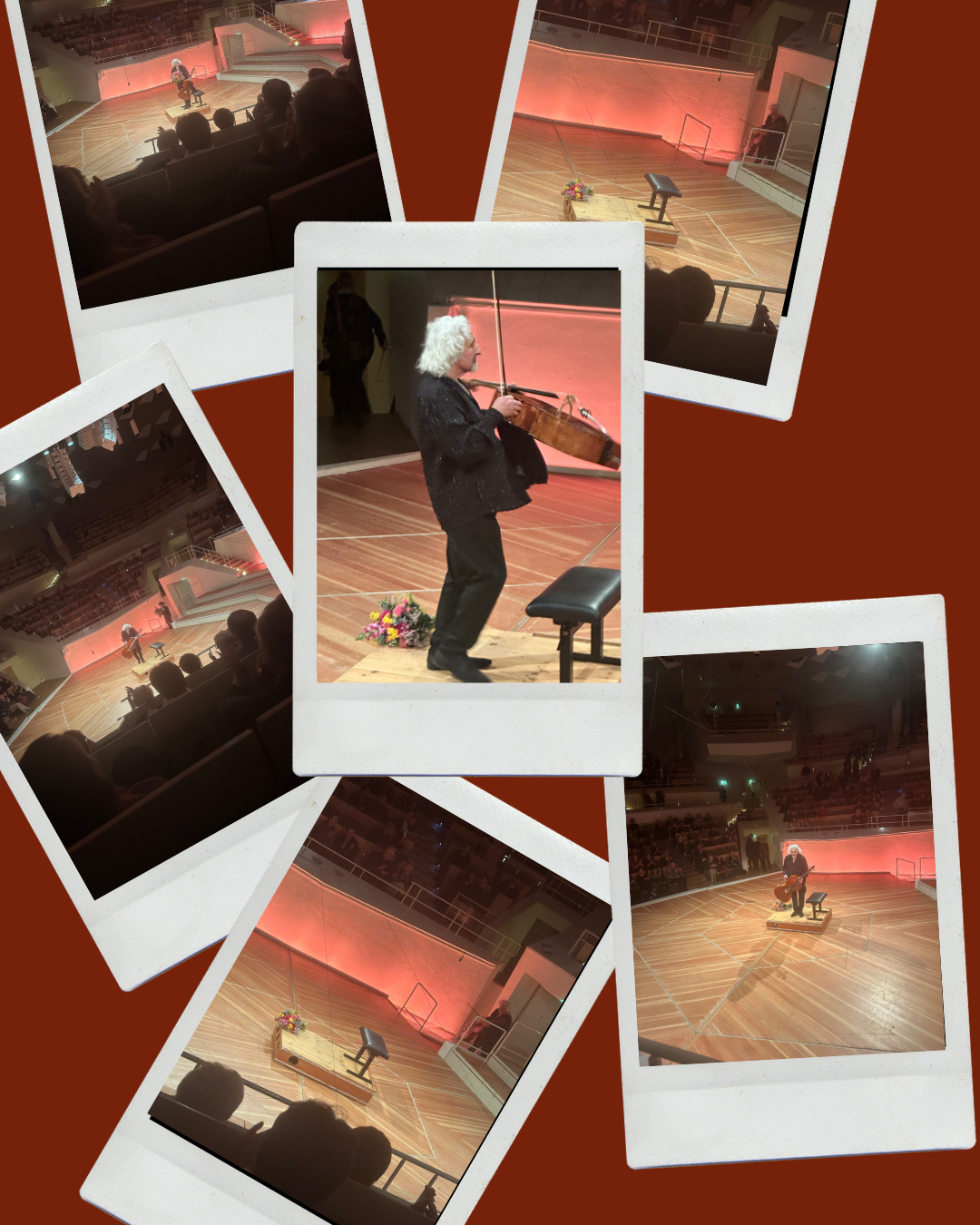
Mischa Maisky, Berlin Philharmonic, chamber music hall, 12 February 2026
15 February 2026
With eight minutes to go until the start of the concert, I handed my dripping umbrella to the cloakroom attendant and quickly skimmed the notice attached to the counter: “Change of program: unfortunately, we have to inform you that Mischa Maisky will play cello suite no. 5 instead of cello suite no. 6 tonight because of adjustments made to his repertoire due to health considerations. Cello suites no. 2 and 3 will continue to be part of the program tonight.”
Racing up the stairs to the concert hall, I quickly took my seat. The chamber music hall at the Berlin Philharmonic is a more intimate space, the performer sits at the centre of a sunk stage, surrounded by the audience, seated amphitheatre style. To my dismay, I noticed quite a lot of empty seats. Maisky is a huge name, who, at the ripe age of seventy-eight, has earned himself the status of classical music legend. Somehow, the empty seats, the rain, the darkness, the program change due to mysterious health considerations made me feel slightly ill at ease.
And then Maisky walked in. I felt he wasn’t looking well. As he stiffly approached the small platform at the centre of the sunken stage, wearing one of his wide, silverish concert shirts cut low enough to expose the chunky statement piece pendant he always wears, he looked less like the charismatic classical “rock star” I remembered, and more like a troubled, biblical sage. His grizzled face almost hidden behind his wild white mane, he sat down, quickly adjusted his cello and the dark cloth that hangs from the back of its fingerboard, and started to play J.S. Bach’s cello suites no. 2. Once finished, he wiped the sweat from his brow, exited, returned in a loose black shirt, pendant again exposed, and started to tackle cello suite no. 3.
Watching a live performance is a deeply subjective yet powerfully collective experience. There is a special suspense about watching Bach’s instrumental solo suites: there is only one human being on stage, endeavouring to communicate his or her inner self to a collection of strangers. It’s the ultimate combination of witnessing the raw, physical craft of classical music and its spiritual dimension. It can be magic, if the performer manages to spin delicate threads to every individual in the audience, weaving a tapestry of joint emotional experience.
But I wasn’t feeling the magic. And since I was facing a legend, I inevitably started looking for the fault in myself. Was I too tired for the cello suites? Was I distracted by the health notice, which made me speculate what was wrong instead of focusing on the music? My seat neighbour’s mind had also started going off on tangents. Complete strangers, we shared our speculations at the start of the intermission: “His right hand looks really swollen, like after a bee sting.” “Really? To me, it looked normal.” “I think he doesn’t look well.” “I think he has the flu.” After the intermission, Maisky walked in quickly: “Wow, the doors haven’t even closed, he really wants to finish!” Cello suite no. 5 followed – and ecstatic applause accompanied by loud shouts. Maisky walked in and out somewhat rigidly but graciously accepted the ovation – treating the audience to two encores: “I didn’t expect this!”, my seat neighbour exclaimed.
Inevitably, I had to think of the common expression: “Did we watch the same show?” I was upset at the audience for not letting Maisky rest because I had convinced myself that he was either in pain, suffering from the flu, or both. But maybe he was healthy and had had to adjust the program for a different health concern? Maybe his interpretation of Bach had not been affected by ill health, maybe it simply had not spoken to me personally, since it had clearly touched the majority of the audience?
I could not resist the temptation to vindicate my feeling of unease by turning to Google. My conclusion: the man is a rock, a hero and a miracle. As for Maisky’s stiff, somewhat troubled looking walk: in June 2024, Maisky suffered a severe infection of the spinal cord that almost paralysed him. After a successful operation, the long road to recovery began. Initially, he couldn’t even hold up his phone let alone sit up in bed. Usually, people need to spend at least two-years in rehabilitation. After six months, Maisky was back on stage, albeit with some adjustments to his repertoire: “It feels like my hands have shrunk…. When I began playing again, my kids listened to me and told me what was okay and what was not.”
Maybe Maisky’s iron will reflects his difficult past. This was already his second unlikely come-back. Born in 1948 in Stalin’s Soviet Union, he was arrested in 1970 because he had tried to buy a tape recorder on the black market. He was sentenced to two years in a labour camp. In 1972, a friendly doctor got him transferred to a mental asylum because this was the only way for him to avoid military service after imprisonment. In the winter of 1972, he emigrated to Israel (following his sister, who had emigrated in 1969), and started his stellar career in the West. Maisky is a true force of nature.