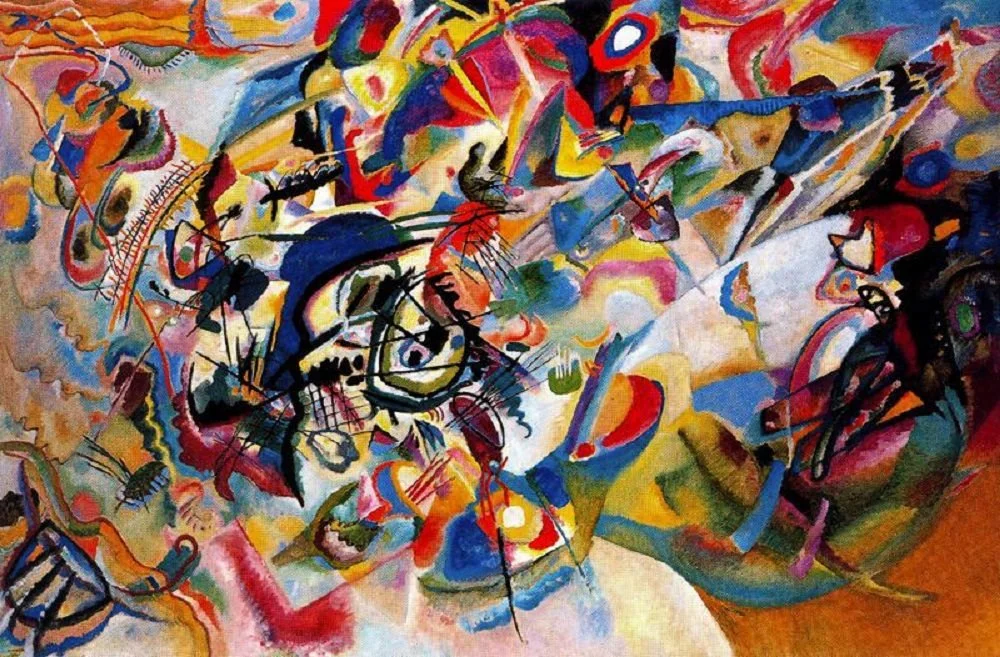
Vassily Kandinsky, Composition VII, 1913. Tretyakov Gallery, Moscow
20 February 2026
“What is music?” is a question of ontology, that is, the study of being. There are a number of things you can mean when you ask such a question – “when I listen to a recording, which part of it is the music?” But when I ask such a question, I mean “what is the difference between music and sound?”
First, let’s agree on this – music involves sound. In fact, a commonly encountered definition of music is “organised sound.” This definition would certainly satisfy the contemporary music fans amongst us; the clashing pans and boiling kettles of John Cage’s Water Walk both create a sound, and do so in a just about ordered manner. But for some, this is precisely the problem, the definition is far too broad. And more than this, instead of arguing about what music is, we shift the problem to “what does organised mean?” Language is organised sound, the beeping of supermarket self-checkout machines is organised sound, but are any of these music? Probably not.
But thinking about organisation reveals something key to the nature of music: people. Music is (or used to be) sound organised by people, generally for the purpose of people listening. There is an inherently social aspect to music. It is on this basis that Christopher Small suggested music is not a noun, but a verb. According to Small, listening, composing, performing, or any form of musical engagement, is musicking. But you may say, “you have kicked the can down the road, what counts as a musical engagement?” If we try defining “musical engagement” objectively, we’re just going to face the same problem as with previous definitions. There is going to be no answer which seems intuitive to all…
But if one just accepts that there is no objective definition of music and that it is a mind-dependent concept, then we get rid of all the problems. To borrow from Luciano Berio, music can be anything we engage in with the intention of engaging in music. Indeed, we must ask ourselves why we want an object definition of music. For those musical conservatives who believe musical progression should have died with Beethoven, the answer is easy: they can tell us that contemporary music is a disgrace and, in fact, not even music at all. And this is precisely the issue with defining music: we all have different intuitions of what music is, what it should be, and what it can be. Given this, why should we think there would be an objective definition of music? Bear in mind that the likes of Haydn and Berlioz had been accused of producing noise as opposed to music, a notion that seems absurd today.
What shines through is that the border between music and noise is culturally regulated and so has always been in flux depending on the attitudes of the times. If you are looking to objectively distinguish between music and noise, you are taking grains of sand away from a heap and asking me when it stops being a heap. I can give you an answer, just not a meaningful one.
You might also enjoy. . .
Introducing Choreographer Merle Cunningham: Embracing Chance in Modern Dance