From New York with Love: “Noguchi’s New York”
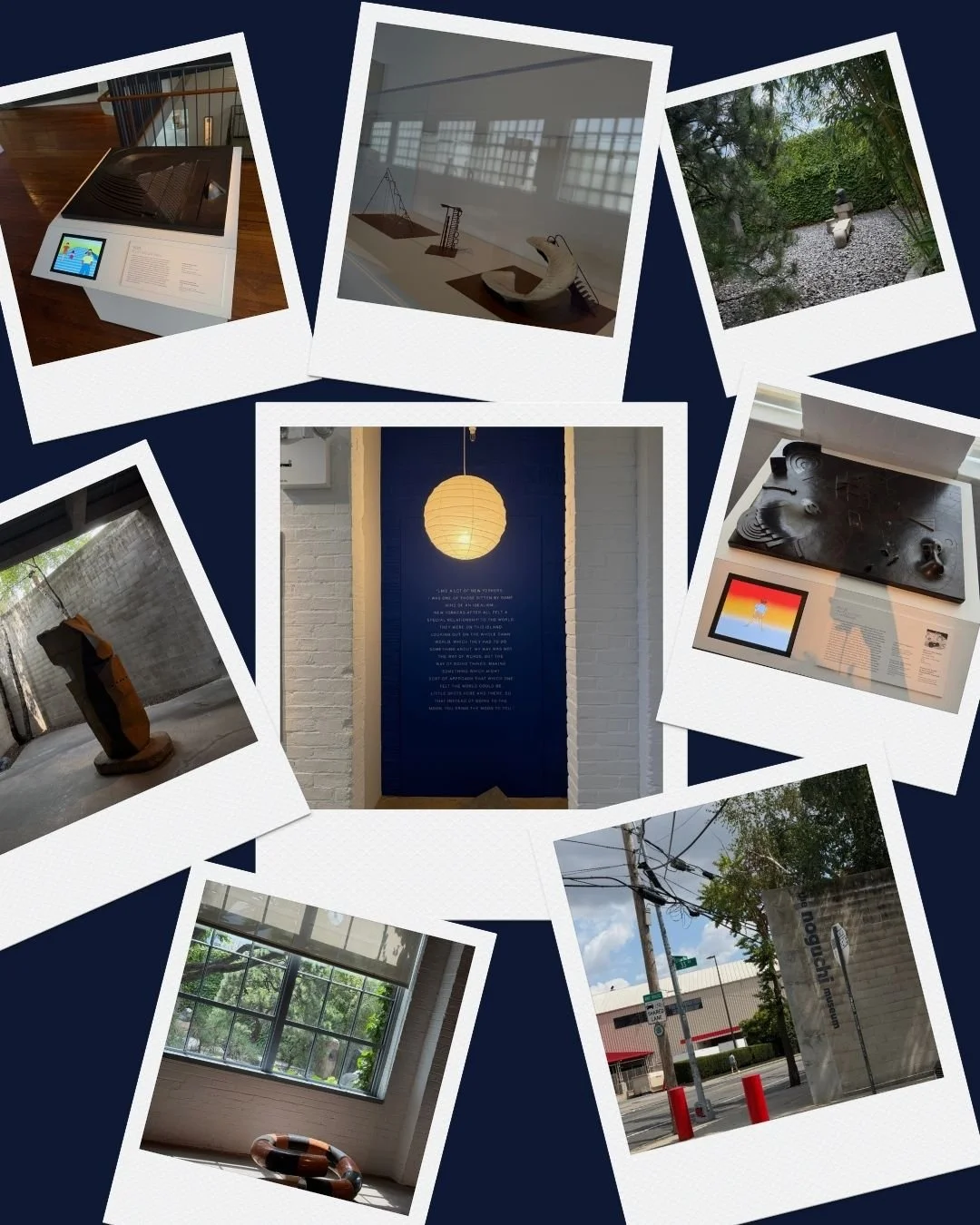
Photos by Olivia Merola
Dear Reader,
Perched just off the intersection of Vernon Boulevard and 33rd Road in Queens, Isamu Noguchi’s final gift to New York City breathes like a hidden secret. Its quiet façade sits opposite a monstrous Costco, where shoppers file through sliding doors, their carts piled so high you might think they were preparing for some impending doom.
Long Island City is a curious part of New York. Composed largely of smokestacks and billowing warehouses, my thirty-minute walk from the F train recalled the “valley of ashes” in F. Scott Fitzgerald’s The Great Gatsby. I saw only one other person during my trek along the Boulevard. By the time I made it to The Noguchi Museum, I felt as though I had stepped onto the moon.
I was there to see Noguchi’s New York, an exhibition curated by Kate Wiener that traces the artist’s lifelong attempt to engage with the city around him.
“I’m really a New Yorker, not Japanese, not a citizen of the world, just a New Yorker who goes wandering around like many New Yorkers. And like a lot of New Yorkers, I was one of those bitten by some kind of an idealism…” Noguchi said this in a late-career interview. I immediately knew what he meant. I, too, can only describe myself as a wanderer, bitten, starry-eyed, and ever-trying. I think it’s something about how this city moves, constantly spinning you in every direction: either play the game or let it eat you.
Noguchi certainly tried to play the game. Literally. Play is central to the exhibition, particularly through his imagined playgrounds. As a dancer, I understand play as a release from codified movement, and a freedom that makes us newly curious about bodies, movement, and space. Noguchi extended that curiosity to the city itself. He says, “The experience is not merely looking through the eyes, but with the whole body and the whole situation of ourselves and of other people.” He wanted sculpture not simply to be looked at, but to be engaged with, explored, and experienced alongside others.
Inside the gallery, I moved between models of landscapes New Yorkers never had a chance to inhabit. Beginning with Play Mountain (1933), Noguchi proposed a mountain playground that was meant to occupy a section of Central Park. He envisioned it as a center for exploration and gathering. New York City Parks Commissioner Robert Moses rejected it, as did the United Nations when he proposed United Nations Playground (1951-52), a wonderland of hills and caves. Even Playscapes for Great Apes House (1946), proposed for the Bronx Zoo, went unrealized. The halls began to feel like a graveyard of unrealized treasures.
But in the museum’s garden, that feeling changed. Here, outdoors under a canopy of trees and pathways lined with stone sculptures, Noguchi’s vision of a communal space was no longer confined to paper; it had been realized. When I spoke with Wiener, she suggested that Noguchi ultimately created such a space in the museum itself. Conceived by the artist as a unified work of art, the museum melds with the city surrounding it. I stood beneath a canopy of trees among Noguchi’s stone sculptures, hearing car horns and the occasional warehouse truck rumbling into a nearby lot. Wiener called the experience a “sonic fusion,” a phrase I couldn’t help but immediately scribble into my notebook.
As I left the museum, I was thinking about a Noguchi sculpture just across the East River in Lower Manhattan. Although Noguchi never realized one of his playgrounds in New York (Playscapes was ultimately built in Atlanta, Georgia), he did reshape the city through several public works. The example that I think about the most was Red Cube (1968), a jutting twenty-four-foot rhombohedron — a geometric slanted cube with six diamond-shaped faces — balanced on one corner outside 140 Broadway in Manhattan. There is something wonderfully subversive about such a bright, red, whimsical object occupying the Financial District, perhaps one of New York's least playful landscapes. One can only hope that as the district’s serious hustlers flock into their office building, the bright red cube interrupts their momentum, if only for a moment, and invites them to play.
From Long Island City,
Olivia
You might also enjoy. . .
Furnishing a Woman’s Mind: Isamu Noguchi’s Vision for Martha Graham’s Stage Worlds