Cedar Tavern, NYC, 1950/60s: The Birth of an All-American Avant Garde
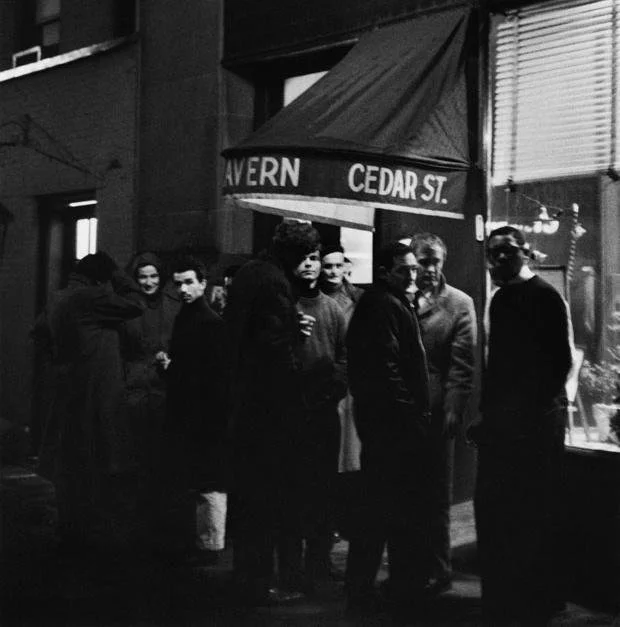
Cedar Tavern, 1960s
1 May 2026
It’s the mid-1950s in downtown Manhattan and we’re taking a trip to the Cedar Tavern. It’s not clear that there is anything particularly special about this place. As we enter, we’re met with a stark interior, full of mismatching furniture and with strips of paint peeling off the walls. Yet, as night falls, the tavern becomes full of painters, poets, composers and jazz musicians. For these artists, the tavern is their favourite spot after a day’s work. It becomes a place for intellectual sparring and (in the case of the painter Jackson Pollock) some physical brawls too. As well as some famous painters and writers we also notice a trio of young composers. They are John Cage, Morton Feldman and Earle Brown. As they squeeze through the crowded tavern, they quickly find themselves debating with Pollock or catching up with his painter friend Wilhelm de Kooning.
What we’re witnessing, on a microscopic scale, is the incredible exchange of artistic ideas that took place in downtown New York in the 1950s and 1960s. Artists across all different fields are trying to find new forms of expression, ways to shake up art and shock their audiences. In the visual arts this leads to Abstract Expressionism, a movement which puts spontaneity and instinct at the centre of art. For Pollock this involved a process of rapidly throwing paint onto a large canvas, which became known as the “drip technique.” In music this innovation takes the form of experimental music, a school that abandons traditional notions of harmony and counterpoint and becomes interested in unusual and striking sounds. John Cage, for example, who quickly established himself as the spokesman of avant garde music, takes the approach of using chance procedures in his pieces, making the process of composing an essentially random one.
Despite his interaction with people like De Kooning and Pollock, Cage, perhaps in an attempt to stand out from his avant garde colleagues, did not claim to have been influenced by the New York painters. His colleagues Earle Brown and Morton Feldman, however, wanted to find ways of incorporating the ideas of visual art into music. Brown, for example, was drawn to Jackson Pollock’s painting, which displayed a spontaneity and directness that he found lacking in art music. Yet, Brown’s main obsession was with the “mobiles” of Alexander Calder. These were suspended abstract sculptures that rotated freely, guided by air currents. What fascinated him about mobiles was the idea of “non-control,” that our experience of art was not guided by its creator but other arbitrary factors. He realised that, as a composer, he could set up a piece with multiple valid ways of being played, practically shattering the idea of a fixed musical work which had dominated in Western Classical music. This notion of “non-control” outraged the European avant garde, including Pierre Boulez, who insisted on greater control over every possible musical parameter using a system called serialism.
Brown, on the other hand, was not interested in strict systems but in mobility and indeterminacy. His most direct attempt to tie music to visual art was his 1964 Calder Piece, which is written for four percussionists using one hundred percussion instruments. This piece is intended to be performed next to Calder’s sculpture Chef d’orchestre and features detailed graphic notation using a series of sketched lines (in other scores Brown used large, numbered rectangles). These graphics leave great room for interpretation, creating “open forms” with no pre-determined pitches, rhythms or duration. It’s clear that many of these ideas came from Brown’s deep engagement with the visual arts.
Like Earle Brown, Morton Feldman was also well connected to the visual art world. His first major collaboration was when Pollock asked him to write music for a documentary that demonstrated his “drip technique.” Feldman wrote a set of austere and dissonant pieces scored for an overdubbed cello line, meant to accompany Pollock’s energetic painting. For Feldman, this was an important step towards a radical new musical style, one which is intimate, meditative and focused on the sounds and timbres themselves rather than melodies or chord progressions. Like Pollock, Feldman was heavily guided by his instincts; he remembered telling Cage once that he had no idea how he’d written one of his pieces. Cage replied to this, exclaiming, “isn’t that wonderful. It’s so beautiful and he doesn't know how he made it.”
Later, Feldman would write pieces called De Kooning (1963) and For Philip Guston (1984),after two more leading figures of Abstract Expressionism. De Kooning, written for an unusual ensemble of horn, percussion, piano, violin and cello, instructs that “each instrument enters when the preceding sound begins to fade.” This creates a delicately evolving collage of timbres, bringing a single sound to the audience’s attention. While many composers had become focused on twenty-minute-long compositions, Feldman began writing pieces that would last multiple hours. A performance of For Philip Guston, for instance, typically lasts four to five hours, putting great demands on an audience’s attention span. This was yet another rejection of musical tradition, a result of the avant garde spirit which captured downtown Manhattan.
It seems that the reason for these ties between visual and musical avant garde was because artists had found a shared interest. For both musicians and painters, artistic creation became about process rather than product. As the scholar Kyle Gann points out, “music was now about sound the way paintings were about paint.” New processes and techniques in music were inspired by these encounters between painters, poets and composers in venues like the Cedar Tavern. The vibrant New York scene fuelled their artistic thinking pushing them towards more radical and innovative experimentation. Barriers between traditional forms of art were being eroded and, as Earle Brown puts it, the artists “were all in a kind of creative soup together.” While some artists, including Feldman and Philip Guston, would later fall out due to growing artistic differences, the ambition and energy of the 1950s art scene would continue to have an impact right through their careers.