The Remarkable Escape of Tracey Emin

Tracey Emin, Lighthouse Gala Auction in aid of Terrence Higgins Trust, 2007. Photo by Piers Allardyce
1 May 2026
Margate is that uncomfortable thing, a seaside town accessible a little too quickly from London. From the eighteenth century onwards it has had a reputation as a place of convalescence. I wonder if it ever lived up to it? TS Eliot’s disturbing poem The Waste Land, started in a beach shelter while recovering from a nervous breakdown, would suggest not.
In the summer of 2024, I also found myself there, succumbing to pangs of melancholy. The town, in the midsummer sun, looked painfully bleached. People in swimming costumes thronged the train station; those at the beach looked overdressed and dizzied. Suddenly I recognised it: this was the confusing haze painted by Captain Booth, an eccentric, retired sailor who lived in a Margate boarding house. We know him as JMW Turner. He had the vision to preserve Margate’s hallucinatory state on canvas. In his paintings, the whole town wanders off into the burning sea.
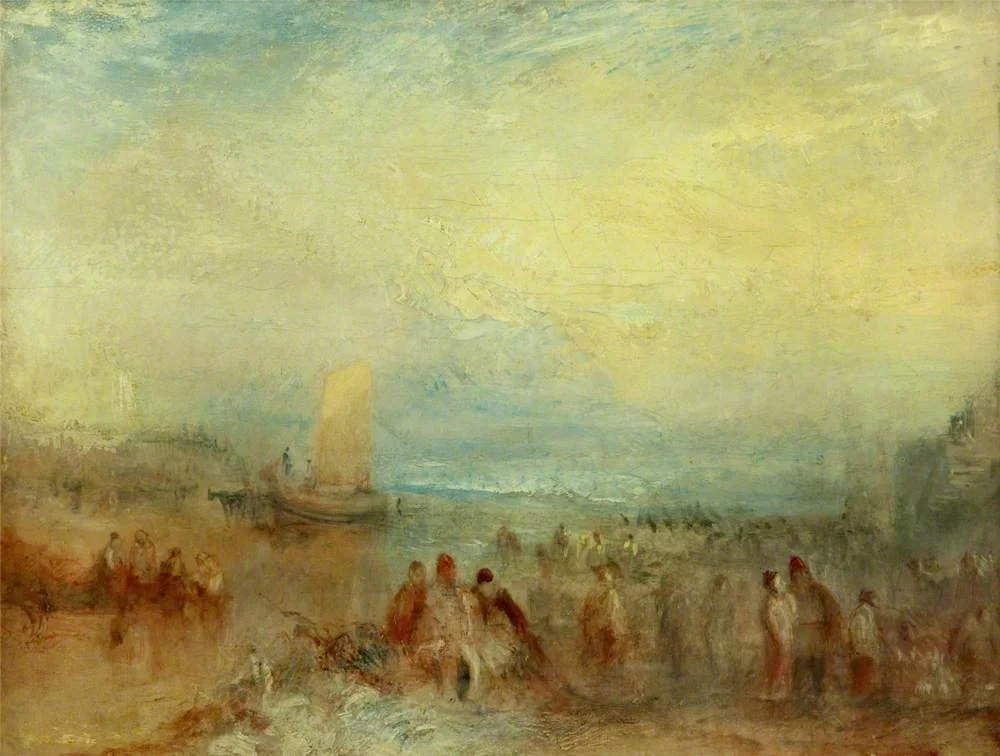
JMW Turner, Margate Harbour, c. 1835-1845, Sudley House, National Museums Liverpool. Image: Art UK
By the seaside, life, death and love become painfully light. The same yellow glow as Turner, this time projected and made by Super-8 film, begins artist Tracey Emin’s film Why I Never Became a Dancer. We move shakily down the town’s streets, as the artist unfolds her story of leaving Margate, where she grew up. “I never liked school … so at thirteen I left,” begins Emin. “Sex was just something you did,” she says, like “fish and chips” and “lunchtime discos.” Later, she recounts dancing in a competition, feeling beautiful and alive. Some of the same men she had sex with when she was younger begin shouting “slag” from the sidelines. She is losing her balance. We spiral on to the street with her and arrive at the older Tracey, living in London. She is dancing once more. This time we cannot keep up with her, as she whirls around the room to You Make Me Feel. “This one’s for you!” she shouts, after naming the boys who humiliated her in Margate.
I was shocked how many young artists I know seemed sceptical about the work, or even about Emin herself, an artist known for her autobiographical work. Brought up under immense financial strain, her father left when she was just seven years old, her family moving into an abandoned flat and surviving on the margins. When she shot to fame with My Bed in 1998, Emin was talking directly to the world about herself, about everything (and I mean everything) that had happened to her. Perhaps that could be the reason one friend even decried Tracey Emin’s recent show as “vulgar”. The idea that Emin is “vulgar”, though, seemed to speak about a certain attitude to taste, and it reminded me of something…
In 1997, Emin appeared alongside six men in a televised discussion about art. She appeared injured - her finger in a cast - and visibly drunk. (Emin later explained that she was heavily medicated and should not have been put on television at all.) Halfway through the programme she tore off her microphone and left. Her critics relished her public humiliation. Even The Guardian, a newspaper vaunting its cultural open-mindedness, printed an article unthinkingly calling the incident “her most significant contribution to British art.”
When I saw the footage as a student, it felt remarkably poignant. Emin complains, “You people aren’t relating to me now. You’ve lost me completely.” She stands out, in a floral, sheer top, flanked by the philosopher Roger Scruton in black bow tie. Her on screen anger was not random, but a reaction to disapproval by so-called “intellectuals.” Her work is not elusive. Its subject matter, her own body, is determinedly present. It scorns the pompous rituals that we associate with the words “contemporary art.” Tracey Emin escaped her punishment at the hands of the art world, as she escaped her fate in Margate. Dance was her survival, just as her body offered her freedom. She occupies a wondrous wasteland that has endless appeal.