Conflict Resolution, Greenland Style
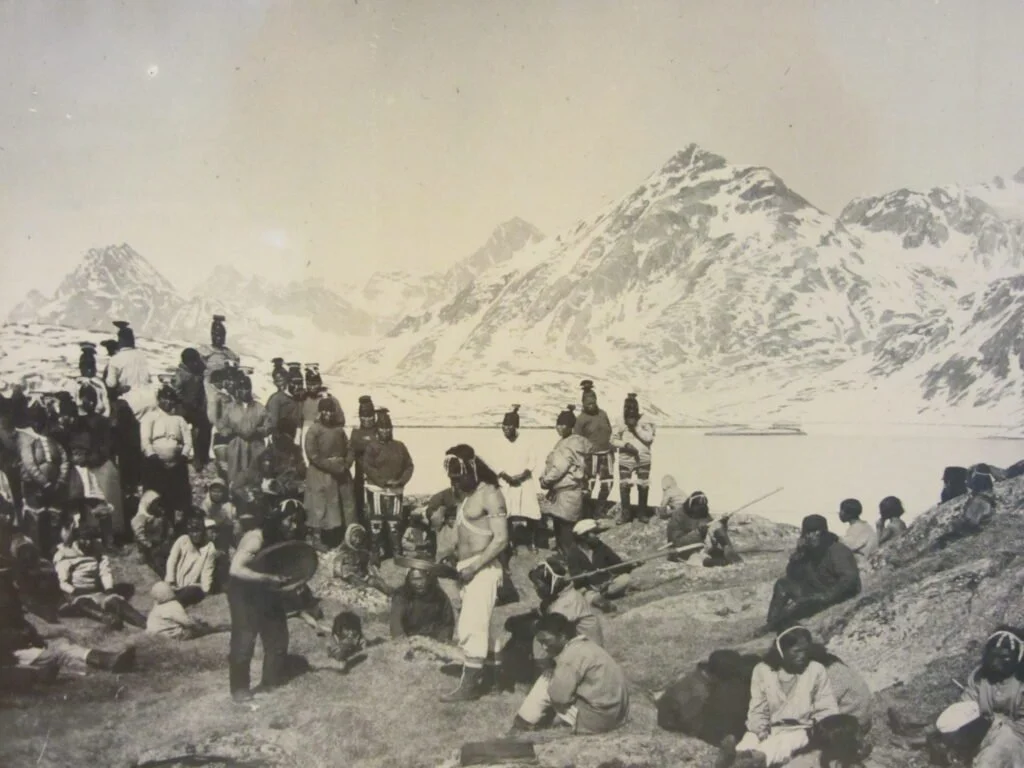
Inuit drum song and dance (qilaatersorneq) duel (ivinneq) near Qingaaq at the Ammassalik Fjord in Greenland, 1905. Photo by William Thalbitzer
23 January 2026
It’s been an arctic rollercoaster. Since his re-election, U.S. President Donald Trump has threatened to annex Greenland, an autonomous territory of Denmark, a member of NATO and the EU. This January, the world watched events spiral from bad to worse as Trump announced, “We have to have it,” refusing to rule out military force while declaring that he no longer felt obliged to think solely in terms of peace since he had not been awarded the Nobel Peace Prize.
Threats to punish Denmark’s European allies with twenty-five percent import tariffs were followed by a collective sigh of relief when Trump dramatically reversed course on 21 January 2026, declaring that he would not use military force and that the threatened tariffs would not go into effect. But the Greenland crisis isn’t over yet. As the world is holding its breath, waiting for what will happen next, let’s take a closer look at Greenland – and at an ancient way of resolving conflict, Greenland style.
Greenland is the world’s largest island and the third largest area of the North American continent after Canada and the United States. Eighty-one percent of its total area is covered by the Greenland ice sheet, the second largest body of ice in the world after the Antarctic Ice Sheet. Even though Greenland is part of the North American continent, it has been culturally and politically connected to the Scandinavian Kingdoms of Norway and Denmark for over a millennium since the first Norse settlements in 986, which remained in place until the early 15th century. In the early 17th century, the Kingdom of Denmark-Norway sent explorers who re-established a permanent Scandinavian presence.
Greenland was transferred from the Norwegian to the Danish crown in 1814. Its status as Danish colony ended in 1953, when Greenland became fully integrated into the Danish state. In 1979, Denmark granted home rule to Greenland. In 2009, Greenland gained self-rule through the passage of a law that also made clear that any decision to gain independence from Denmark would be made by the Greenlanders themselves.
About eighty-nine percent of Greenland’s roughly 57,000 inhabitants are Greenlandic Inuit, an indigenous peoples of the Arctic region. The musical history of Greenland begins over 4,000 years ago with the drum, qilaat. Drawing close to each other inside a skin tent or a turf house, someone would bring out a drum to pass the time during the long arctic winters. The drum could entertain, it could accompany dance, songs, and stories, but it was also an important tool for the Greenlandic shaman. The Christian missionaries did not like the drum dancing and singing because it stood for the pagan culture they sought to eliminate; drum singing and dancing came close to extinction, but there has been a revival since the Greenlandisation of the 1970s.
But drum singing and dancing were not just part of everyday spiritual and social life – they also offered an alternative, non-violent way to resolve disputes. In a drum fight, or drum duel, the disputing parties would sing accusations and maybe inflict light violence to each other in front of their families as an alternative to serious physical violence. The audience would give the verdict after each party had sung and danced their song against each other. But beware: if one of the opponents became so angry that he was unable to complete the duel, he would automatically lose. Maybe the American president should start practicing his drumming and dancing – and some self-restraint: in a drum fight, you have to endure your opponent with a polite smile. Giving them the third finger is not an option.