The River Will Live: Threads of Resistance in the Embroidery of Britta Marakatt-Labba
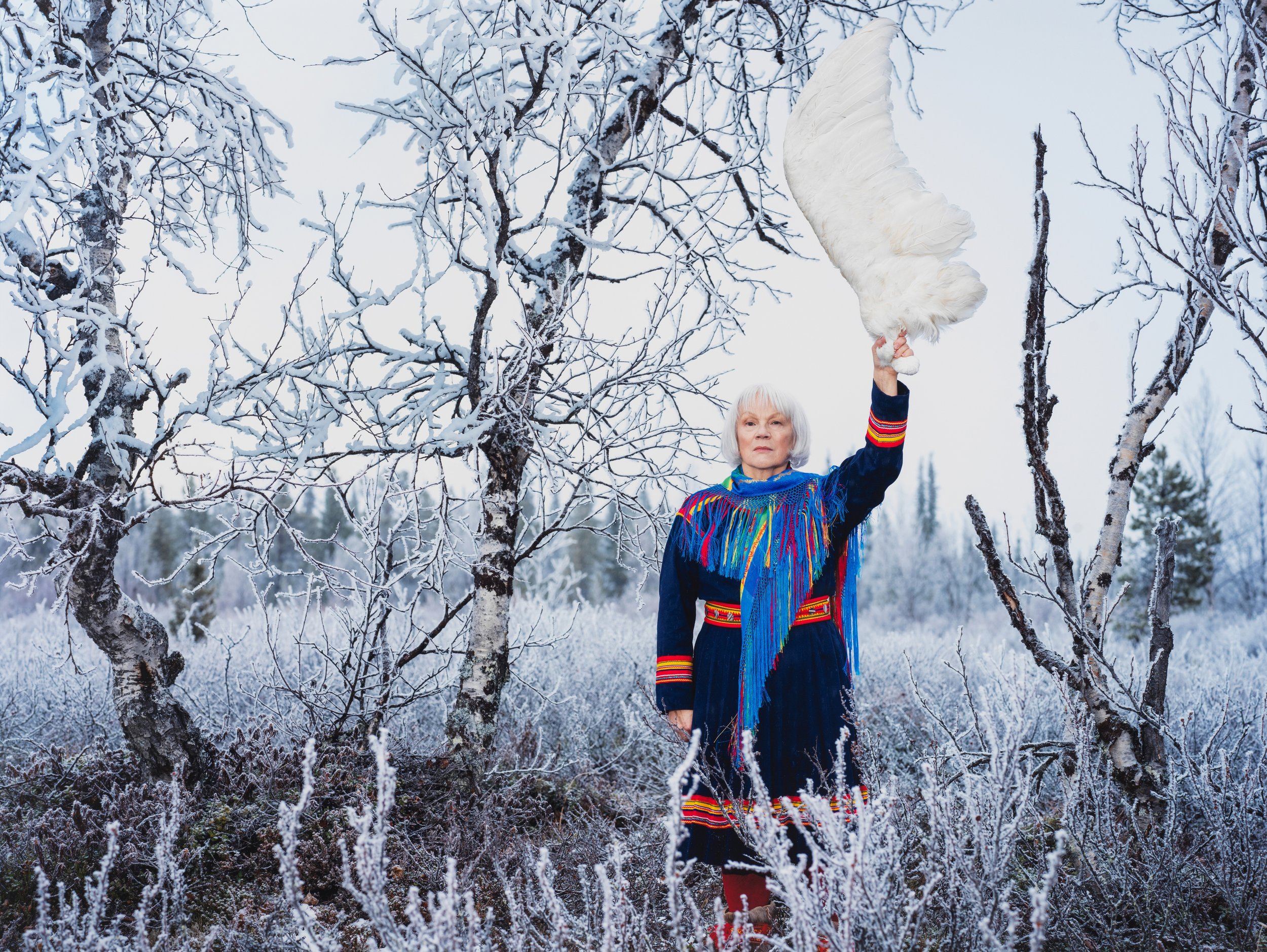
Britta Marakatt-Labba (born 1951), photo by Marja Helander. Portrait of Honour 2022, Swedish National Portrait Gallery.
9 July 2026
Up in the icy tundra of the far north, on a frigid day in January 1981, a young Britta Marakatt-Labba was arrested. It was the penultimate year in a 14-year political battle fought between the Norwegian government and activists advocating for the rights of the Samí people (indigenous people of Northern Europe) and nature. The government was proposing to install a large hydropower plant in the Alta River, deep in the Arctic, with profoundly negative consequences for the reindeer herding culture of the Samí people. Eight Samí artists, known as Mázejoavku or The Mazé Group, sat at the heart of the resistance, determined to use their art to reinvigorate Samí identity and oppose those that threatened to quash it. Among the founders, Britta Marakatt-Labba, used embroidery to tell their story.
Garjját, garjját, kra, kra, kra…
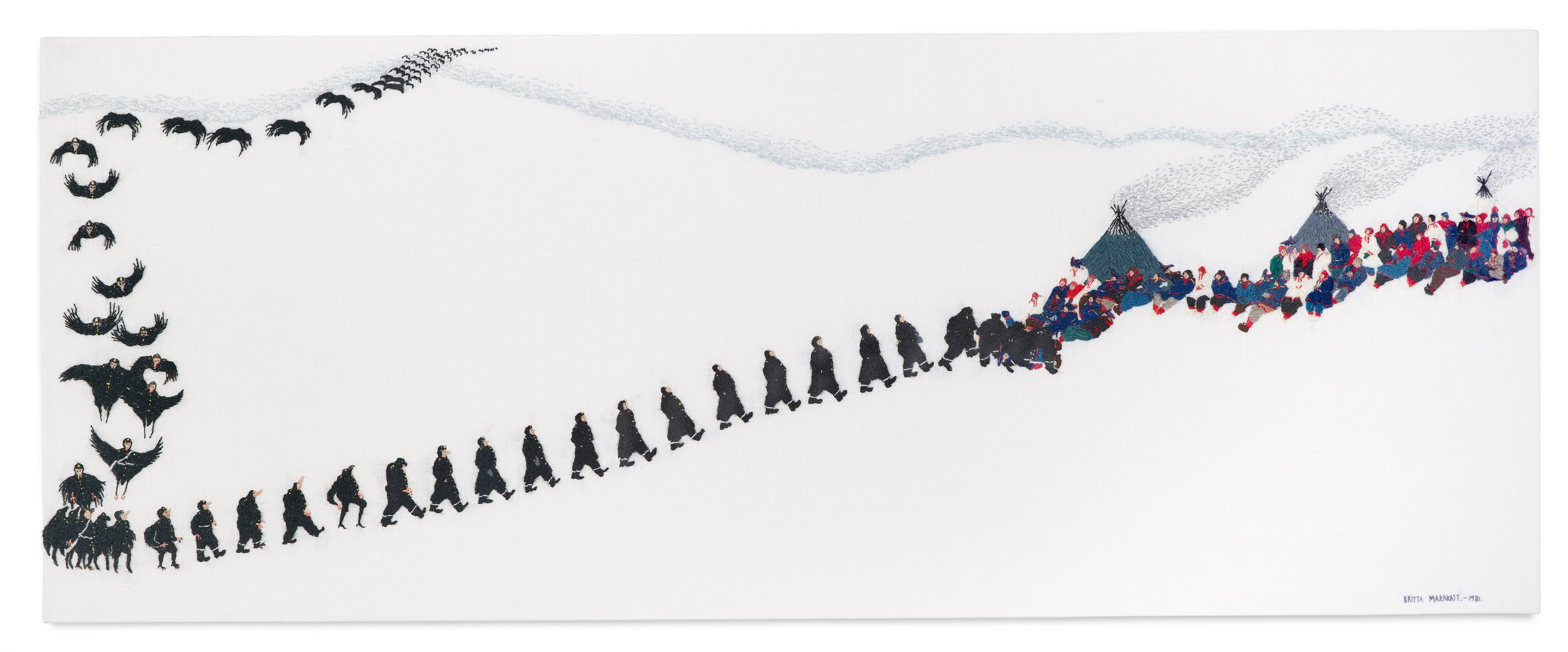
Britta Marakatt-Labba, Garjját (Kråjorna/The Crows), 1981. Embroidery on textile, 41 x 102cm. Koro — Kunst I offentlige rom. Photo: Hans-Olof Utsi, Galleri Helle Knudsen. © Britta Marakatt-Labba/Bildupphovsrätt 2025
In 1981, the conflict between the government and local Samí activists was reaching its climax. The Norwegian government, growing increasingly impatient, sent ten percent of their police force up north. Britta Marakatt-Labba, an eminent Samí textile artist, recalled a story told to her by her mother in which the crows take everything they come across in nature. In Labba’s Kråkorna, a sinister murder of crows swoops down onto the snowy landscape. They morph into a rigid backed uniformed line of police stamping across the canvas, before descending, brutally and devouringly, on the colourfully clad Samí activists.
Kråkorna is just one of many embroidered narrative works by Britta Marakatt-Labba. Labba had been brought up in the Samí tradition of stories being passed down orally, to see them visually was less common. But Labba was greatly inspired by the narrative traditional artworks of the Inuit people in Greenland and embroidery was in her blood, as her mother, and grandmother, and their grandmothers before them, had spent their lives cultivating Duodji (Samí handicraft) with particular emphasis on the decorative elements of Samí traditional dress — the gákti. It was a natural development then that Labba married her admiration for narrative visual arts with that of her ancestral skill of hand crafts. It is this that laid the foundation for her largest work, the epic, and wonderfully woven twenty-four metre tapestry — Historja — that tells a story and depicts the spiritual life of the Samí people.
Historja, weaving life into art and art into life
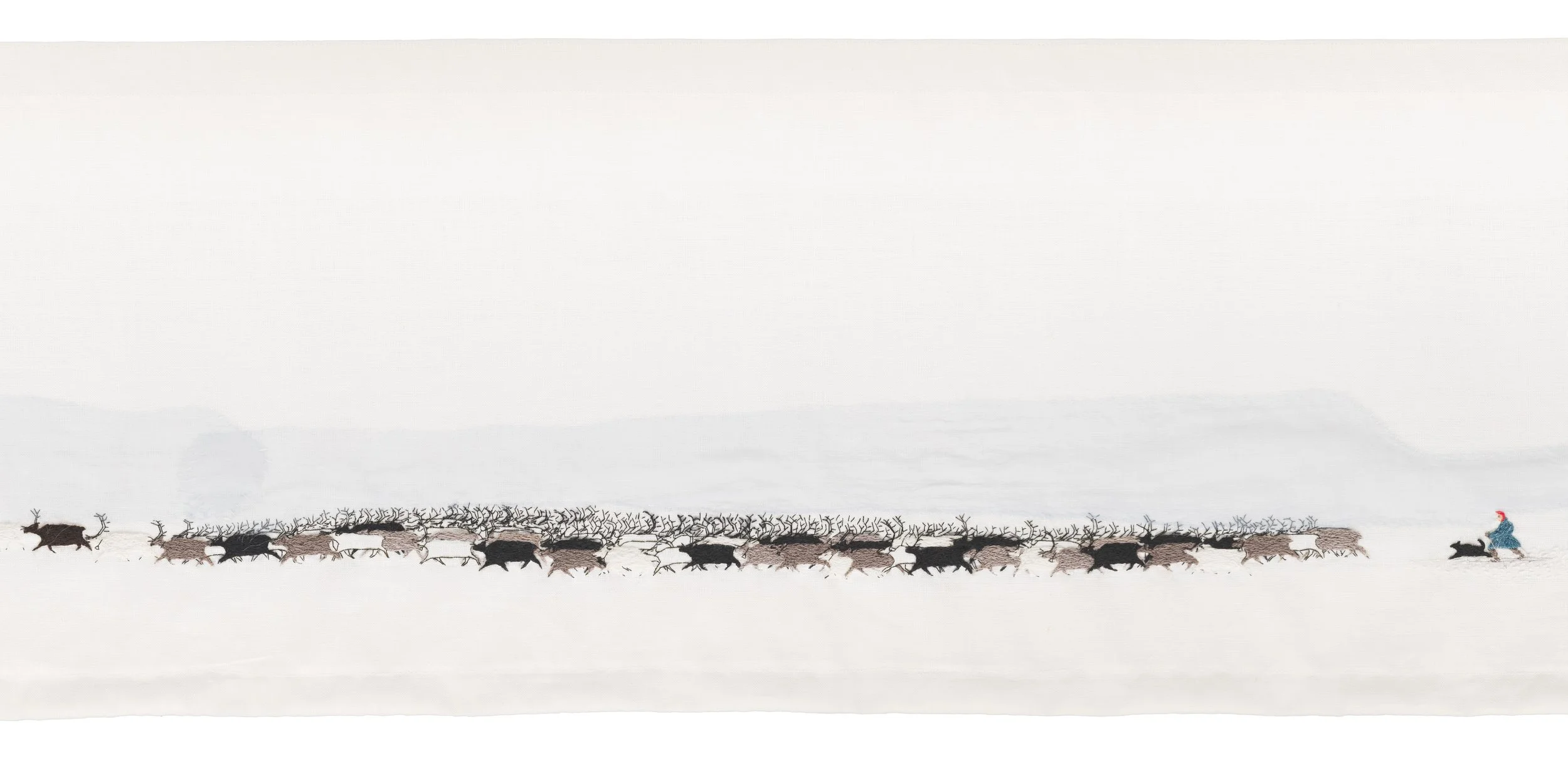
Britta Marakatt-Labba, Historja, 2003-2007. Embroidery on textile, 39 x 2345cm. Koro — kunst i offentlige rom. Photo: Hans-Olof Utsi, Galleri Helle Knudsen.© Britta Marakatt-Labba/Bildupphovsrätt 2025
It would be impossible for me to relay in such a short article, the sheer magnitude and intricacies of Historja. The work is expansive, not just physically, but thematically. Think the Bayeux Tapestry but set in the deep north. Yet perhaps it would be good to focus on the natural world and the cultural life of the Samí that are so central to this work.
Throughout the work, the daily life of the Samí reindeer herder is depicted. Herds of reindeer travel across the textile in shades of grey, brown, black and white with an intricate mesh of antlers framing the scene. Sometimes herded into swirls as if a part of the winds. The Samí are easily distinguishable in their colourful gátki and brightly coloured traditional headwear. Whilst at times the Samí individuals are the only element of colour in a largely monochromatic work they still look at one and in harmony with their sparse and icy landscape.
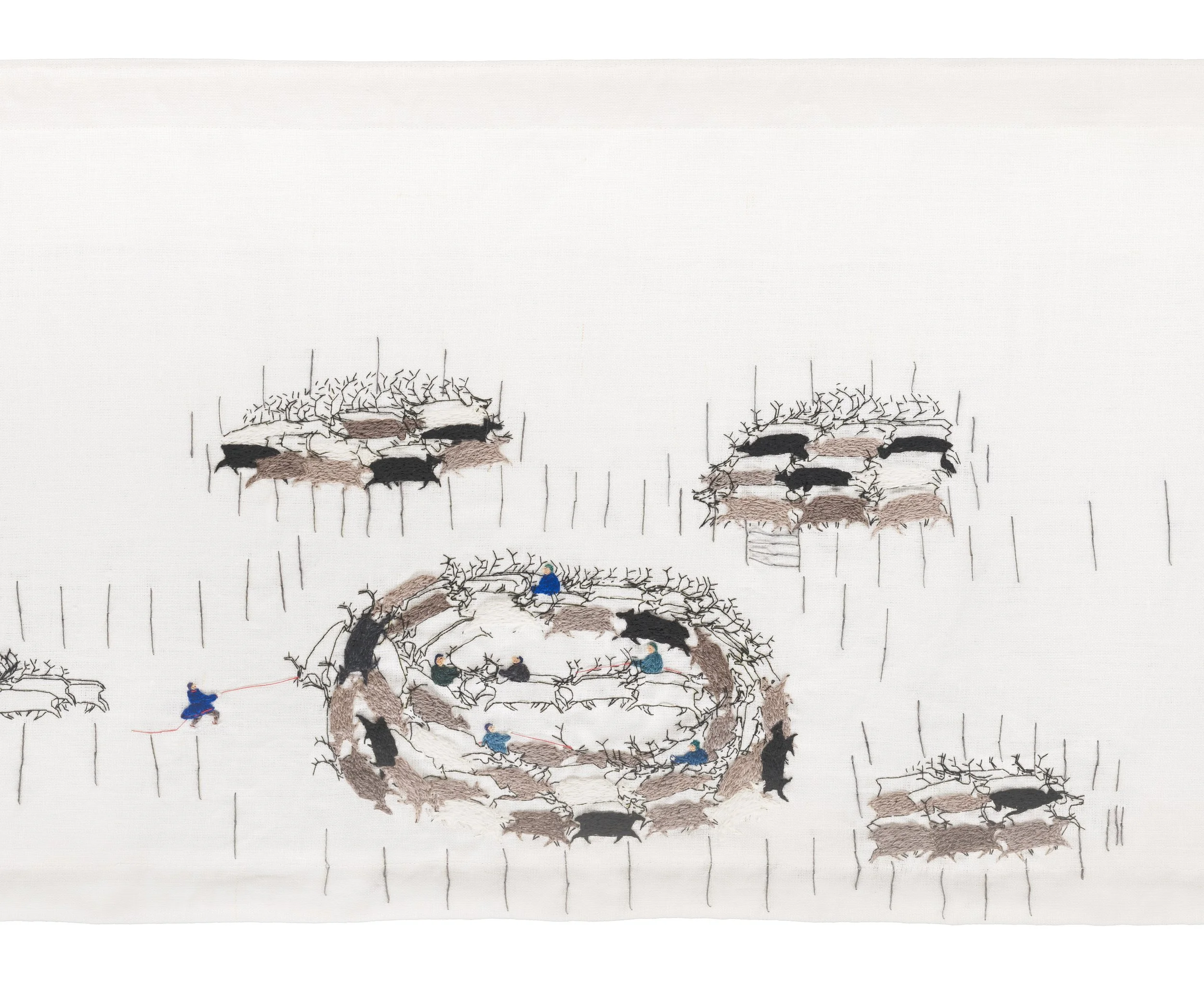
Britta Marakatt-Labba, Historja, 2003-2007. Embroidery on textile, 39 x 2345cm. Koro — kunst i offentlige rom. Photo: Hans-Olof Utsi, Galleri Helle Knudsen.©
Britta Marakatt-Labba/Bildupphovsrätt 2025
But Historja does not only tell the tale of the Samí’s harmonious life in nature. Britta Marakatt-Labba does not shy away from the history that is often painful to look at. At the centre of her tapestry is a scene depicting the 19th century Kautokeino Rebellion. In the 1850s, a group of Samí men inspired by a particularly stringent religious revival, clashed with the local non-Samí in the town of Kautokeino. The rebels killed members of the local authority, arguing that they were carrying out God’s will. As a result, the rebels were sentenced to death or to live out their days as forced labourers. This was a bloody episode in the history of the Samí, and one Britta illustrates with a palpable sense of emotion. Look closely and you can almost hear the chaos of the moment; bundles of bodies piling on top of each other, the blood of the slain glittering the white snow, and the central flaming church with its spire in mid-fall.
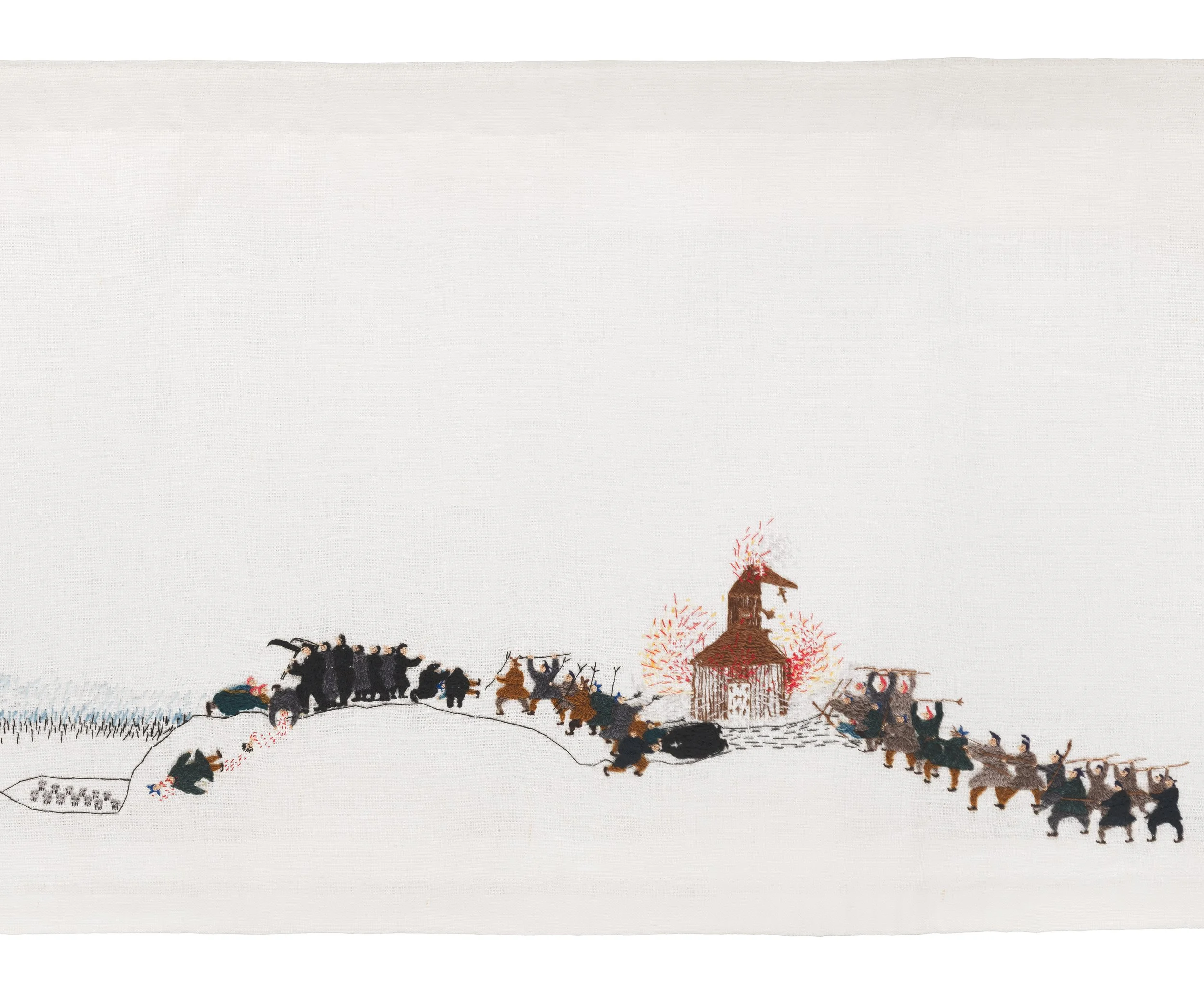
Britta Marakatt-Labba, Historja, 2003-2007. Embroidery on textile, 39 x 2345cm. Koro — kunst i offentlige rom. Photo: Hans-Olof Utsi, Galleri Helle Knudsen.© Britta Marakatt-Labba/Bildupphovsrätt 2025
A Living History
Forty years on from the events of Alta the meaning of Britta’s work is still being felt today. In 2022, Samí activists fought to protect the lands they traditionally use for reindeer herding from the widespread implementation of wind turbines on the Fosen peninsular of mid-Norway. The activists chose to enact civil disobedience outside of the Ministry of Oil and Energy, but what happened next was eerily similar to that of the Alta demonstrations. As part of the exhibition Britta Marakatt-Labba. Moving the Needle young Norwegian activist Gina Gylver describes a moment as if Britta’s work “Garjját/Kråkorna” had come to life. Peacefully, staging a sit in, the Samí activists sang out “Garjját, garjját, kra, kra, kra…” as the crow-like Oslo police came to forcibly remove them.
Through needle and thread Britta has woven conversations into being. As the Samí continue to fight for their rights, and the rights of the natural world, her work remains part of the conversation. It is as if she has extended a hand to her ancestors, her Samí contemporaries, those of us who sit outside her culture, and those in the future looking back. But perhaps most intimately, there is a quiet ongoing dialogue with both her mother and the earth that reared her. Britta lived by the words of her mother, the age-old phrase “listen to your mother” seems to have underpinned a large amount of her life and therefore her work, because for Britta the work of art is akin to life itself. Her mother told her: “For an artist, there is always work to be done.” Britta Marakatt-Labba found a unique way to take the handicraft passed down hand to hand amongst the Samí for centuries, and transform it into a new language and a new way of seeing and being seen.
You might also enjoy. . .