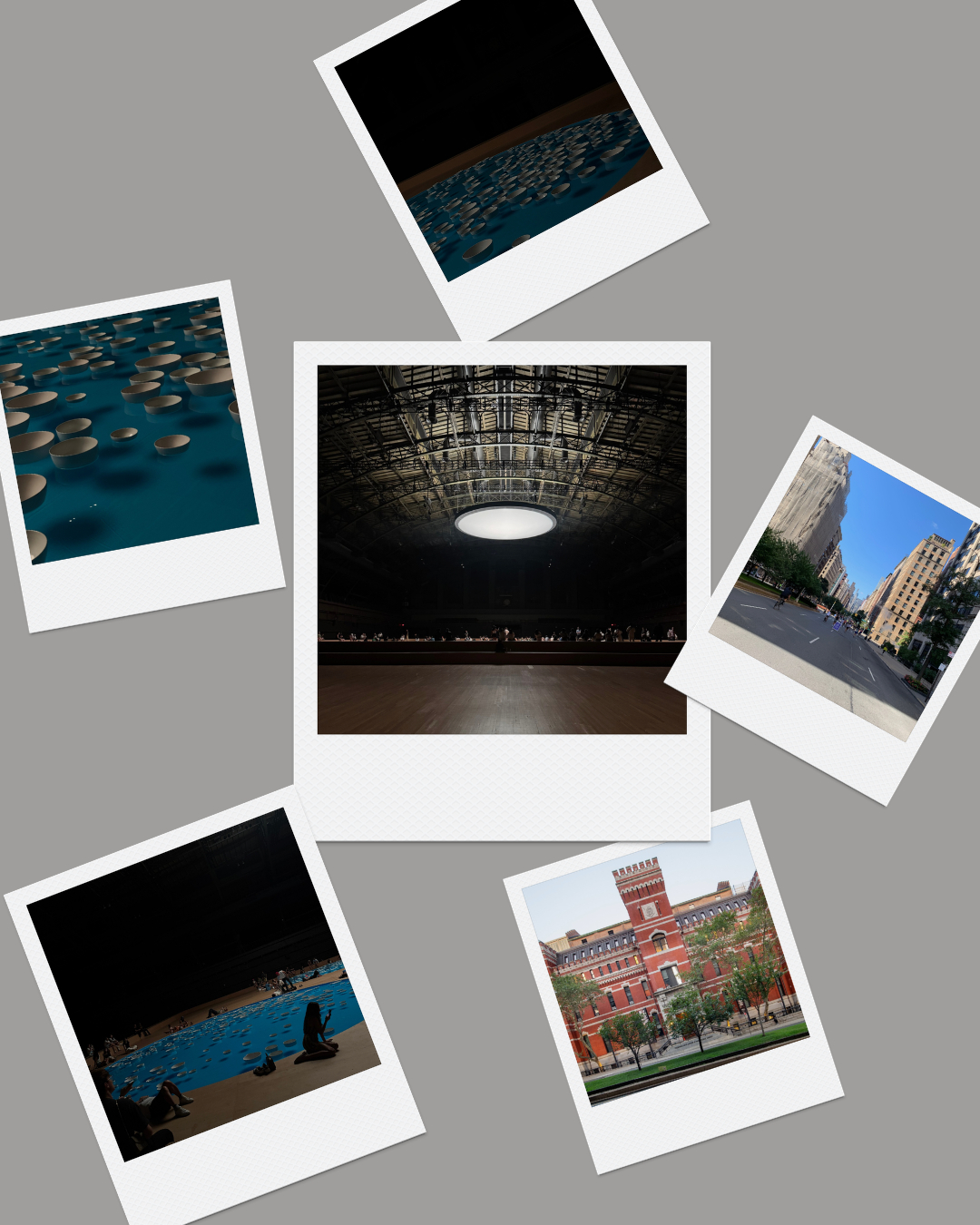
Exhibition images by Olivia Merola. Park Avenue Armory photo by Ajay Suresh, Park Avenue photo by Deans Charbal (Wikimedia Commons)
7 August 2026
Dear Reader,
It’s summer in New York City. The days lengthen, the nights grow shorter, and warm rain showers appear out of nowhere. I have always loved those. We’re out of hibernation now, eager to fill the streets, linger outside a moment longer, bring a book to the park, and pretend, perhaps, that we are living la dolce vita.
You have to romanticize this city. Summer makes that easy to do. Everyone seems to wear themselves a little more lightly. Smiles surface more readily. People fly down the streets on Citi Bikes just to feel the wind in their hair.
Then, amid all the perpetual movement of the city, everything came to a pause.
I went to see Céleste Boursier-Mougenot’s clinamen at the Park Avenue Armory on the Upper East Side. The Armory has a liminal grandeur: entering its immense Wade Thompson Drill Hall feels almost like landing on the moon. Inside, the installation resembles an otherworldly landscape. Circular pools of water stretch across the darkened space. Hundreds of ceramic bowls, each varying in shape and size, drift across their surfaces.
To my surprise, many visitors were lying on their backs along the edges of the pools, as if they had escaped to some distant shoreline of their minds. As the bowls drifted they occasionally collided, producing spontaneous chimes that reverberated through the hall.
I immediately thought of Merce Cunningham and his use of “chance operations.” For his pieces, Cunningham would occasionally use coin tosses or rolls of the dice to allow unexpected arrangements to occur, relinquishing a degree of artistic control. Boursier-Mougenot appears similarly fascinated by unpredictability. Clinamen takes its name from an idea in Epicurean philosophy: the unpredictable swerve of atoms. For Lucretius, this swerve provides the “free will which living things throughout the world have.”
Still, I wondered: The bowls were propelled by water motors, so how spontaneous could their movement really be? Perhaps spontaneity does not require the absence of structure. The current determines that the bowls will move, but it doesn’t determine exactly where they will go, if they’ll touch, or what sounds their encounters will produce. Even chance, it seems, needs a catalyst.
I lay down beside one of the pools to see whether my fellow visitors were onto something. Light conversations echoed nearby. I felt my back press into the wooden floor, let my legs knock to one side, and closed my eyes.
The bowls continued to drift and clank, their rings traveling in waves through the hall. I thought about free will. What do we leave to chance, and what do we attempt to control? How much of our lives can be controlled at all?
Perhaps we need a gentle current. A force that sets us in motion and offers us a direction. What we touch along the way, though—which other lives we brush against, where those connections go, or don’t go—seem to arise from some accumulation of choice and whim.
When I left the Armory, I found myself wondering about all the choices and whims that had somehow brought me to that moment. Moments earlier, I had been staring at pools and bowls and people on their backs, listening to sounds and whispers. And now, I was back onto Park Ave, dodging cabs and cyclists, moving onto the next thing.
This city is full of lives and objects moving along their own unseen currents. Sometimes, it’s nice to wonder where they lead and what it all means. Other times, it’s enough to become still, watch something float away, and let a bowl simply be a bowl.
Yours,
Olivia