21 August 2026
My dearest artlings,
It is only on two occasions that I miss America: when I’m craving a disgustingly large, sweet, and watery iced latte from Dunkin’, extra cream, coconut milk, and when it gets so hot in Europe I realise an AC may also be in order. And last week, as I strolled down Zurich, I very much needed both, preferably at the same time.
I don’t mean to whine too much; I love Europe. If I could move to Switzerland, I would leave London in a heartbeat. Fresh(er) produce and clear-water lakes to swim in, not to mention ski slopes to almost injure myself on, sound like too good a deal to pass up. Especially when there’s also an opera house I’m dying to visit, and a Kunsthaus I’ve fallen in love with.
I dragged everyone to the museum on a scorchingly hot Saturday morning; talk about dedication (or, perhaps, persuasion). The thermometer – in the shade no less – showed an awful 37 degrees Celsius. I’m fairly sure my friends were starting to regret going along with me. Anyways. Everyone has a price. Theirs: a few cold cocktails. As for mine, that was clear: Marisol’s latest exhibition.
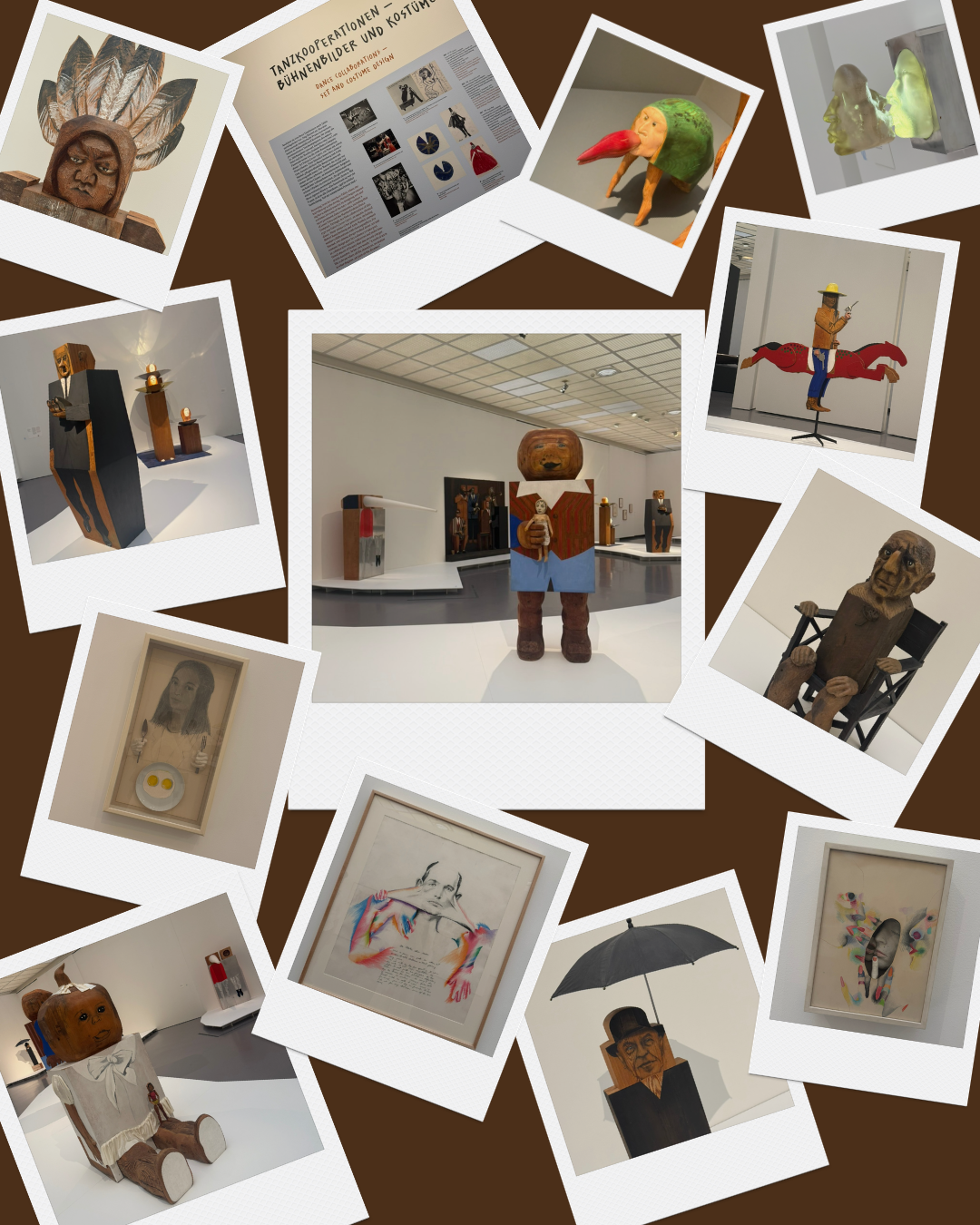
María Sol Escobar (1930–2016), known simply as Marisol, was one of the most distinctive voices of Pop Art in the late twentieth century. Exhibiting alongside icons like Andy Warhol and Roy Lichtenstein, she explored themes of celebrity, consumerism, and mass culture. Yet, she approached them with wit, wackiness, and psychological depth that were distinctly her own. This not only shaped her choice of media – for she sculpted figures from carved wood, plaster casts, photographs, paint, and found objects – but also led her away from mimetic likeness and towards a caricaturisation of modern existence. Creating figures that were equal parts satire and self-portrait, she thought, was a means of exposing the social games of her time – of stripping the personas of power, femininity, and elitism in favour of what lay beneath. It is in this spirit she created Face Behind a Mask (1961), Portrait of Betty (1961), and Picasso (1977), all three now in Zurich to speak of the vulnerability, insecurity, and guardedness that lurk beneath the social personas of otherwise famous figures.
But it wasn’t these works that compelled me most. It was Marisol’s foray into stage and costume design for some of the late twentieth century’s most prominent dance companies, including those of Louis Falco and Martha Graham. Departing from her usually solitary practice, Marisol collaborated with choreographers to create functional works of art that served as active participants within a larger poetic narrative. This fascination found a natural outlet in costume sketches for Las Paredes Oyen, as well as posters, sets, and costumes for the Louis Falco Dance Company’s performance of Caviar (1970). Costume design became a natural extension of her longstanding fascination with the tension between persona and self, public performance and private reality, and the masks and identities we perform. As she herself said: “A work of art is like a dream where all the characters, no matter in what disguise, are part of the dreamer.”
Yet Marisol herself resisted disguise of another kind: the neat labels so often imposed on artists. Reflecting on her life and work, Jung Lee, founder of Shin Gallery and one of the lenders to the Kunsthaus exhibition, observed that she is not an artist you can easily compare to another, much less define in conventional terms. “Marisol is simply Marisol,” he said, for “she does not truly belong to any movement or period. She creates sculpture as if she is drawing, and draws as if she were sculpting. There is a fluidity between mediums that feels entirely her own.” Her work is entirely her own, unburdened by personas, layers, and conventions.
And so, as I stepped back into the sweltering heat, I found myself reflecting on the extra layers I, too, carried – and wondering if any of them would melt away.
From Zurich with love,
Maya