The Royal Ballet School at 100 Years - The Past, The Summer Performance and the Future
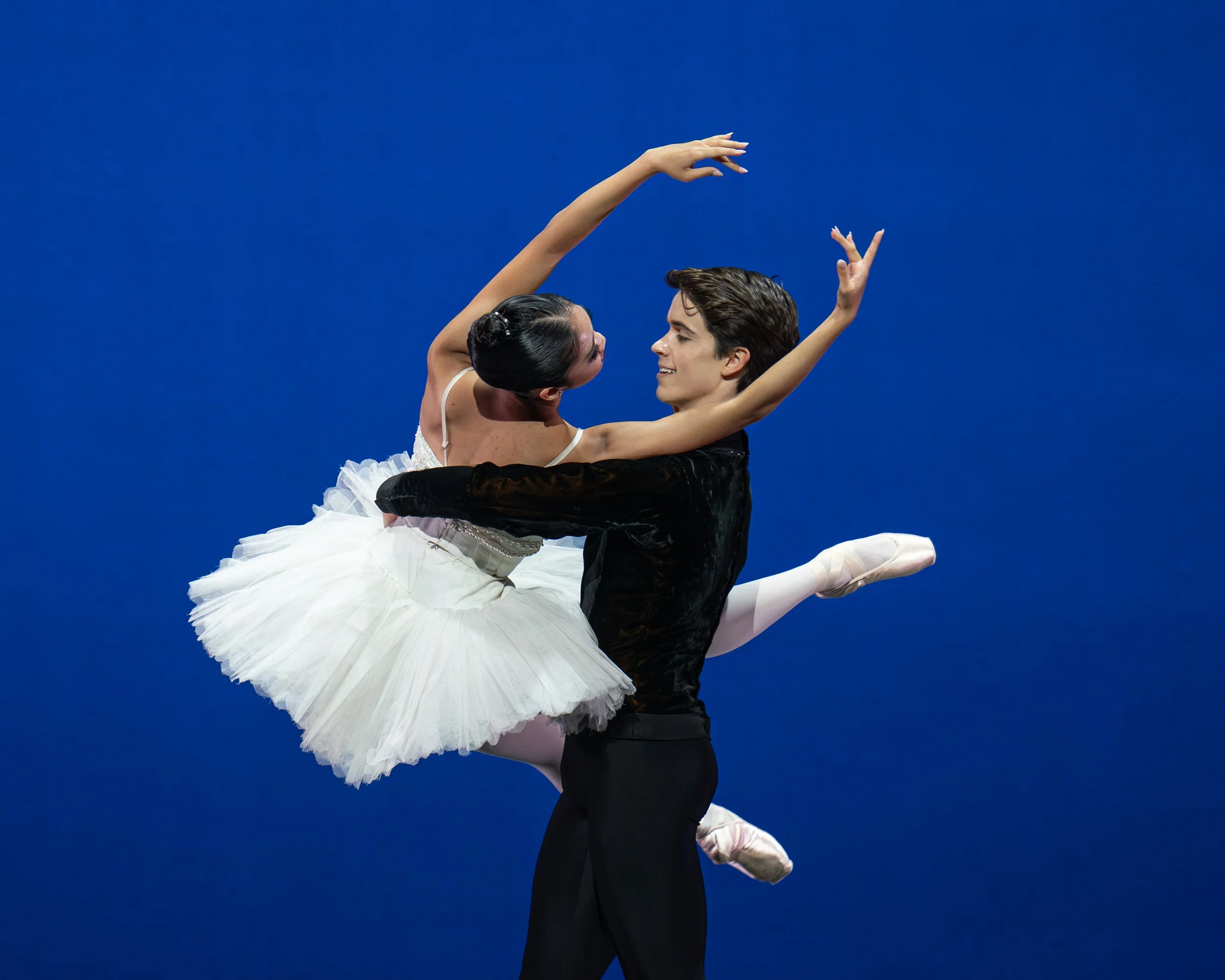
Pre-professional Year students Sophia Koo and Millán de Benito in Christening Suite by Christopher Wheeldon © The Royal Ballet School. Photographed by Photography by ASH
24 July 2026
On Saturday, 18 July 2026, London’s Royal Opera House was buzzing with more energy than nearby Covent Garden with its street performers, market traders, shops and throngs of tourists. A festively dressed, multi-generational audience was filing into the theatre, ready to celebrate their sons and daughters, the next generation of dancers, and the centenary (100 years) of The Royal Ballet School. Before turning to the stars of tomorrow and the choreographers of today, let’s pay tribute to the woman who started it all.
The Founder: Dame Ninette de Valois – « Madam »

Ninette de Valois, early 1920s
In 1926, a young dancer, teacher and choreographer with high cheekbones and serious eyes founded the Academy of Choreographic Art in London. Born Edris Stannus, the twenty-seven-years old Irish-born dancer had adopted the stage name Ninette de Valois. De Valois didn’t just have the piercing eyes of a visionary, but a vision: “Madam,” as she would come to be universally known, wanted to establish a national ballet school like those in Russia and Europe, and nurture future dancers and choreographers for an English repertory ballet company.
Born on a country house in rural Ireland, de Valois and her family had moved to England when she was a child. The little girl studied “fancy dancing,” ballet, and was moved by Anna Pavlova’s Dying Swan. She made her professional debut on the music-hall stage when she was barely fourteen and performed in variety acts and later as principal dancer in pantomimes and opera ballets. After the First World War, she worked with Russian émigré artists connected to Sergei Diaghilve’s Ballets Russes, who had made London their permanent home after the Russian Revolution. In 1923, de Valois joined the Ballets Russes. At the time, there was no national ballet company and no national ballet tradition in Great Britain, but Diaghilev’s company and performances by the Russian ballerina Anna Pavlova had enjoyed great success with British audiences and British dancers were beginning to join and make their name in Diaghilev’s company, setting the stage for a British moment in ballet history. De Valois would later say that she learned everything she knew about running a ballet company from working with Diaghilev.
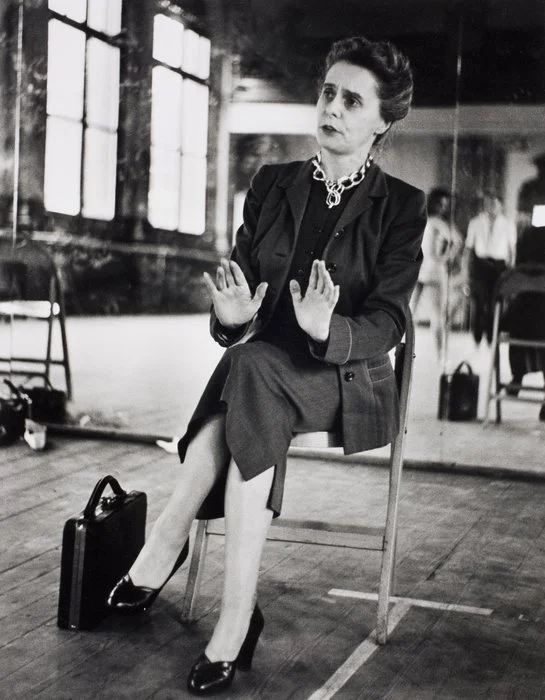
Ninette de Valoi, 1951. International Center of Photography, gift of Alfred Eisenstaedt
In 1926, de Valois quit performing after doctors diagnosed an undetected case of childhood polio and founded her school. That same year, she talked to another woman with a vision: Lilian Baylis of the Old Vic Theatre. Baylis invited de Valois to work with her actors and singers, and to create dances which her students would perform in plays and operas at the Old Vic. Baylis was planning on rebuilding the Sadler’s Wells Theatre and gave de Valois the prospect that, once rebuilt, Sadler’s Wells could serve as a home for a national ballet company. While waiting for the theatre to open, de Valois was also creating dances for Dublin’s Abbey Theatre and Cambridge’s Festival Theatre, which were part of the repertory theatre movement which strove to bring high-quality but affordable drama to audiences outside London. This link to the dramatic theatre would have a lasting impact on the emerging British ballet.
In 1931, de Valois’s school moved to the newly restored Sadler’s Wells Theatre, where it worked as the Vic-Wells Ballet School alongside her fledging company, the Vic-Wells Ballet. In 1956, the school and its affiliate companies received the Royal Charter and were renamed The Royal Ballet School, The Royal Ballet Company and The Royal Ballet Touring Company (later Birmingham Royal Ballet). Dame Ninette de Valois died in 2001 at 102.
The Royal Ballet School’s 2026 Summer Performance

Pre-professional Year students Ivan Malaguti and Sophie Schulten in Swan Lake Act III by Peter Wright © The Royal Ballet School. Photo by Photography by ASH
Ninette de Valois took inspiration from the great national ballet traditions in France, Italy, Russia and Denmark, but set out to create a distinctly British ballet tradition. Today, compared to the Paris Opera Ballet School and the Russian schools, the Royal Ballet School imparts not so much a very distinct style than a distinct ethos of dance to its students. The British school is anchored in a commitment to choreographic enterprise and to deeply musical dramatic expression. The school’s centenary edition of its annual summer performance showcased this approach in an ambitious program comprising Sir Peter Wright’s staging of Swan Lake’s ballroom act (act III), Dame Ninette de Valois 1937 Checkmate Suite, RBS alumnus Christopher Wheeldon’s Christening Suite, and four pieces created specifically for this occasion: Jessica Lang’s The First Voice, David Bintley’s Beauchamp’s Garden, Cathy Marston’s A Line in Reflection, Kristen McNally’s Proceedings and Andrew McNicol’s Of Strength & Grace. The matinée (daytime performance) culminated in the Grand Défilé of all the students.
Opening a performance with Swan Lake’s ballroom act poses special challenges because the dancers and the audience are parachuted into the middle of a drama without emotional warm-up: It is the birthday celebration of Prince Siegfried, who is supposed to choose a bride. A series of national dances and solos performed by several eligible princesses culminates in a central pas de deux of Prince Siegfried and Odile, the wicked daughter of the sorcerer von Rothbart. Odile tricks the prince into swearing eternal love by posing as the swan princess Odette, a beautiful princess turned swan who can only be saved from Rotbart’s curse by true love.
In this performance, the parts of Prince Siegfried and Odile were split between four dancers: Sophie Schulten and Ivan Malaguti admirable tackled the partnering sections while Samantha Striplin and Fabrizio Ulloa Cornejo gave everything in the solo and coda. Standout performers in this Swan Lake excerpt where Cornejo, who gave a delicately romantic psychological dimension to his technically brilliant solo and coda, and Nanoha Shigeoka as a highly musical and technically dazzling Italian princess.

Pre-professional Year students Alecsia Maria Lazarescu and Millán de Benito in Beauchamp's Garden by David Bintley © The Royal Ballet School. Photographed by Photography by ASH
After Swan Lake, Iain Mackay, artisticdirector of The Royal Ballet School, stepped in front of the curtain to give an impassioned speech: He commended the students’ “patience, discipline and old-fashioned hard work” in an age of ever-present temptations of instant gratification and hoped that the performance would bring a sense of connection, hope for a brighter future, and joy during challenging times. The morning then proceeded with a joyful dance of White Lodge (Royal Ballet lower school) students in years 7, 8 and 9, demonstrating musicality and the ability to work together in a large group. The first half of the program concluded with Beauchamp’s Garden, David Bintley’s new, beautiful neoclassical creation to Francis Poulenc’s concerto for two pianos and orchestra. The lead couple of the second movement, Alecsia Maria Lazarescu and Millán de Benito were especially touching in their tender presentation of the choreography.

Deborah Bull and 2nd Year students in A Line in Reflection by Cathy Marston © The Royal Ballet School. Photo by Photography by ASH
One of the most moving performances this morning saw former Royal Ballet principal Deborah Bull take the stage as a teacher/former dancer embarking on an emotional journey into the past during a ballet class in Cathy Marston’s A Line in Reflection. Performed masterly by the Upper School second-year students, two lines of students mirrored each other across a barre as if they were just one line of students reflected by a mirror. Bull, in turn, sees the students as a reflection of her younger self, culminating in a tender encounter with a very young student – or Bull’s imagined former self?
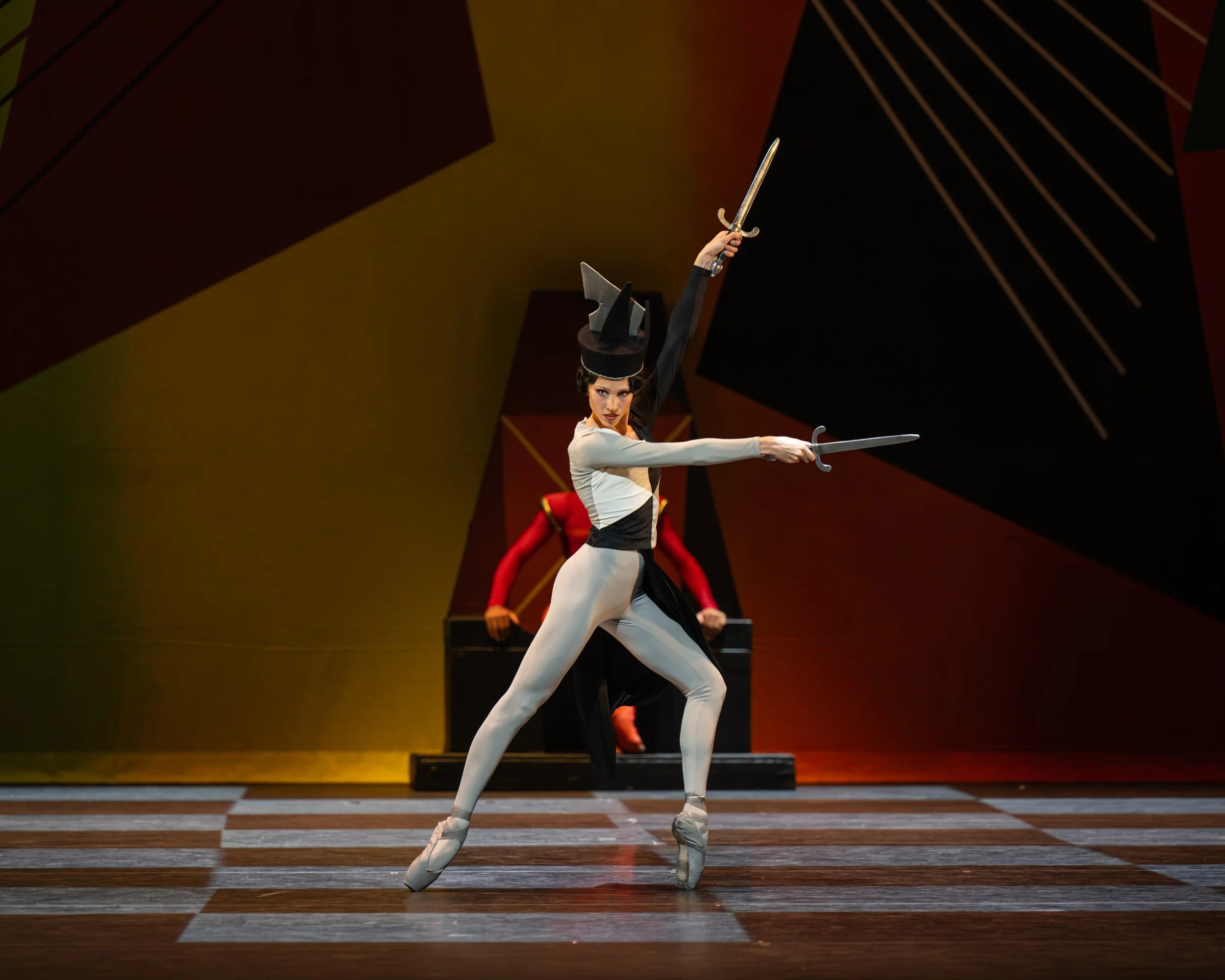
Pre-professional Year student Anna Nouvenne in Checkmate by Ninette de Valois © The Royal Ballet School. Photographed by Photography by ASH.
Another highlight was a suite of dances from de Valois 1937 ballet Checkmate with a standout performance by charismatic Wendel Vieira Teles Dos Santos as Red Knight and Anna Nouvenne as Black Queen, flanked by a very strong suit of knights and pawns. The suite made me yearn to see the complete ballet. Andrew McNicol’s neoclassical Of Strength and Grace to music by Edvard Grieg remained true to its title, showing of the admirable strength and grace of White Lodge students in years 10 and 11. Jessica Lang’s The First Tribute paid homage to Ninette de Valois by combining music by Beethoven with poems written by Ninette de Valois, read by former Royal Ballet star ballerina Darcey Bussell, Monica Mason (former ballerina and director of the Royal Ballet) and current Royal Ballet director Kevin O’Hare.
The pre-professional year of the Upper School beautifully performed Christopher Wheeldon’s Balanchinesque tutu ballet Christening Suite (outstanding: principals and soloists Sophia Koo, Millán De Benito, Martha Savin, Nanoha Shigeoka, Wendel Vieira Teles Dos Santos, Fabrizio Ulloa Cornejo), paving the way for an increasingly virtuosic Grand Défilé of all the students of the school, a finale that brought down the house.

All students of The Royal Ballet School in the Grand Defile © The Royal Ballet School. Photographed by Aimee Tregunno
The Future: A Daring Experiment

Year 10 and 11 students in Of Strength & Grace by Andrew McNicol © The Royal Ballet School. Photographed by Photography by ASH
During its centenary year, The Royal Ballet School is introducing the biggest change to its training model in a century. Until this year, year 7 was the earliest entry point to full-time ballet education at The Royal Ballet School. The Royal Ballet School’s lower school (White Lodge) for years 7-11 is a boarding school situated in Richmond Park, Greater London. Most of the students across all years board at White Lodge. Each year, there are only a few who elect to be day students if they live close enough. From September 2026, entry to the School will no longer be in year 7 of general education (age 11-12). From September 2027, this approach will be extended to Year 8. After a careful review, the School has decided that the emotional strain of moving away from home while starting full-time training at such a young age can put too much pressure on a young child, and that those who enter full-time training slightly later often display greater resilience and physical and emotional readiness. The School will try to bridge the gap that a later start of full-time training might imply by offering a new UK Scholars programme to expand on its existing Mid Associate programme.
Ninette de Valois created the Associate Programme in 1948. Today, it supplements the pre-professional, local ballet education of talented children between the ages of 8 and 18 by offering them weekend training in The Royal Ballet School’s System in nine centres across the UK in addition to their regular ballet classes. Children are selected by audition. Junior, Mid and Senior Associates attend classes every Saturday or Sunday in term time. Each session is 2 hours 15 mins, with the exception of Mid and Senior Associate classes in Leeds which are 3 hours.
Starting September 2026, the UK Scholars programme will offer additional training to exceptionally talented Mid Associates who would in the past have been considered to be at the level to join the Royal Ballet School full-time. In addition to their Mid Associate training, the UK scholars will attend camps on nine weekends throughout the year. The curriculum will include ballet training in the School’s system, creative and choreographic exploration, conditioning and development support, and performance opportunities.
This is a very bold step. The dance world will be observing the results closely, even though it will take years for advantages and disadvantages to become clear. Just for comparison, the Paris Opera Ballet School offers a six-month programme to talented children age 8-11, and full-time entry at age eleven; the School of American Ballet admits students from the age of six, the Russian schools start their professional full-time training from age ten or eleven, and the same applies to most professional ballet schools attached to professional companies on the European continent. At the same time, this model harks back several centuries to a time when serious ballet training was only available in the major cities and at schools attached to major companies. Times have changed. The Royal Ballet School might be on to something: an educational model of the past might not be the only model right for today’s world. Time will show.

Year 7, 8 and 9 students in Proceedings by Kristen McNally © The Royal Ballet School. Photographed by Photography by AS
You might also enjoy. . .
From Paris with Love: The Paris Opera Ballet School at the Palais Garnier
Zenaida Yanowsky, Coach and Former Principal Dancer, The Royal Ballet
How to Become a Cello: Royal Ballet Principal Marcelino Sambé in Cathy Marston’s “The Cellist”
Mariko Sasaki, The Royal Ballet: Getting Ready for a Swan Lake Debut