From Plantation Song to Concert Stage: The Fisk Jubilee Singers and the Birth of the Concert Spiritual
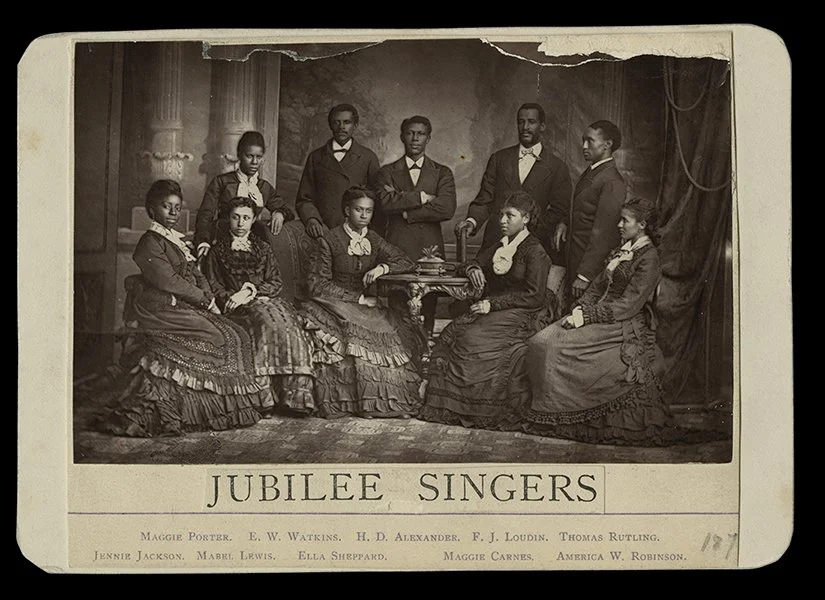
Albumen cabinet card of the Fisk Jubilee Singers in London. This photograph was commissioned by Queen Victoria who arranged for it to be sent to America as “a gift from England to Fisk." The following people are depicted: Maggie Porter, E. W. Watkins, H. D. Alexander, F. J. Loudin, Thomas Rutling, Jennie Jackson, Mabel Lewis, Ella Sheppard, Maggie Carnes, and America W. Robinson.
12 June 2026
Singer, composer, and pianist Ella Shepphard was born in 1851 to enslaved parents on a Tennessee plantation. Twenty-three years later, in 1874, she performed with the Fisk Jubilee Singers for Queen Victoria, and found the British to be astonishingly ignorant of Americans, and Black Americans in particular (although the queen testified that the FJS “sing so beautifully they must be from the Music City of the United States.") Sheppard was much more appreciative of the German Crown Prince’s reaction to their performance in Potsdam. How did this group of singers, most of which were born in slavery, come to exist, birthing the monumental genre of the Concert Spiritual and moving audiences around the world with their performance to this day?
Fisk University, founded with the abolition of slavery, was the first American institution to offer a liberal arts education to “young men and women irrespective of color.” The treasurer of the university, George L. White, had to find creative solutions for the acute financial situation the institution quickly found itself in. Luckily, he was also a professor of music. White assembled a group of nine talented students, and founded a choir to go on tour and raise money to save the establishment. The Fisk Jubilee Singers were founded - only six years after the civil war. Most of the young singers in the group had been born into slavery, and released not long before.
At first, White selected choral repertoire within the Western art music tradition. He then overheard the singers amongst themselves, singing the plantation songs they had been raised with, hearing their parents sing them as had their parents before them. These were the spirituals - songs expressing faith, work, and hardships - sung by enslaved African-Americans. The songs cultivated resilience, hope, and community, and even contained coded messages about the way to freedom. Originating from a white American family in New York, White had never encountered the rich musical tradition of the plantations before, and was deeply moved by it. He decided to create choral arrangements of the songs for the group to perform on tour.
The FJS did not have a smooth path to success. At first they struggled to earn enough to cover travel expenses and find shelter and food, and were received sceptically by audiences. White American audiences were taken aback by this group of black performers: their music was a very different concept from Blackface Minstrelsy - popular theater shows featuring white performers with faces painted black, ridiculing black characters and presenting racist stereotypes, often through satirical dance and song. This was the only format in which crowds were accustomed to seeing anything resembling a black performer singing on stage - which left the FJS with difficult prejudices to overcome.
The group’s name was established during the group’s difficult first tours. It was inspired by the book of Leviticus, stating that all slaves must be freed in “the year of the Jubilee” which occurs every fiftieth Pentecost. The name later inspired the founding of other Jubilee choirs.
Adapting this musical tradition for public concert productions was not a simple process: spirituals were deeply personal, sacred, and embodied in the context of their original use. As the early singers in the group describe, it was a gradual and sensitive process until they and their parents felt remote enough from the original context of the songs to remember them and perform them to external audiences. Today these original spirituals are considered a cultural treasure, and are arranged by various composers around the world. This would not have been possible without the Jubilee singers, who carried spiritual melodies with them from their childhoods, making them into unforgettable musical experiences for audiences in the cultural capitals of the US and Europe. The FJS still exist today, touring around the world with what has become a canonical choral genre.
Listen to the Jubilee Singers sing“Swing Low, Sweet Chariot.”