Bridging the World: The Balcony in Art and Literature
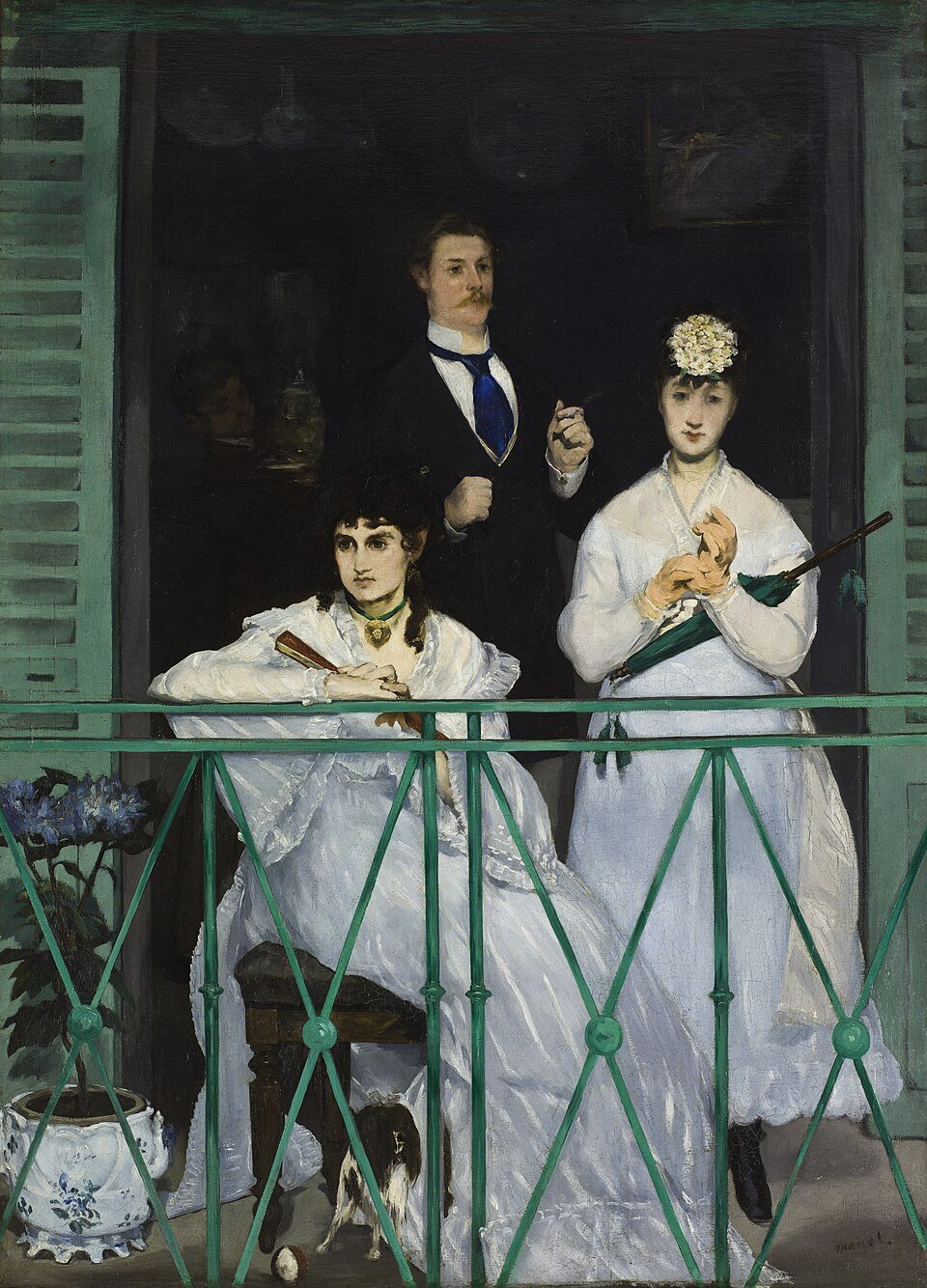
Edouard Manet, Le Balcon, 1868. Musée d’Orsay, Paris, France
12 June 2026
Newly elected Pope Leo XIV emerges onto the balcony of St. Peter's Basilica; Eva Perón gives her famous rallying address on the Casa Rosada balcony in Buenos Aires; an English royal wedding is not complete without a balcony kiss at Buckingham Palace. Throughout history, the balcony has long been a stage for power, desire and spectacle. Serving as both a culturally important fixture that inspires many writers and authors, as well as a space to launch political change due to its theatrical and stage-like nature, the liminal space that the balcony offers—somewhere between public and private life—uniquely positions the simple architectural feature as a symbolically loaded gateway.
Famously, romance flourishes on a balcony. Shakespeare’s “balcony scene” never actually mentions a balcony in the original text of Romeo and Juliet, but it's hard to imagine the star-crossed nature of the two characters without it. The architectural intervention is a physical manifestation of the obstacles that keep Romeo and Juliet apart, while also providing a pivotal location for her to think aloud. Unaware of Romeo eavesdropping below, Juliet reveals her true feelings for him. On the ground, there is a clear power dynamic at play: Juliet is elevated above Romeo: a virtuous saint on a pedestal above her worshipper. And let’s face it, there is nothing more romantic in the media than a profession of love from an ill-fated lover.
While balconies have been an architectural staple for thousands of years, the cultural phenomenon they play in late-19th century Paris is particularly noteworthy. Due to Haussmannisation, which saw Paris undergo a period of intense urbanisation that featured newly built house façades, the balcony was a novel feature of Second Empire Paris. Both part of the private, domestic setting of the home, as well as jutting out into the public realm, balconies provided a space to regard the spectacle of the city from a safe distance—exposed yet detached.
Impressionist artists like Édouard Manet and Berthe Morisot turned their eye to the figures that occupied these ambiguous spaces. Painted in 1868–1869, Manet’s The Balcony (image above) depicts four acquaintances on a green balcony; they enigmatically stare out onto the street, yet remain on the fringes of public urban life. Morisot’s renowned work, Femme et enfant au balcony, similarly centres on a Parisian balcony, with a fashionably dressed woman and a child overlooking the city. Morisot’s balcony makes a clear division between the figures and the city around them, contrasting the domestic sphere of the subjects with the unbounded domain of their wider environment.
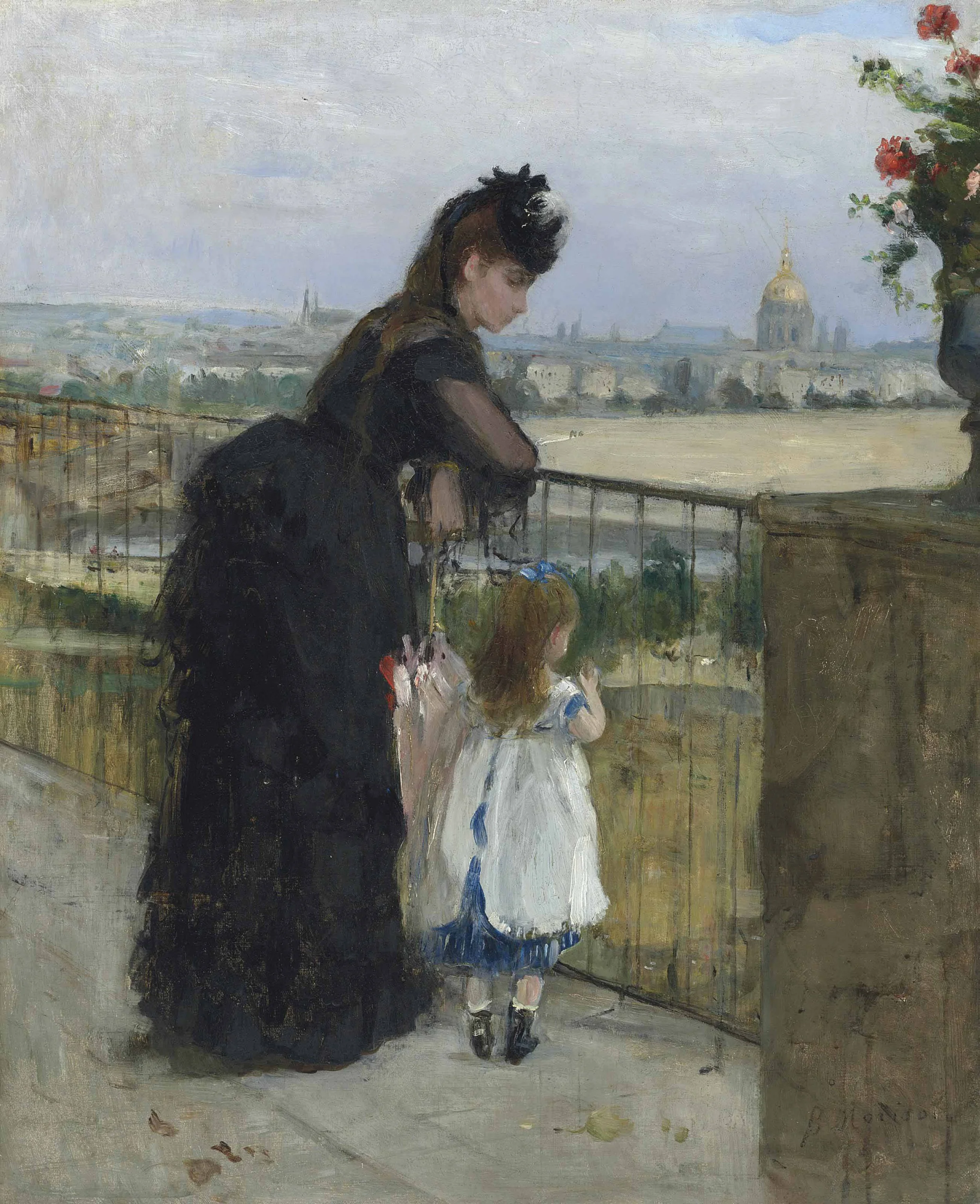
Berthe Morisot, Femme et enfant au balcon, 1872. Artizon Museum, Tokyo, Japan
The detached and inscrutable nature of Manet and Morisot’s figures as they observe from their balconies suggests the division and resultant isolation impressed upon Parisians while their city grew. As industrialisation sparked dynamic social and economic change, artists and writers sought to capture the new sense of alienation that individuals felt within the modern city. Offering a place for seeing and being seen, the balcony both practically and symbolically reflects the first modern metropolis: a city on the precipice of great change, and its inhabitants on the brink of joining in.
An emblem of romance, modernity and political power, the balcony’s ability to captivate and inspire goes far beyond its flair for a fresh breeze. In terms of cultural dignitas, we need look no further than High School Musical’s Troy Bolton climbing onto Gabriella’s balcony to serenade her with the "Start of Something New" reprise.