Channeling Gene Kelly's Wisdom: Passion and Perfectionism
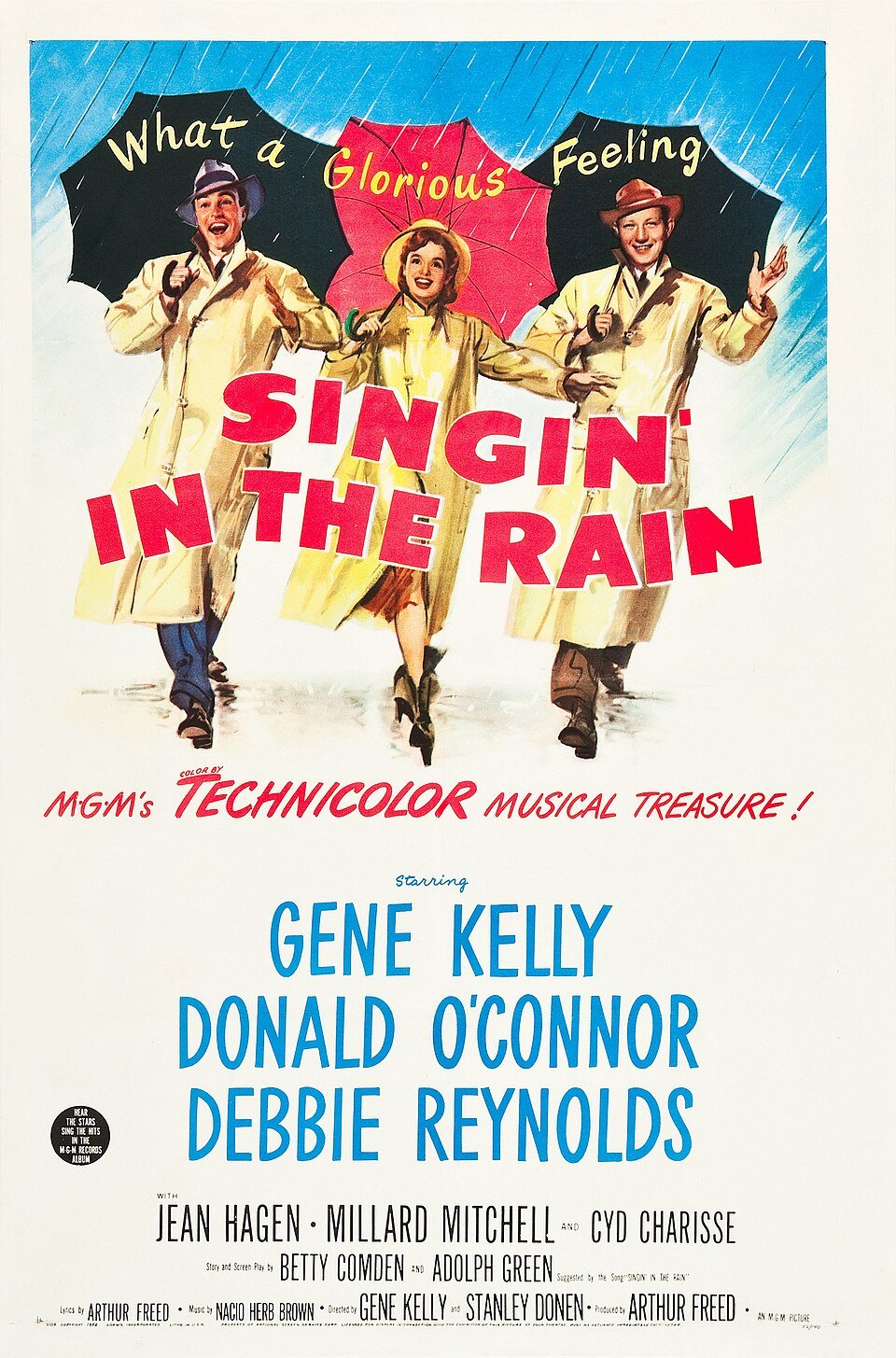
Poster for the American theatrical run of the 1952 musical film Singin' in the Rain. Wikimedia Commons
September 2026
My first memories are of movies. In my earliest recollections, I’m dwarfed by the overstuffed armchair in front of our television as dream ballets formed my tiny consciousness. Perhaps no image from this time has proved more indelible in my mind than Gene Kelly and Cyd Charisse in the “Broadway Melody” ballet from Singin’ in the Rain, swooning in vivid technicolor before a painted backdrop.
Though this is true for millions around the world, someone who notably escaped the near-ubiquity of Gene Kelly’s movies in popular culture was his third wife, Patricia Ward Kelly — when she and Kelly were first courting, she had hardly heard of him. This quickly changed, however, as she began working as his archivist during his lifetime. Since Kelly’s death in 1996, Mrs. Kelly has remained dedicated to uplifting his legacy, which she thinks is ripe for (re)discovery by young people around the world. To make her case, she’s using the native language of today's youth: the internet.
Mrs. Kelly, channeling her late husband’s wisdom, has one piece of advice for younger generations: “‘Don’t sacrifice good for the sake of excellence’ is bad advice.” Though Kelly was often criticized for his perfectionism as a dancer, director, and choreographer, he felt that striving for perfection was the bare minimum. He balked at the notion that his drive and precision should be notable, when in many professions, it’s standard-issue, “Do you go to the sloppy surgeon?,” he was fond of asking.
Mrs. Kelly, whose work has brought her into contact with an audience of young people, believes that this message is more urgent than ever. She says that those who would dismiss Gen Z and its short attention span as an unserious audience are missing the opportunity buried in the problem: “The real question is: what is causing them to tune out?” Mrs. Kelly said in an interview. “When you give them quality material, they are engaged.” Young people can be bolstered by the message that all art worth making should come from a place of seriousness and deep intention, even if the product is as seemingly simple and joyful as Gene Kelly’s movies. And his movies themselves — that quality material Mrs. Kelly refers to — are a crucial way to bridge the 75-odd years of history that separate Kelly’s world from ours.
Kelly, perhaps best known as Don Lockwood in the 1952 MGM classic, Singin’ in the Rain (which he co-directed and choreographed), began his dancing career in his hometown of Pittsburgh, Pennsylvania. From there, he dabbled in sports, studied economics, and even enrolled in law school, but dance was never far from his mind. Teaching in the family dance studio that would soon bear his name, he encouraged young boys — nervous, as he had been, about being ridiculed for enjoying the supposedly feminine art of dance — to stick with it. These two themes would come to underpin his career: a lifelong love of working with children, and a reinvention of American theatrical dance as something sporty, cool, and masculine. After appearing on Broadway in Rodgers and Hart’s Pal Joey, Kelly caught Hollywood’s attention, and in 1941, he journeyed west. Throughout the 1940s and 1950s, starring in dozens of musical films opposite stars like Judy Garland, Rita Hayworth, and Frank Sinatra, Kelly created a new kind of dance for the 20th century man, drawing on his athletic talents to add a sporty flair to his choreography. The streetwise answer to Fred Astaire’s top hat and tails, Kelly was all khaki pants and loafers — offscreen, he favored Converse sneakers. He often worked with young children, as in An American in Paris’s wonderful “I Got Rhythm” - one of the reasons, Mrs. Kelly believes, that has allowed him to remain accessible to younger audiences.
It’s Kelly’s trail-blazing reinvention of what was once called “cine-dance” that Mrs. Kelly feels is most urgent to preserve and amplify. “From the beginning of his career, he wanted to do more than just be popular, even to do more than just dance,” film historian Jeanine Basinger wrote of Kelly. “He strove to devise a cinematic language of dance which replaced dialogue and told the audience what the character felt, thought, was.” In addition to Mrs. Kelly’s efforts on a forthcoming biography of Kelly, she also organizes events like symphonic tributes and film screenings and has toured the country performing a one-woman show about her late husband’s life. Constantly, Mrs. Kelly says, people approach her after these events to express the depth of their connection to Kelly’s oeuvre. She is particularly struck by the way young people react, whether they’re seeing a movie for the first or fortieth time.
Now, Mrs. Kelly is using social media to connect with Kelly fans around the world. She runs dedicated Instagram and Facebook accounts called Gene Kelly Legacy that, combined, boast close to 80,000 followers. Her near-daily posts highlight Gene’s career, celebrate important milestones, and reveal Kelly’s unlikely friendships and collaborations with just about every major entertainment figure from the 20th century. Her latest digital venture, a project she calls “Because of Gene Kelly,” is a website featuring an interactive globe on which people can drop pins of light declaring that, even in the most out-of-the-way places, Gene Kelly’s work has changed lives. Her dream, she says, is to “see the entire world covered with lights” — his light.
Since its launch this spring, “Because of Gene Kelly” — a title borrowed from a friend of Mrs. Kelly’s, whose Centralia Ballet Academy in Washington state has encouraged young boys to dance, well, because of Gene Kelly — has 236 lights from thirty-one different countries, all people led there by Mrs. Kelly’s enthusiastic efforts to promote the project on social media. To those who would argue that Mrs. Kelly’s estimate of Gene’s reach seems a bit high, the scale of outer space is not out of the question: “Because of Gene Kelly I became the first cinematographer in space,” wrote Jannicke Mikkelsen from the remote Svalbard, Norway. “The first movie I fell in love with was Singin’ in the Rain. The dance, the songs, the cinematography. I felt my calling to follow in their footsteps. Little did I know I would be inspired to achieve the impossible. I became Norway’s first astronaut.”
When he danced, Kelly escaped the force of gravity, and he has inspired millions of others to attempt the same, each in their own unique way. Even if you don’t succeed all the time, giving yourself the opportunity to try — to care about something, and to work hard at it no matter what obstacles you face — is what life, for the Kellys, is about. Next year, Singin’ in the Rain, the crown jewel of Kelly's dozens of films, will celebrate its 75th anniversary. It remains one of the most beloved movies of all time for people of all ages, and its very plot reflects Kelly’s passion: a group of collaborators striving to make a musical film. That’s a legacy worth celebrating.