Dispatches From a 21st-Century Conservatoire
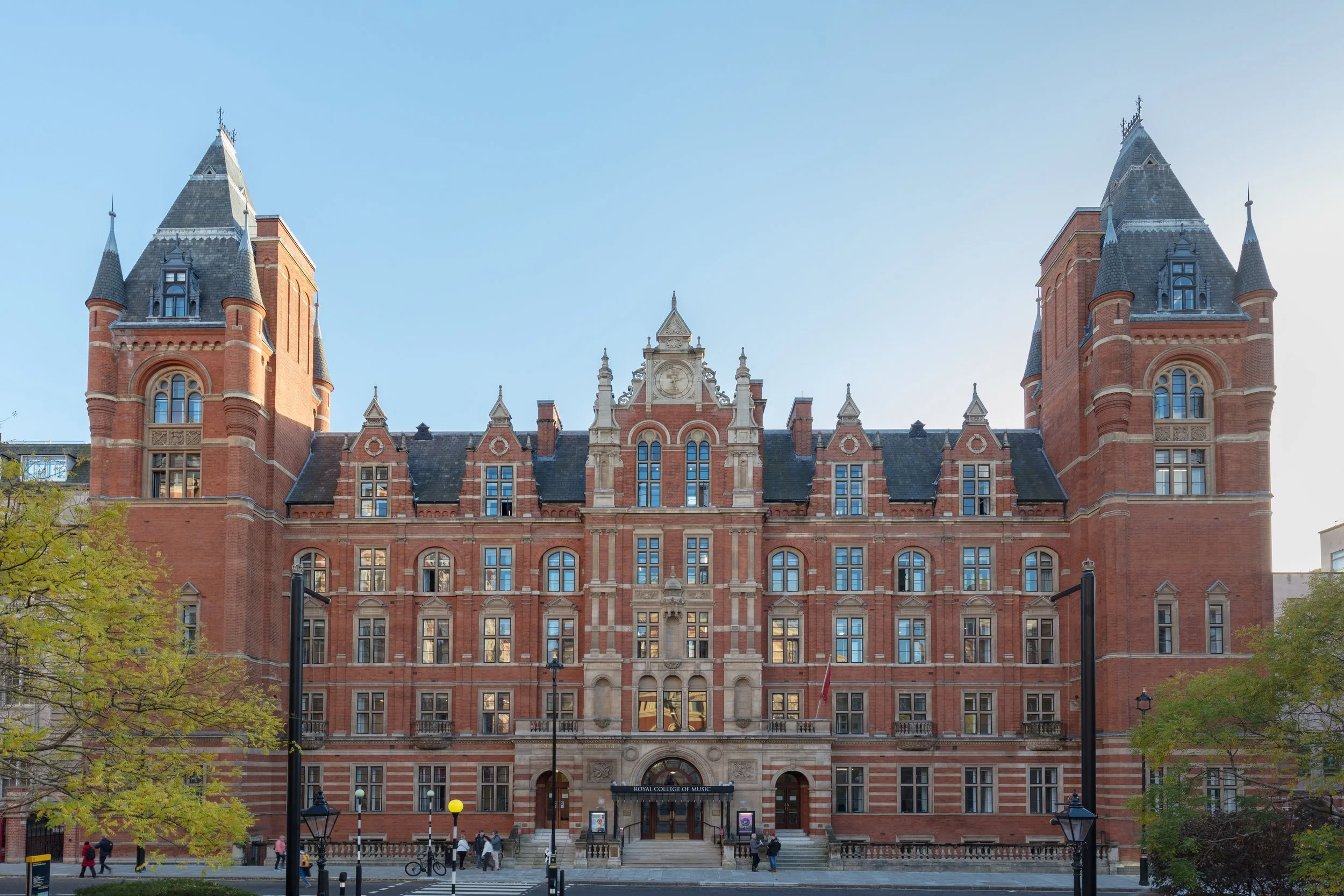
Royal College of Music, London. Photo by Diego Delso, 2022, Wikimedia Commons
September 2026
Every year, September rolls around and conservatoire students receive an ominous email containing a pack of excerpts to learn for their start-of-year audition. This is my second year without receiving one of these emails, and the back-to-school nostalgia of social media has made me want to reflect on the idea of the conservatoire—specifically that of one in the 21st century.
The conservatoire originated in 16th-century Italy, with orphanages providing trade skills, including music training. The first secular school of music was founded in France in 1784 and was created to train musicians for public concerts. This later expanded to include all branches of a classical music education and is now known as the Conservatoire National Supérieur de Musique. Throughout the 19th century, this style of institution spread across Europe and America, with multiple “conservatoires” popping up, including my old university, the Royal College of Music, founded in 1882.
While every country handles this slightly differently, in the UK you can study music at university or at a conservatoire. The university route offers a broad degree spanning performance, composition, history, analysis, and teaching, among other areas. The conservatoire route, by contrast, is heavily focused on performance (although there is ample opportunity to explore other areas of music too). Neither option is better or worse—rather, each suits different individuals.
The state of the music industry has of course changed drastically since 1882, let alone the 16th century. Gone are the days of patrons; welcome to the age of social media promotion and influencing. So how exactly have conservatoires changed to reflect these wider societal shifts? I interviewed three friends from the Royal College of Music who have chosen very different paths—from chamber music to orchestral playing to producing and administration. I asked them to assess the state of the modern-day conservatoire.
Becca Marr is a violist based in London and is currently pursuing her Master’s degree at the Royal College of Music. As a member of the Jasmine Quartet, Becca is committed to bringing contemporary classical music to unconventional spaces and making the string quartet genre fun!
When did you start playing your instrument?
I originally started on the violin when I was four. I switched to viola at twelve because they wouldn’t let me into youth orchestra as a violinist, but needed more violists.
At what point did you realize you wanted to play professionally?
I think around when I was sixteen and considering my uni options. My parents wanted me to do a dual degree so I would have a backup plan. I originally went to a normal university, but my heart really wasn’t in it, so I decided to transfer.
At what point did you decide to go to a conservatoire?
I decided to transfer a few months into my time at a standard university—maybe around October. I needed the time to do my thing, aka practice and not have other academic subjects to worry about. If I wanted to get where I needed to be to play professionally, I needed to lock in, in a way that a university could not provide.
What is the draw of a conservatoire in your eyes?
Honestly, dedicated time to practice. They know you need the time and space to get better at your instrument and they build the course around that need and provide infrastructure to do so. They also expect you to use that time to practice, rather than just hang around.
What conservatoire stereotypes are correct and which are false?
String players are a bit crazy and so are pianists (in regards to how much they practice). It is intense and there is a lot of pressure, but within that pressure there is scope to create a career you are actually excited about. For a false stereotype, I’d say not everyone wants the exact same career path. For example, not all string players are aiming for an orchestral career.
How do you think conservatoires have adapted to the 21st century?
I think it mainly shows in the individuals that work there rather than broader structural changes. The support I’ve received from individual professors has been amazing. The system is not set up to help contemporary music, but my professors have stepped in to help. It is crucial that professors don’t pressure their students into a specific career path, and across the board the ones at RCM are very encouraging of exploring individual interests.
How do you think they could do better?
Related to the answer above, the institutions themselves need to have better infrastructure for integrated contemporary music. For example, my contemporary string quartet has received major pushback from RCM. We were disqualified from an internal string quartet competition after being told we were “unjudgable” due to our repertoire being so different compared to other groups. We have also been told by members of staff that we are “too young” to specialize in contemporary repertoire. If the college supported students who are not taking the strictly Western classical path, it could open up a lot of new opportunities for both the institution and its students.
What was your favourite memory from studying at college?
I have two. The first is my first-year lessons with my viola professor because she was the first prof that really believed in me when I needed it. The second was winning that same string quartet competition a year later—it was a nice redemption arc.
Flautist Hollie Tibbotts is currently pursuing her Master’s degree at the Royal College of Music, supported by the HR Taylor Trust and the Wavendon Foundation, where she studies with Katie Bedford, Emer McDonough and Sue Thomas. She has performed with the Orchestra of the English National Opera, Westminster Opera Company and Albion Orchestra. She also enjoys performing with her flute and harp duo, Aura Duo, whose recent highlights include being selected as Kings Place Young Artists and performing together in the Elgar Room at the Royal Albert Hall.
When did you start playing your instrument?
When I was seven years old. I had heard a flute quartet playing at a Christmas concert and immediately wanted to learn.
At what point did you realize you wanted to play professionally?
Quite late actually. It was just a hobby until I was maybe around fourteen or fifteen, and even once I started learning with my RCM teacher who lived locally at the end of year eleven, I was still keeping my options open. I didn’t even take GCSE music. It was probably once I got to sixth form—which had an amazing music department—so probably around sixteen years old.
At what point did you decide to go to a conservatoire?
Around the time I realized I wanted to play professionally.
What is the draw of a conservatoire in your eyes?
The initial draw was my teacher, who I was already learning with. Also, the course is very intensive and the amount of time you get to devote to getting better at your instrument is unparalleled. I had never played in a proper orchestra with strings until I got to college, so getting to play amazing music with lots of people was very exciting to me.
What conservatoire stereotypes are correct and which are false?
It is stressful and there’s a lot of pressure. My experience of college has been great. Everyone is very friendly and passionate about what they do. Sometimes the passion combined with the intensive environment does make it feel like there is a lot of pressure. However, I would also say people are a lot more open about how much pressure we put on ourselves, and it is nice to see people being more willing to have these conversations.
How do you think conservatoires have adapted to the 21st century?
I think they are trying to program more modern and diverse music. I also think that there is greater awareness and attention towards musicians' mental and physical health, which is so important.
How do you think they could do better?
My main gripe with college is the amount of practice rooms/practice allowance—something I think many students would agree with.
What was your favourite memory from studying at college?
The friends I have made along the way. Chamber music was so much fun and we were so lucky to have a lot of exciting opportunities. The orchestral and opera projects were very fun. And of course my 1-1 lessons with my teachers—they are the reason I came in the first place.
Max Pritchard is a producer, performer and educator working across live arts, literature and community settings. His work combines clear, collaborative project coordination, artist support and community engagement to create accessible creative experiences. He also maintains an active practice as a trombonist and chamber musician.
When did you start playing your instrument?
I started playing trombone in primary school, back when I was about nine, simply because I thought it looked cool. Plus, it was loud enough to annoy my family, which definitely added to the fun.
At what point did you realize you wanted to play professionally?
I never had a single moment where I knew I wanted to play professionally. I just knew I really enjoyed making music. As I kept performing more and more, it naturally became the path I gravitated towards.
At what point did you decide to go to a conservatoire?
I decided to apply to a conservatoire during lockdown when I found myself really enjoying playing trombone and wanted to get better. Having the extra time to practice made me realise I wanted proper training and a place where I could focus on improving.
What is the draw of a conservatoire in your eyes?
For me, the draw is the intensity. You’re surrounded by people who care deeply about music and want to improve. The access to specialist teaching and performance opportunities is unmatched.
What conservatoire stereotypes are correct and which are false?
Conservatoires can feel intense, and everyone is focused on improving. But the idea that they are all hyper-competitive or full of intimidating music prodigies isn’t true. Most people are just normal students who work hard, support each other, and occasionally panic over exams like everyone else.
How do you think conservatoires have adapted to the 21st century?
They have adapted by broadening their training beyond traditional performance, offering modules in education, community work, digital skills, and portfolio careers. There’s a much stronger focus on versatility now.
How do you think they could do better?
Conservatoires need to teach students balance, not just music intensity otherwise it’s easy to get stuck in a music-only bubble. Giving students access to wider activities, like societies and sports, would help them become better musicians and people.
What was your favourite memory from studying at college?
My favourite memory from college was being part of a trombone choir. Learning the music together, figuring out things as a group, and sharing all the excitement and stress made those rehearsals and performances some of the best moments in my time there. I don’t get to play in trombone choirs very often now, so looking back, I appreciate those moments even more.
These three interviews reveal plenty of overlap, but also plenty of differing opinions. Everyone agrees that the stereotype of a competitive environment is false (this was also my experience), but beyond that there is little consensus. To one person, the conservatoire might offer a perfect schedule with ample time to practise, while another might find it simply isn't enough. One might think a 21st-century conservatoire means one that embraces contemporary music, while another thinks it means a genuine embrace of work-life balance.
This can be boiled down to the fact that a conservatoire is a single institution asked to meet the needs of thousands of students. Every musician will have a different career, whether that involves pivoting into another field, teaching, performing—or some combination of all three, as seen in portfolio careers. To ask it to tailor its model to fit every one of these paths would be an impossible task. What it can do, instead, is encourage individuality and curiosity in these regards and others. My experience at the RCM definitely showed it’s possible. I was interested in musicology, and by my fourth year, half of my degree was made up of music history modules.
And while the conservatoire can, of course, do some of the heavy lifting, it is also on the student to embrace curiosity and opportunities. On my first day at RCM, I was told during a woodwind faculty meeting that RCM is really what you make of it: if you are keen and embrace opportunities, they will come back to you tenfold. Let this be a sentiment for us all to welcome into our own lives.
You might also enjoy. . .
Noa Kageyama, Performance Psychologist (The Juilliard School): Making Performers Bulletproof
The Royal Ballet School at 100 Years - The Past, The Summer Performance and the Future
Spencer Rubin, Oboe Student, The Juilliard School: On Oboe Reeds, Juilliard and Favourite Oboe Concertos (June 2024)