Letter from New York: Merry Christmas from the Queen of the Night
Photos by Olivia Merola
23 December 2025
Dear Reader,
It’s winter in the city now, just weeks away from the holidays, and the air is stirring with that familiar holiday expectancy. Christmas tree stands have arrived, and lined a few lucky streets of Midtown, Manhattan. I walked through some of them, and took a crisp inhale of fir, my nose red from the cold, my scarf whipping against my long wool coat. One tree seller looked up from stacking the balsams in the corner. “It’s a cold one.” My breath fogged the air. “Certainly is.”
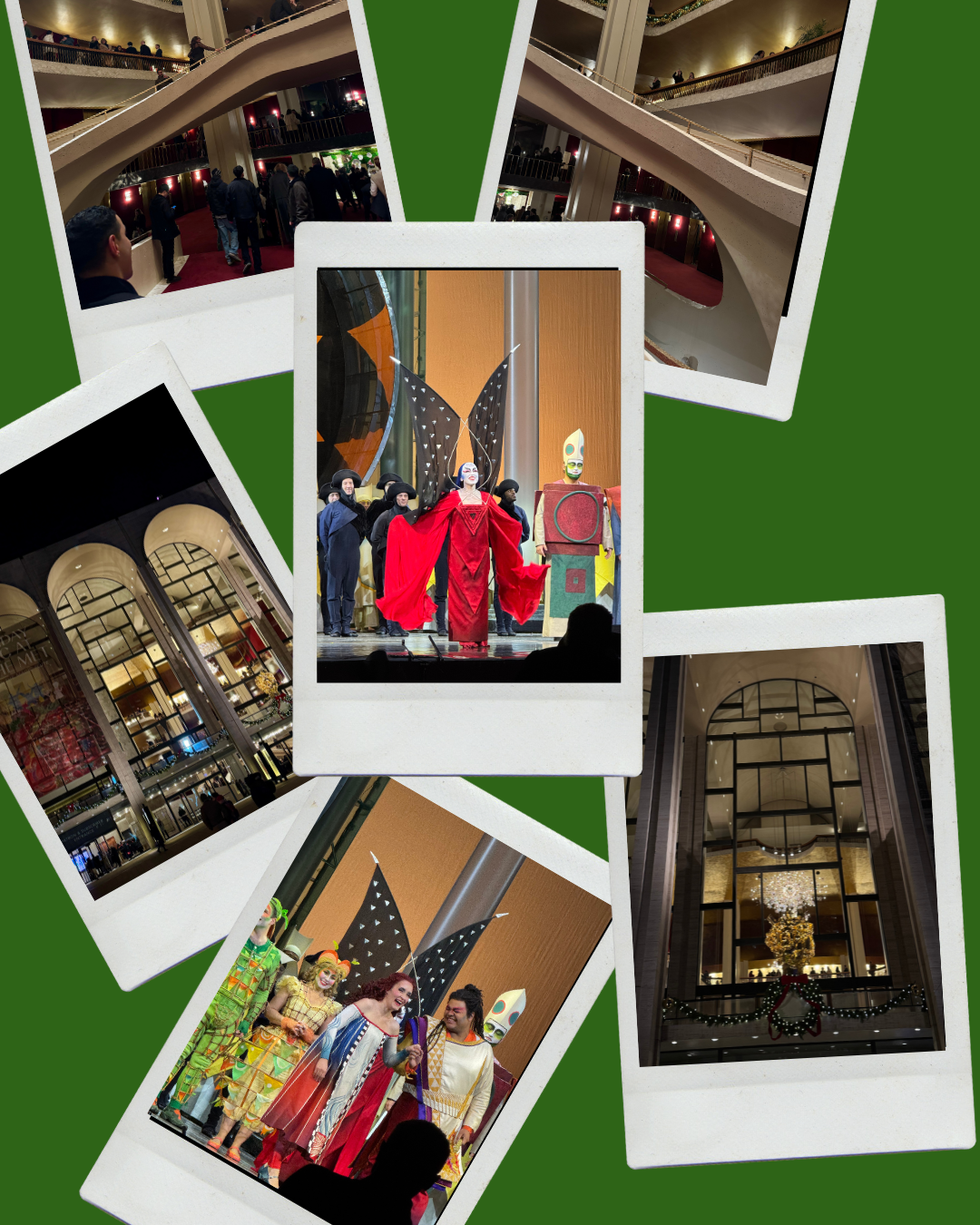
Just a few more blocks uptown, and the strong noble archways on West 63rd Street welcomed me like a sanctuary of warmth. Crowds flocked through the lobby doors, all bundled and cheery, as if entering mass on Christmas Eve. I arrived only minutes before curtain call, the warning bells ringing clear through the red velvet mezzanine as I rushed to my seat. Instead of a sermon, I was there to see Mozart’s The Magic Flute, now something of a holiday tradition at the Metropolitan Opera House. This abridged version, sung in English rather than its original German, runs just ninety minutes, welcoming younger audiences, and anyone who might hesitate to make an opera-length commitment on any other night.
The lights dimmed and the young boy in front of me, maybe six or so, squirmed in his chair before hushing in awe of the storybook-like quality of Julie Taymor’s fantastical set, complete with enchanting puppetry and colorful costumes. After about forty minutes, the childlike wonder abruptly shifts, as the Queen of the Night commands the stage. Her wrath feels curiously familiar, like the sharp scolding of a second mother. Her tone is powerful, her famous arias sliced cleanly through the theater.
Like the winter moon, she sings in opposition to Sarastro, the sunny, wise, high priest representing reason, wisdom, and order. Aigul Khismatullina stepped into the role tonight, adorned with fabrics flowing from her head, a long blue wig trailing behind her as if she had arrived from some distant planet. It’s always a treat to get to see this aria performed live.
And then, of course, there is Papageno. He’s one of those warm, goofy characters that instantly remind you of a family friend everyone has grown up with. I’ve always admired his well-meaning ridiculousness, his longing for a simpler life in a world dominated with virtue, morality, and noble quests. His duet with Papagena, “Pa-pa-pa, Pa-pa-pa” is charming and innocent, and even slinks its way into Miloš Forman’s Amadeus, a film that I recommend to all Mozart lovers.
I always found it interesting how Mozart and his librettist, Emanuel Schikaneder, chose to resolve the opera. We never do see the fury of the Queen of the Night surface, nor is there a clash between the moon and the sun. Instead, the stage closes, illuminated and grand, the entire ensemble standing wholly with Sarastro, singing his praise and all that is good. I wanted the Queen of the Night to have her chance. Something felt incomplete as I walked out of the theatre; it always does after this opera. But when I stepped out of those theater doors and into the ice of the midnight air on the Lincoln Center Plaza, I thought of her.
Maybe she did get her chance. Maybe this winter belongs to her.
Welcoming Winter,
Olivia