Ode to Manipulation
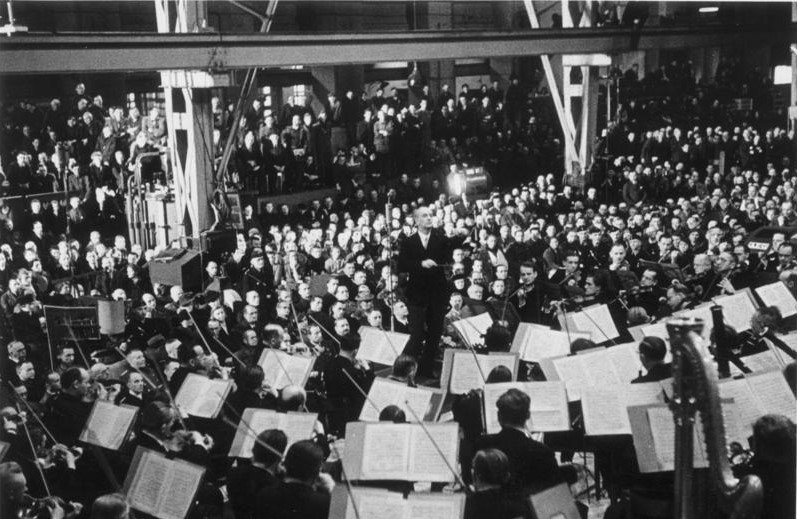
Wilhelm Furtwängler conducts the Berlin Philharmonic during a work break at the electricity company AEG, Berlin, February 1942. In Nazi Germany, such concerts were organised by the organisation “Kraft durch Freude,” “Strength Through Joy,” a part of the national labour organisation at the time.
9 January 2026
Beethoven's music is perhaps the most revered in history. His symphonies particularly are as well-liked as they are overplayed – the words "profound" and "moving" pour out of discussions of these works. Indeed, even the likes of Hitler and Stalin thoroughly enjoyed Beethoven’s symphonies, or at least used them in their political careers. Famously, Beethoven’s 9th was played in celebration of Hitler’s birthday. Alex, in Stanley Kubrick’s film adaptation of A Clockwork Orange, is similarly a great fan of this piece – his most violent crimes are soundtracked by the symphonies of Beethoven. Why is it that the symphonies of Beethoven, often considered the pinnacle of musical achievement, have been used by some of the most despicable characters of history and fiction? Well, I suspect it has much to do with this feeling of being moved.
The feeling of being moved is incredibly powerful – it is profound. But, I ask, can you describe the feeling of the profound? I would suspect not – for as emotionally rich as the profound experience is, it is curiously empty. It is almost definitionally indescribable. In fact, maybe this is the perfect definition:
The Profound: the experience of an ineffable emotion, an emotion that is too great to be expressed in words.
The experience of the profound – being moved – is, in a sense, pure experience, and in this way can be mapped onto anything. The profound can reflect the greatest ecstasy, the deepest pain, the most barbaric perversion, the most incomprehensible virtue, or any combination of these things. It is for this emptiness that we must be cautious of the profound – the profound can be a Trojan horse for ideology. The real problem with the profound is that it feels full and meaningful, but it is without foundation. What, specifically, in a Beethoven symphony moves you? Perhaps there is a concrete answer, but it seems to be that it just does. The feeling of being moved is a blank slate, but a powerful one that can be directed almost anywhere. When Hitler played Beethoven’s 9th to celebrate his birthday, he gave foundation to the profound feeling evoked by the symphony: it became about the glory of the Third Reich and the German people. The same was true of Stalin’s propagandic use of Beethoven’s music. The same is true for the EU, Beethoven’s 9th being the (inter?)national anthem.
The 9th symphony obviously cannot be about the glory of two diametrically opposed totalitarian states and a liberal institution. What this tells us is that the feeling of being moved is ripe for co-option and perversion. We can see this in A Clockwork Orange: that Alex rapes and murders to the soundtrack of Beethoven’s symphonies is a deeply ironic corruption of the “pure and the beautiful.” The music, in Alex’s mind, reflects the “triumphs” of his exploits.
The problem is this: music is (with many exceptions) non-referential. Or at least, it does not explicitly refer to something concrete. So, depending on its context, it can accumulate a number of different meanings. These can be crafted to direct our emotional reaction to music in any number of directions. Suffice it to say, music is moving but cannot tell us how to be moved. We, therefore, have to be cautious of being moved in directions we do not want to go.
You might also enjoy. . .