14 November 2026
Dear Reader,
It was a foggy and cold November afternoon, the kind of day on which the sun disappears around 16:00. On such days, one has to take precautions to escape the impending winter blues. Everyone has a different way of dodging them, starting a new knitting project or rewatching old movies, for example, and for some it means spending more time in art galleries.
My mom and I are the latter, so on said gloomy afternoon we made our way to the Neue Nationalgalerie. We were on a specific mission: to see the Cattelan exhibition “NIGHTS.” Everyone around us kept mentioning it: “Have you seen the hanging horse?” “Have you seen the pigeons?” So naturally, we had to find out what all the fuss was about.
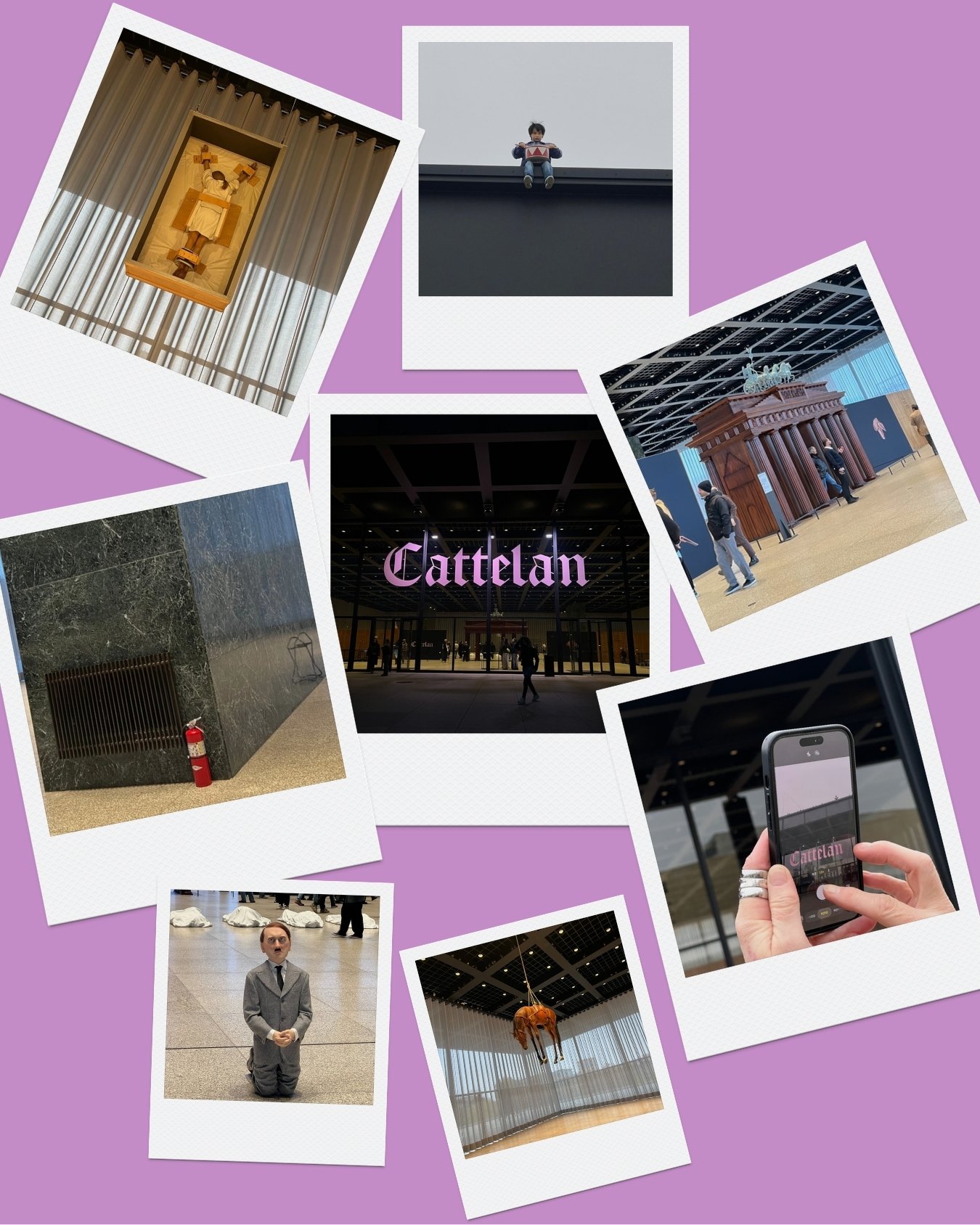
Walking up the stairs to enter the museum, my mom stopped me and pointed to the roof of the gallery: “Look! It’s Oscar!” I look up and see the first piece of the exhibition. A little boy with a drum on his lap sits high up on the roof of the museum, dangling his feet. If you’re in a rush (like I was because I was freezing), you might walk past him and not even notice Oskar Matzerath, the main character from Günter Grass’s 1959 novel The Tin Drum. The boy born with an adult brain who decides to stop growing at age three while witnessing the rise of Nazism is playing his drums as a sign of resistance.
We made our way into the warm gallery. After getting our tickets and putting our ten layers of winter clothes away, we headed for the Brandenburger Tor. Yes, the Brandenburger Tor. The “NIGHTS” exhibition is located on the ground floor of the gallery and welcomes its visitors through a scaled-down Brandenburger Tor. “PURGATORY” is one of the new pieces created specifically for this exhibition. After stepping through the Brandenburger Tor, I was overwhelmed by the amount of people walking through the Mies van Rohe’s glass pavilion; we were not the only ones who had the idea of spending the afternoon in the museum. I did not know where to start. On the left, I saw the horse hanging from the ceiling, when I looked up I saw the thousand pigeons watching over us, then right in front of me were nine life-sized marble figures. My mom and I stood in front of the marble figures, stunned by the amount of people and possible routes through the exhibition.
We decided to take the program as our guide. We read the context of the pieces while standing in front of them. This worked quite well for us because we had something to hold on to so we would not get lost again, but we were still overwhelmed by the range of topics. There were pieces reflecting National Socialism like the boy playing the drums, pieces connected to death, to Italian art and the importance of craftsmanship, pieces connected to imperial power and to religion. Plus every piece was discussed in multiple contexts in the program brochure as well. For me, there was something off about the exhibition and while we were there we couldn’t really articulate what it was.
The pieces themselves are amazing and after reading the process behind the curation of the exhibition, everything seemed to make perfect sense. But let us take a closer look at the two main pieces of the exhibition: "HIM" and "DAWN." "HIM" is one of Cattelan's signature works. The sculpture was usually positioned in a way where visitors had to approach the artwork from behind, so for example in the corner of a room or in front of a gate. When walking towards it, the figure seems to depict a kneeling child. But after walking around it, one realizes that the sculpture is Adolf Hitler. By portraying the supreme symbol of evil as a helpless child, Cattelan pushes us to think about him as a human being, and by extension about the moral and ethical dimensions of being human. In the "NIGHTS" exhibition, "HIM" is shown quite differently. Not isolated in the corner of a room to arouse the visitors curiosity but in conversation with "DAWN," a sculpture of a young woman, which is hanging from the ceiling. I did not quite hear their conversation while I was standing in front of the two pieces, to me they seemed to be separate parts of the exhibition. But according to the program, the two sculptures together are supposed to create a church-like structure within the space.
"DAWN," the female figure, is displayed in the crate in which it was transported to the gallery. The art piece was first shown in the Kunsthaus Bregenz in 2008, where it was the last piece of the exhibition. The visitor's last stop was at the bottom of a staircase looking up at a door. On this doorframe, Cattelan installed the woman facing the visitors, using the motif of the crucifixion while at the same time referencing a photograph by Francesca Woodman. In Woodman’s 1977 self-portrait, her head is tilted to the side in the same way, and her body appears to float in the doorframe. In order for the work to have the impact Cattelan intended the rails of the stairs were removed. The piece and the space in which it was presented are tied together in a way where they work with each other.
I think this is what I was missing from the Cattelan exhibition in the Neue Nationalgalerie. It felt like the Mies van Rohe’s glass pavilion was not doing the pieces justice and vice versa, it felt like the room and the pieces being presented in it were out of sync and competing against each other rather than working together in creating a specific meaning, a specific feeling (like the shock of realizing that the kneeling figure is not a portrayal of a child but of Adolf Hitler). But maybe art is supposed to do exactly this: to make us think and reflect? I definitely grappled with this exhibition for a while. So simply because of this, I believe it is worth seeing, to think about the pieces and their history, the different contexts that they can be discussed within and how spaces and art interact with each other, either highlighting their messages or confusing the viewer a tiny bit.