Why Do Basquiats Sell for Millions?
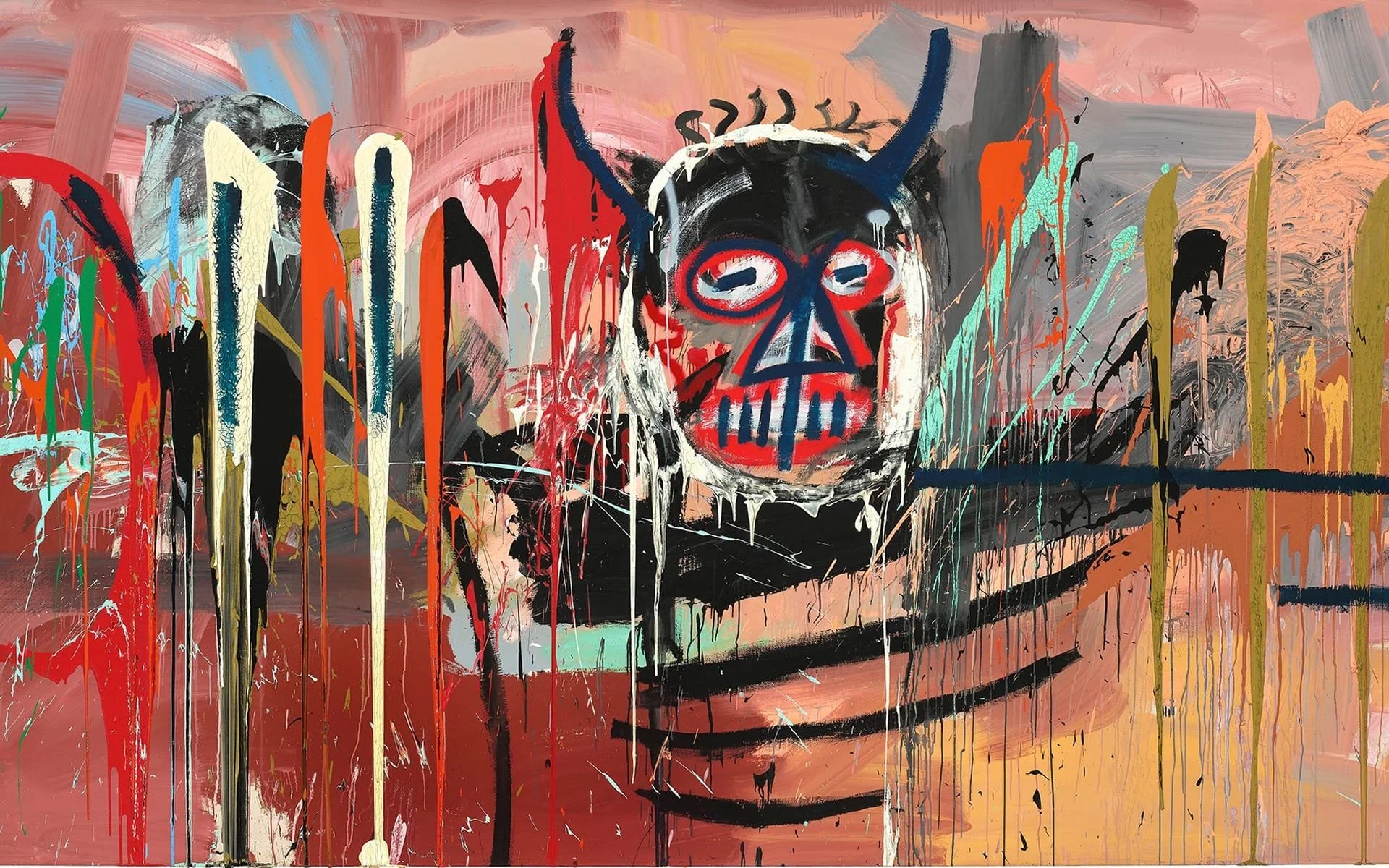
Jean-Michel Basquiat, Untitled, 1982. PHILLIPS
Everyone has heard of Jean-Michel Basquiat (1960-1988), the American painter who conquered NYC’s art world in the 1980s, collaborated with Warhol, had a tumultuous fling with Madonna, and passed away from a heroin overdose. And yet, his work remains misunderstood. Commonly associated with the Neo-Expressionist movement, his practice began with graffiti under the “SAMO” tag, through which he merged text and image to render enigmatic epigrams all over Lower Manhattan. His later work, which made its way into exhibitions as soon as 1981, took shape on canvas, drawing on his Caribbean heritage to explore dichotomies like wealth versus poverty and inner versus outer experience.
Not that I knew any of this when I first saw a Basquiat. In fact, standing before Dos Cabezas (1983), I thought it was messy, sloppy and unimpressive. That's not art, is it? By the time I saw Undiscovered Genius of the Mississippi Delta (1983) at Kunsthaus Zürich seven years and an art history degree later, my initial impressions had softened, but I still thought it paled in comparison to the canonical masterpieces hanging downstairs. Perhaps because it lacked the formal characteristics I’d come to expect: a “proper” composition, a clear narrative, an expression of draughtsmanship. (Little did I know it was consciously pushing past the canon to broach new directions in the trajectory of art.)
But that's not what interested me most. Instead, I found myself compelled by the prices Basquiats were commanding at auction – typically in the millions. Why would such seemingly messy works drive demand, and why were museums and collectors so keen to splurge on them? In the face of established canonical works that sold for hundreds of thousands, say smaller Picassos or portraits by Alessandro Allori, what made them so inherently valuable?
I cannot pretend to have a firm answer, but there is one hypothesis: the art market runs on hype, novelty, and, often, absurdity. When an artwork scores on all three, it becomes reflected in its price.
Move past Basquiat for a moment and consider Maurizio Cattelan’s The Comedian – a fresh banana duct-taped to a wall 1.6 meters above the floor. It was first presented at Art Basel Miami Beach in 2019, where the art gallery Perrotin offered three editions for $120,000–150,000 each. The artist had previously described it as a “sincere commentary and a reflection on what we value,” no doubt in critique of the art market and its financial mechanisms. And yet the piece fell prey to those same mechanisms: in November 2024, it sold for $6,240,000, moments before new owner Justin Sun proceeded to peel and eat the banana in public. When it comes to absurdity, that surely outranks the (wrongly) perceived messiness of Basquiat's work.
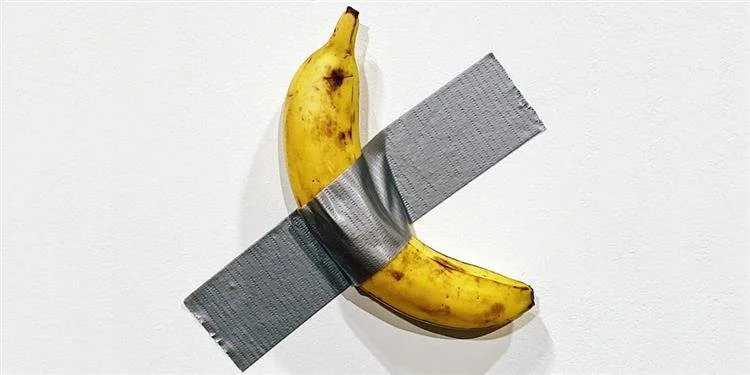
Maurizio Cattelan, Comedian, 2019.
Yet, conceptual artwork holds profound value – not just monetary, but artistic – rooted in the idea that materialises into a physical piece. At its core, that’s the very principle that guided Renaissance art: the notion of disegno, the mental spark that, through the hand, materialises into the world. And, sure, it may not result in flawless drawings but it still successfully translates an artist’s innovative, creative vision into a tangible, visible whole.
But to return to Basquiat: the value of his work, I believe, lies in the novelty and complexity of its visual language. What I once dismissed as mere scribbles is actually a unique vocabulary of anatomical studies, crowns, skulls and fragmented references to jazz and Black history, collated to interrogate race, identity and power. These references draw on diverse sources, from Leonardo da Vinci to downtown street culture, while challenging the boundaries between abstraction and figuration, high art and graffiti, questioning the established canon, and forcing a reconsideration of what constitutes a masterpiece.
Auction prices, in that case, seem a lot more reasonable. Basquiat's auction record remains the $110.5 million paid for Untitled (1982) in 2017, though other sales don't lag far behind: in 2024, Untitled (ELMAR) (1982) fetched $46.5 million at Phillips New York, while in 2025, Baby Boom (1982) achieved $23.4 million at Christie’s and Crowns (Peso Neto) (1981) sold for $48.3 million at Sotheby’s.
Of course, beyond his conceptual genius, other factors have helped cement Basquiat’s market value. Institutional engagement and critical reception are among them: sustained attention from museums, critics and scholars has affirmed the depth and art-historical significance of his work, while major retrospectives at the Whitney Museum in 1992, the Brooklyn Museum in 2005 and the Fondation Louis Vuitton in 2018, among others, have lent his oeuvre legitimacy beyond the auction room. Then there is the death effect: his untimely death at twenty-seven left behind a finite body of work and a legacy frozen in time, with no possibility of future scandals or missteps to tarnish his reputation, thus bolstering his prices.
This may not offer a concrete, mathematical explanation for why Basquiat’s work sells for millions, but it does shed light on how his prices are formed, and why private and public collections are willing to pay them. More importantly, it reveals an underlying pattern: the market has a weakness for artists whose work is unusual, distinctive, iconic and, preferably, highly publicised. Basquiat ticks all these boxes. For all the apparent messiness of his paintings, their ideas are complex, their technique is revolutionary, and their visual language is unmistakable. You know when you’re looking at a Basquiat. And in a market where recognisability, rarity, and reputation converge, that, in itself, is worth millions.
