From Berlin with Love: “Nureyev” - The Price of Freedom
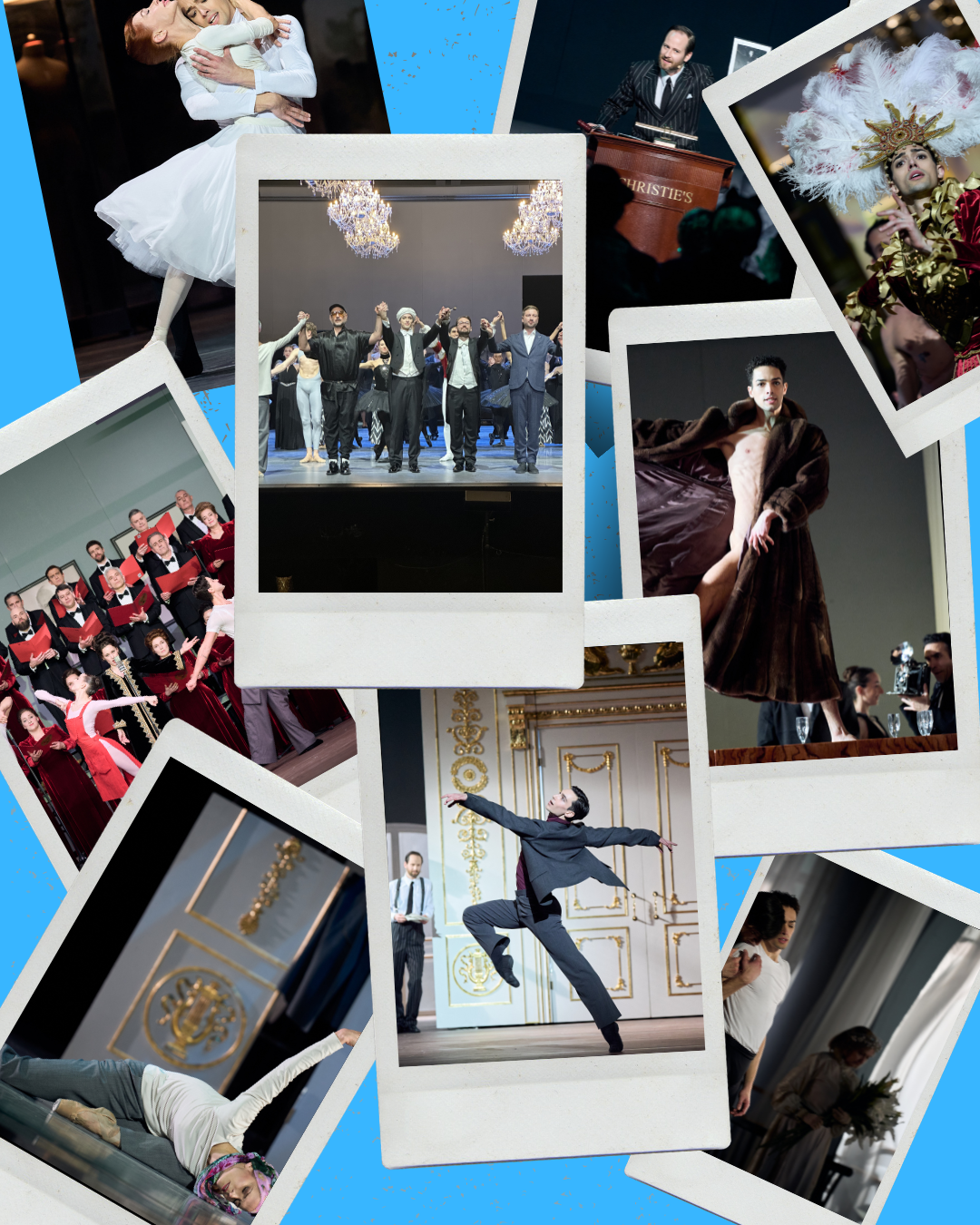
Production photos by Carlos Quezada. Curtain call photo by Christina Ezrahi
30 March 2026
Dear Reader,
The inevitable finally happened. I went to the wrong opera house. Why are there so many opera houses in Berlin?
The answer is historical. After World War II, the world was divided into two blocs controlled by two superpowers. The United States of America led a free Western bloc of democratic market economies; the Soviet Union led an Eastern bloc of Communist dictatorships with planned economies. The dividing line ran right through Berlin: West Berlin was a free, democratic island surrounded by communist Eastern Germany; East Berlin was the capital of the communist German Democratic Republic. In the shadow of the Berlin Wall, Berliners on each side of the divide frequented concert halls, opera houses and museums. Germany was reunified thirty-five years ago, but Berlin still has several opera houses. The Staatsballett Berlin is a fusion of three ballet companies and continues to perform at three venues: at the Deutsche Oper, the Staatsoper Unter den Linden and the Komische Oper. Usually, before setting out to attend a ballet performance, I triple check which opera house I am supposed to go to. This time, I didn’t, because I had been certain that the performance would be taking place at the Staatsoper Unter den Linden. I was wrong. Panic ensued.
We jumped into a taxi; I broke into a violent monoluge of self-accusations: how could I have made this mistake? After a few minutes, the taxi driver gently asked in a slightly scared voice: “May I ask when the performance is supposed to start?” “Ten minutes ago!” Silence followed – and driving skills that would have made James Bond proud, transporting us from the former East to the former West. Fifteen minutes after the scheduled start of the performance, we pulled up in front of the correct theatre, the Deutsche Oper. Bracing myself for the ushers’ refusal to admit latecomers, I met with relaxed smiles: “Oh, this happens all the time! People constantly confuse the opera houses. We will take you up to a box for latecomers in the fourth circle.” A friendly usher waved us into an elevator, handed us over to the usher of the latecomers’ box, and I sat down with a sigh of relief.
That night’s premiere had special significance for me: the ballet Nureyev had premiered against all odds at Moscow’s Bolshoi Theatre in 2017. At the time, Russian President Vladimir Putin’s authoritarian regime was already promoting values that combined nationalist, xenophobic and anti-liberal ideas with a dangerous nostalgia for Russia’s Soviet past. For Russians subscribing to these ideas, the name Rudolf Nureyev did not evoke happy associations: in the late 1950s, Nureyev had been one of the most exciting young talents of Leningrad’s Kirov Ballet, but the willful, charistmatic young man had attracted the attention of the secret police watchmen accompanying the Kirov on its first tour to Paris in 1961. Nureyev had broken all the rules imposed on the dancers lest they succumb to the temptations of the capitalist West: insatiably curious, Nureyev had met and befriended French dancers and explored the city’s “decadent Western life” on his own. The loose cannon was ordered back to Russia; Nureyev envisioned his future life at a small theatre in the Soviet provinces, forbidden to ever travel again, and defected to the West.
The rest is history: Nureyev became an international superstar well beyond ballet circles. He was also gay. The Bolshoi’s General Director Vladimir Urin therefore took a conscious gamble when he commissioned the ballet Nureyev: the “promotion” of LGBTQ identity to minors became illegal in Russia in 2013. The path from the planning board to the stage was not a smooth ride. The Moscow premiere scheduled for July 2017 was abruptly cancelled on the pretext that the corps de ballet “wasn’t ready,” but the production team believed that it was because of concerns that the ballet contained “gay propaganda.”
When the hotly anticipated ballet finally premiered in Moscow in December 2017, one of the key members of the production team, the politically outspoken, openly gay director Kirill Serebrennikov, had already spent several months under house arrest. The remainder of the production team received its opening night ovation wearing t-shirts with the slogan “Free the director.” The ballet ran to huge acclaim in Moscow, but was removed from the Bolshoi’s repertoire after new laws banned all public expression of LGBTQ identity in 2023, declaring the international LGBTQ movement an “extremist organisation.”
Fast forward to Berlin, March 2026. This is the first time that Nureyev is shown outside of Moscow. Serebrennikov has been living in exile in Berlin since 2022. Together with him, choreographer Yuri Possokhov and composer Ilya Demutsky have created a truly touching, original Gesamtkunswerk that weaves together dance, music,song and the spoken word. The team uses a clever narrative device to tackle the complex task of telling Nureyev’s story on stage. Nureyev not only pushed the boundaries of classical dance, he also translated his artistic success into significant wealth: In 1995, the auction house Christie’s auctioned off almost one-thousand items that had belonged to Nureyev at two auctions in New York and London.
In the ballet, the story of Nureyev’s life is told through the objects that are auctioned off. The auctioneer, played brilliantly by actor Odin Lund Biron, introduces each object and joins or comments on the action of the different scenes. In one scene, he reads out sections from letters written to Nureyev by two of his dance partners, fellow defector Natalya Makarova, and Alla Osipenko, who remained in Russia. In a different scene, Lund recites quotes by Charles Jude and Laurent Hilaire, two French protegées who became starts of the Paris Opera Ballet under Nureyev’s mentorship while he directed the company. The writers of the letters are embodied by two abstracted figures, “The Diva,” danced by Polina Semionova, and “The Student,” danced by Anthony Tette in two of the most touching scenes of the evening.
And there are many touching scenes. David Soares rose to the challenge of inhabiting the part of Nureyev. Soares had danced with the Bolshoi before joining Staatsballett Berlin after Russia’s invasion of Ukraine, and had therefore participated in the original prodution at the Bolshoi. A dancer of beautiful lines who can seem a bit reticent, Soares brilliantly pushed his own artistic boundaries with the unusual acting requirements of this production. In an emotional kaleidoscope, he moved from the young dancer driven to take a life-changing decision at the spur of a moment, to the pop icon of exhibitionist and risky sexuality, to the choleric and difficult professional and the dying artist marked by AIDS in a closing scene that brought audible tears to many members of the audience. With a visibly moved Soares at the centre, the production team and the ensemble brought down the house during the standing ovation that followed.
The Berlin premiere could not have been more timely. Nureyev is ultimately about freedom, and the price people might be willing to pay for it. In a pre-performance talk, composer Ilya Demutsky recounted how the production team wanted to bring something of themselves to the ballet. Right before the moment of Nureyev’s defection in the ballet, an overly enthusiasitc Komsomol (communist youth movement) corps de ballet dances to a patriotic song written by composer and librettist that includes the line: “Nobody chooses their motherland. . . “ Under any dictatorship, there is an inherent tension between the crimes of the regime and individual cultural belonging. For every political exile, the taste of freedom is made bitter by a profound sense of cultural dislocation.
In the final scene of the ballet, Demutsky subtly incorporates the sounds of a Tartar lullaby into Ludwig Minkus’s “Kingdom of Shades” from the ballet La Bayadère. Nureyev brought La Bayadère to the West and chose it as his final production for the Paris Opera Ballet. As the fusion of the music implies, until his final breath, the small Tartar boy born on the Transiberian railway always remained a part of Nureyev, the ballet icon who gave up his home and family in the name of freedom. Nobody chooses their motherland, and yet, even during the darkest hours of political repression, ordinary people hold on to the nostalgic sounds, memories and tastes of childhood, finding moments of belonging and comfort amidst the changing quick-sands of politics and ideology.
May all the good people living through challenging times in various corners of the globe see brighter days soon.
Happy Passover and Happy Easter.
From Berlin with Love
You might also enjoy. . .