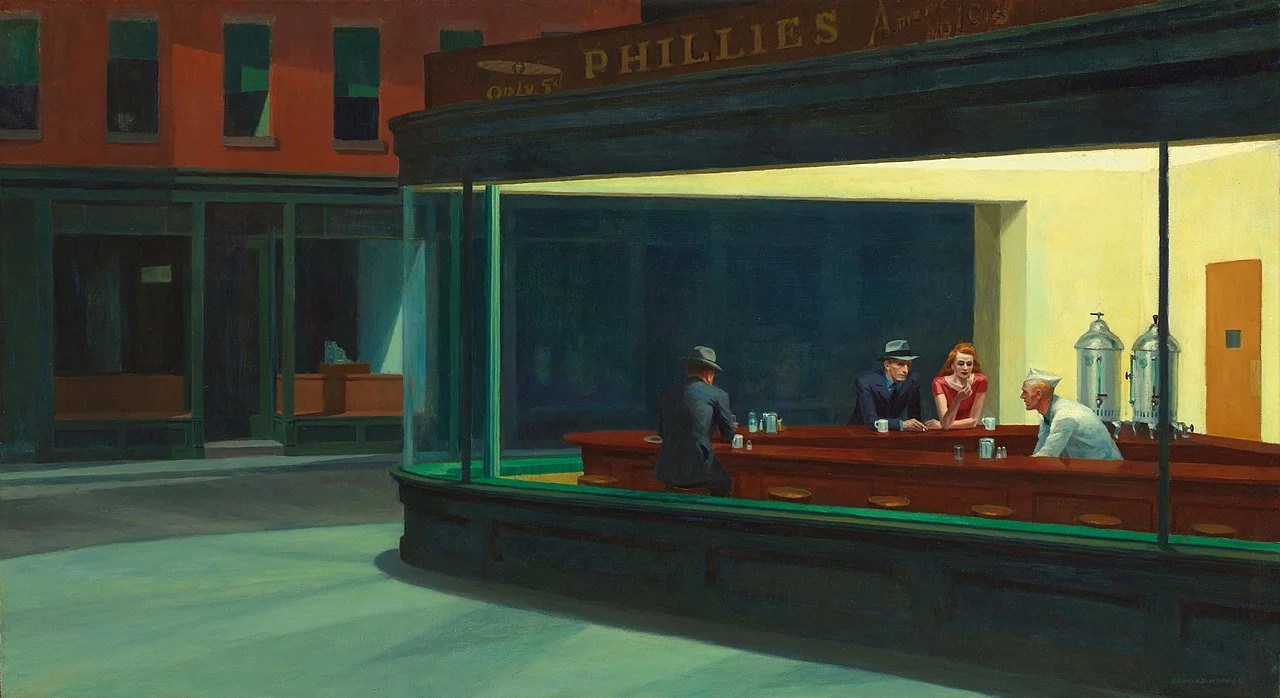
Edward Hopper, Nighthawks, 1942, oil on canvas. Art Institute of Chicago, Chicago
2 April 2026
There’s something awfully lonely about Hopper’s work, and I don’t quite know what it is. Renowned for his scenes of American cities, women gazing from open windows, and young couples loitering on verandas, Edward Hopper remains one of the most famous artists of the twentieth century. And yet, his work is, I believe, among the least understood.
Take Nighthawks, for example. Depicting the corner of a downtown diner late at night, the painting is rendered in hues of blue, green, and red. These colours, in themselves, create a sense of melancholy–and withdrawal. The use of light exaggerates that. Falling from the diner’s ceiling and onto the four figures within, it contrasts with the darkness of the street–and the left-hand side of the composition. The result is clear emotional separation between the diner’s luminosity and the hollowness of the empty street.
But it is the figures’ expressions–and our relative position, as viewers–that hold the key to the work’s loneliness. Although they’re all gathered around the bar, the figures–three men and a woman–express a remarkable sense of inwardness, self-aborption, and unease. Look at the man on the left-hand side: sitting with his back to the viewer, he’s lowered his gaze to his drink, likely lost in thought. At such a late hour, in a nearly empty diner, his lowered gaze suggests emotional heaviness, as though he has come here to work something out, yet we are given no access to what it is. That’s isolating, is it not? The remaining two patrons also appear shielded; though seated next to each other, their bodies don’t betray closeness or comfort. Instead, through their sullen expressions, and the protective gesture of their arms as they rest on the bar, they appear withdrawn from one another, from the bartender, and from us.
When asked about the painting’s solemness, Hopper said he “didn’t see it as particularly lonely,” and that it merely conveyed the “loneliness of a large city.” But as I glance at it, I disagree. And I think I know what makes it lonely: it’s where it places us. We are neither at the diner nor right outside it. With no crowd to join or door to enter, we are left suspended outside the scene altogether. We have momentarily halted across the street, like a lonely passerby watching others remain absorbed in their own lives while we stand apart from them.
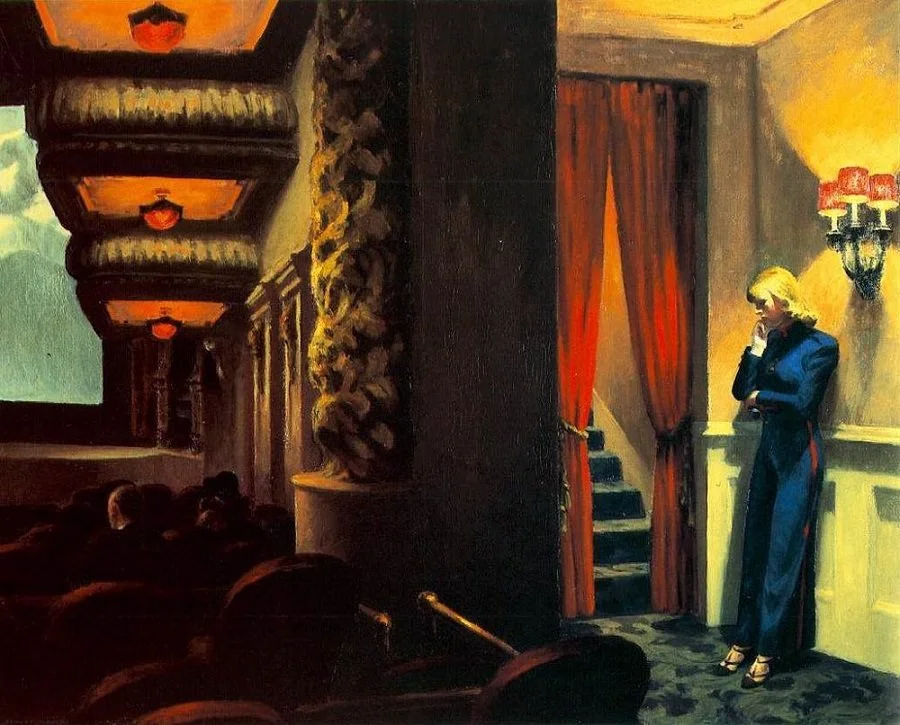
Edward Hopper, New York Movie, 1939, oil on canvas. MoMA, New York City
A similar effect occurs in New York Movie. A lone female figure stands in the cinema corridor, a thick brown wall separating her from the main auditorium and introducing the same sense of withdrawal produced by the diner window in Nighthawks. Her head is bowed in thought, and her fingers cradle her chin, as if supporting the weight of her thoughts. The three-lamp fixture behind her illuminates the scene while signalling where its energy lies: in thought itself. In Hopper’s interiors, light does not merely describe space; it determines the emotional register of the scene, isolating figures even as it makes them visible. It seems as if this woman has stepped out of the salon due to emotional overwhelm, triggered by an event or person the viewer is not privy to–quite like the man with the bowed head in Nighthawks. When the painting was first exhibited, this led one contemporary reviewer to note that it captured “the loneliness of the individual in an impersonal setting.” Looking at it, we once again become bystanders, momentarily stumbling across the loneliness of others as we pass through Hopper’s city.
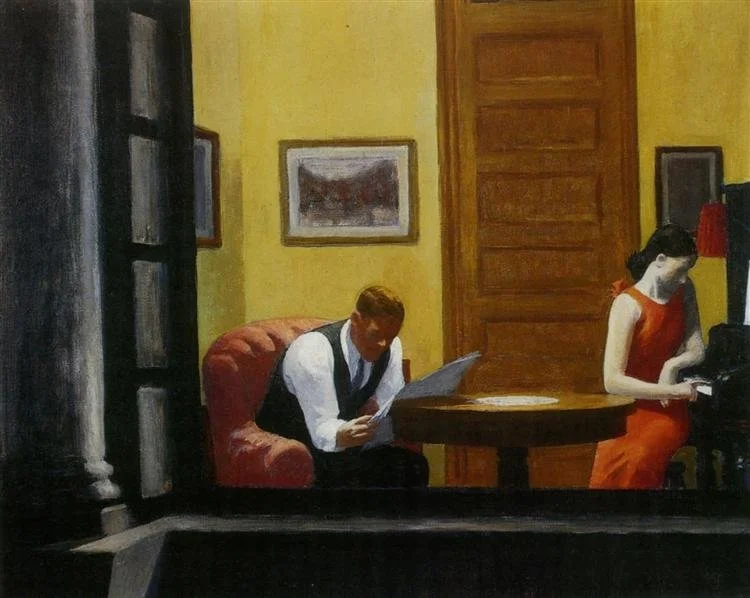
Edward Hopper, A Room in New York, 1932, oil on canvas. Sheldon Museum of Art, Lincoln
Finally, glance at Room in New York. A couple sits at home: the man reads the newspaper, long associated with the masculine sphere of public affairs, while the woman lightly touches the piano keys, signalling the feminine domain of domestic entertainment. They neither face each other nor touch. The torsion of her body, awkwardly twisting between table and piano, suggests discomfort not simply with the room she inhabits, but with the role expected of her, suspended between wife (table) and entertainer (piano), and still unseen by her husband. In glimpsing this through their open window, we again witness a scene we should not have access to, feeling the emotional weight of tensions that are not our own, what Lewis Mumford called “the loneliness of even occupied houses.”
The loneliness of Hopper’s paintings, then, arises from several factors: the painted architectural divisions, the monotony of his colours, the implied tensions of the figures, and, above all, the position that we, as viewers, find ourselves in. Looking at his work, we remain removed, uninvolved, and unseen, like voyeurs briefly entering the lives of others only to experience their isolation. Hopper’s cities, it seems to me, do not simply imply solitude; they evoke it visually, placing us at the same spatial distance from others that his figures inhabit emotionally.