From London with Love: The Southbank Centre - Culture as a Democratic Social Good
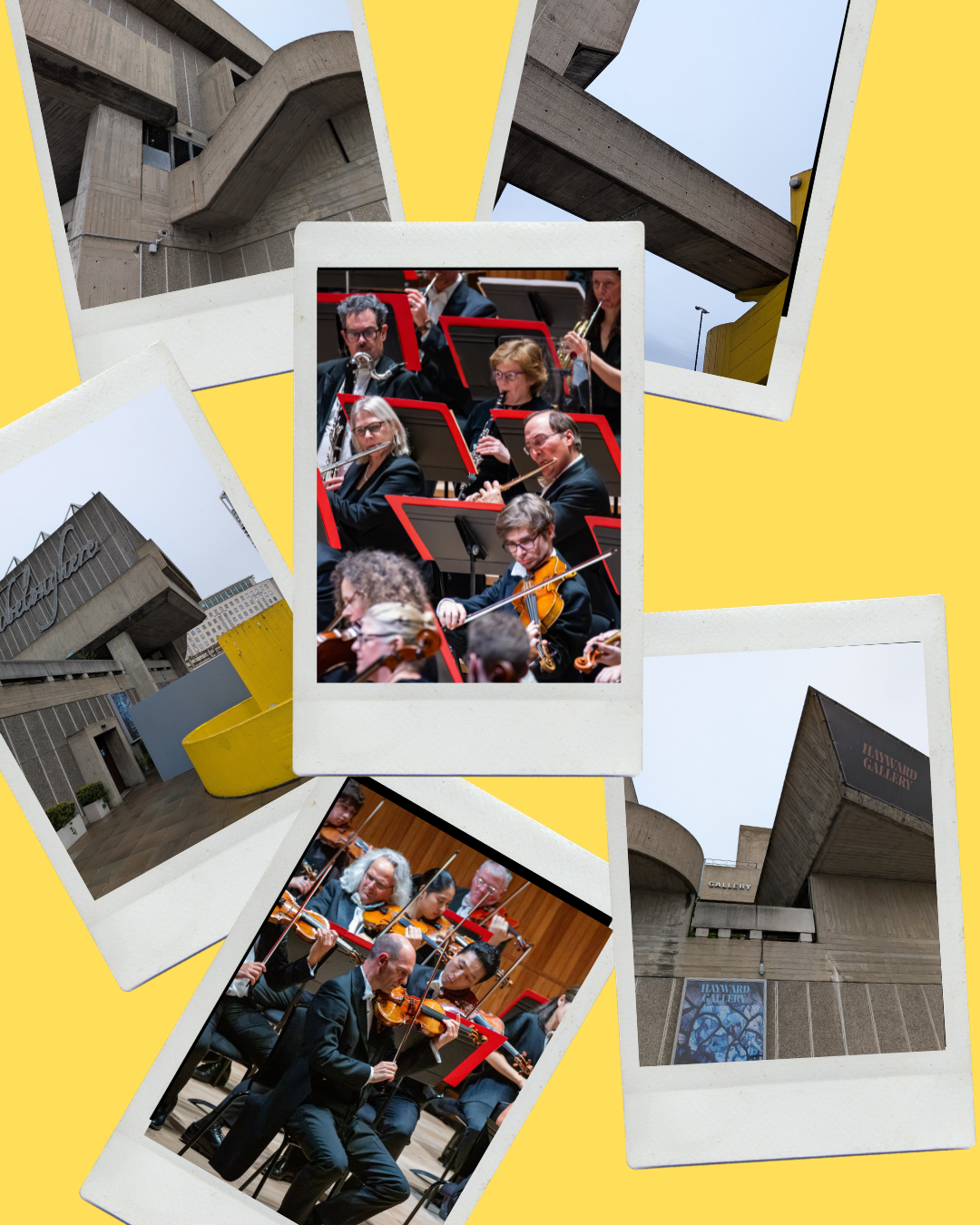
Orchestra images by Marc Gascoigne. Southbank Centre images by Jack Marley.
9 May 2026
Dear Reader,
Wondering around a jungle of concrete on a cold and drizzly spring day may not be everyone’s idea of fun. However, for admirers of brutalist architecture a visit to London’s Southbank Centre holds a special appeal. The sprawling complex lays long and low across the banks of the Thames, surrounded by remnants of historic industrial dockland. Braving some adverse conditions, I went for an exploration of the centre’s various buildings and outdoor areas. And it really is an exploration. Perhaps the architecture’s central charm is that it is not a building that one is simply in or out – a binary threshold of public and private – but rather a weavingly organic amalgam of stairwells and mezzanines, underpasses, porticos and overhangs. Walking around, I was variously under, amongst, above the concrete forms, each angle revealing another stark geometric form thrown in relief against the stone-grey sky.
The reason for my visit was a concert by the Philharmonia orchestra in the larger of the Southbank’s two concert halls, the Royal Festival Hall. Wandering around the foyer before the concert began, I was struck by the sheer amount and variety of activity. Many concert hall foyers are places of waiting: a nice bar, plush soft furnishings, some ushers in waistcoats. Here, a large concert was soon to start, barely registered. To one side, one of the orchestra’s bassists demonstrated the instrument to a small audience. Immediately behind them two models sat back-to-back stony still, surrounded by concentric rings of amateur portraitists, stern faced with concentration. A lower basement level doubled as a buggy storage and miniature ballroom, couples swirling to salsa; in the interval I spotted a small group of teenage girls there filming a TikTok dance. Elsewhere school kids revised, families chatted, freelancers worked. It was a thriving cultural third space, exactly what this country desperately needs more of.
The concert itself, originally meant to be the main event of the day, was by this point a lovely addition to it. It was a programme of Gabriela Ortiz, a living Mexican composer who is one of the orchestra’s featured composers, alongside early-19th-century German works by Ludwig van Beethoven and Felix Mendelssohn, under the baton of Clemens Schuldt. Ortiz’s piece was muscular and dynamic, with bold fanfares from a bolstered brass section split across the stage. Beethoven’s Emperor Concerto followed, and though receiving top billing in the concert it was conspicuously the weak link – juxtaposed with such a fresh and sonically rich symphonic fantasy, the small early-19th-century forces and surprisingly quiet and detailed piano acoustic felt almost mannered. The second-half Mendelssohn – his Scottish Symphony – was a real treat, Schuldt’s joyously full-bodied conducting re-finding the vivacity and immediacy lost in the Beethoven. Star of the show, however, was the young girl in the front row of the choir stalls who conducted along with the dancelike second movement, melting the hearts of about five hundred people across the hall in the stalls and balcony. It was a fitting image for the day, art and culture as a democratic social good for everyone to access, and the Southbank as a space where they can do it.
Jack