From Paris with Love: The Annual Performance of the Paris Opera Ballet School at the Palais Garnier
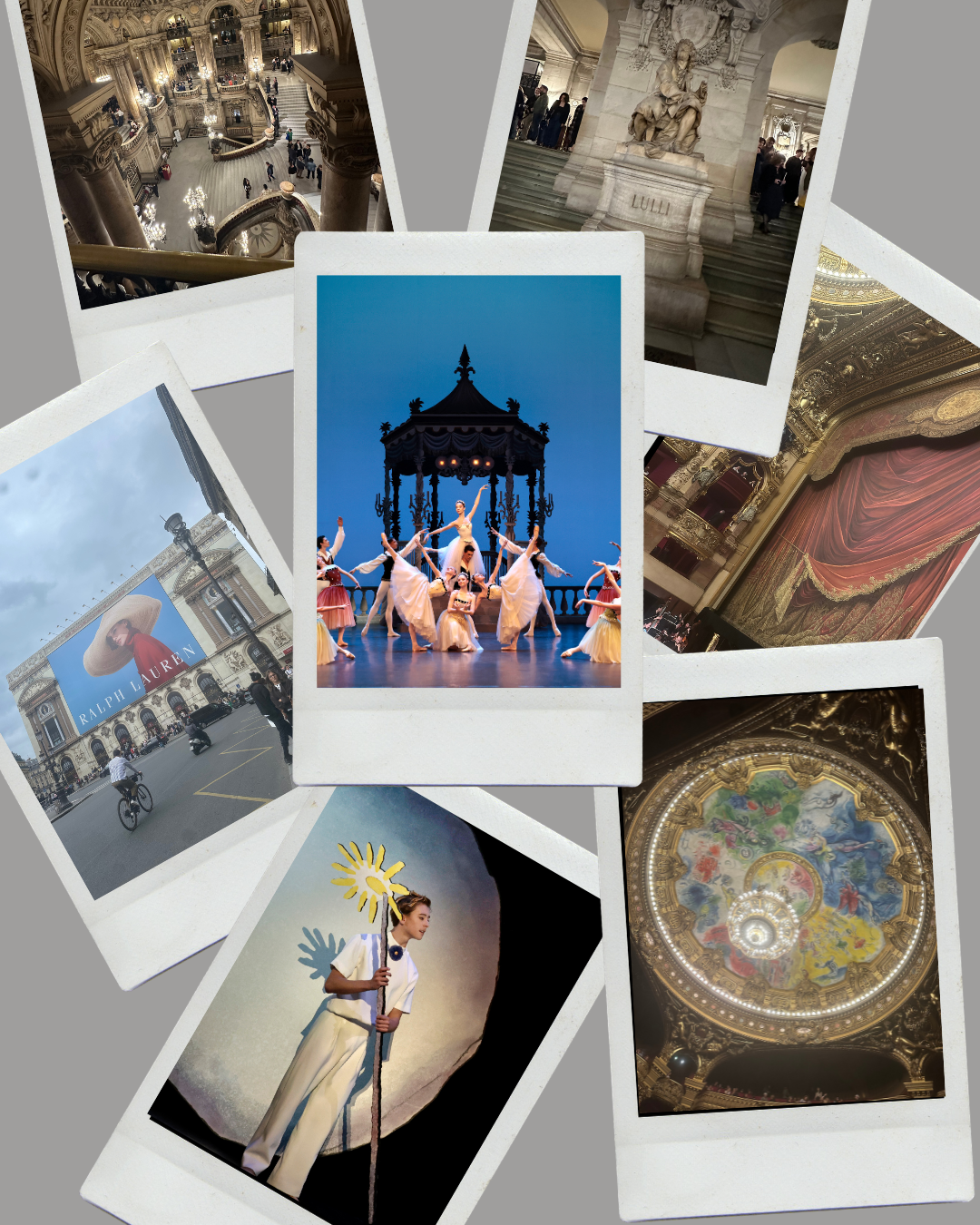
Performance images © Svetlana Loboff. Images of the Palais Garnier by Christina Ezrahi
9 May 2026
Dear Reader,
Strolling down the wide Avenue de l’Opéra leading up to the Palais Garnier (the Paris Opera) is one of my great joys. Especially when I am on my way to attend the Paris Opera Ballet School’s annual school performance. At the moment, the joy of this approach is somewhat tampered by a gigantic advertising billboard on the Opera’s façade, displaying a Ralph Lauren model wearing a red coat and an enormous straw hat. But as soon as I had passed some hungry people eating sandwiches on the steps outside the Opera and entered the building through a mesh banner printed with an image of the façade that is currently under restoration, four monumental statues marked my transition from the bustling streets of Paris into a different universe.
Looking up to the imposing figures of composers Jean-Philippe Rameau, Jean-Baptiste Lully, Christoph Gluck and Georg Händel, a passerby would be forgiven for believing that he was in the stony presence of four great monarchs. The theatrical opulence of the Palais Garnier reflects both the central role of ballet and opera in French culture and the building’s historical role as a stage for social display. Ballet as a theatrical art from is rooted in the court of the French monarch Louis XIV (1638-1715), whose byname Le Roi Soleil (the Sun King) not only symbolised his absolute power, but also his love for dancing: one year before his coronation in 1654, Louis commissioned the twelve- hour long Ballet Royal de la Nuit (“The Royal Ballet of the Night”) that ended at sunrise with the appearance of fourteen-year-old Louis as the rising sun. Louis was drawing a clear parallel between himself and Apollo, the god of music and dance who is closely associated with the sun. Fifteen years later, in 1669, Louis XIV granted the privilege to create an Academy of Opera in 1669. This moment is considered the birth of the Paris Opera, making the Paris Opera Ballet the oldest professional ballet company in Europe. In 1875, the Paris Opera moved to the Palais Garnier, a building also conceived to enable nineteenth century French society to perform its social status while attending performances. Case in point: the two large boxes created originally for the emperor and empress across the stage were designed so that the audience could see the important guests inside the loge, who were unable to properly follow the performance on stage.
We live in very different times, but even today, there is a fairytale magic to the Opera. Rushing up the grand staircase framed by torch-bearing statues, I was suddenly gripped by the irrational fear that I might be turned into a pumpkin: each opera house has its own way of letting its audience know that a performance is about to start or continue. At the Palais Garnier, this sounds like a clock about to strike twelve. About ten minutes before the performance starts, the clock starts its sonorous, insistent ringing, making me feel like a member of Cinderella’s entourage about to be returned to its original pity state once the fairy godmother’s spell breaks at midnight.
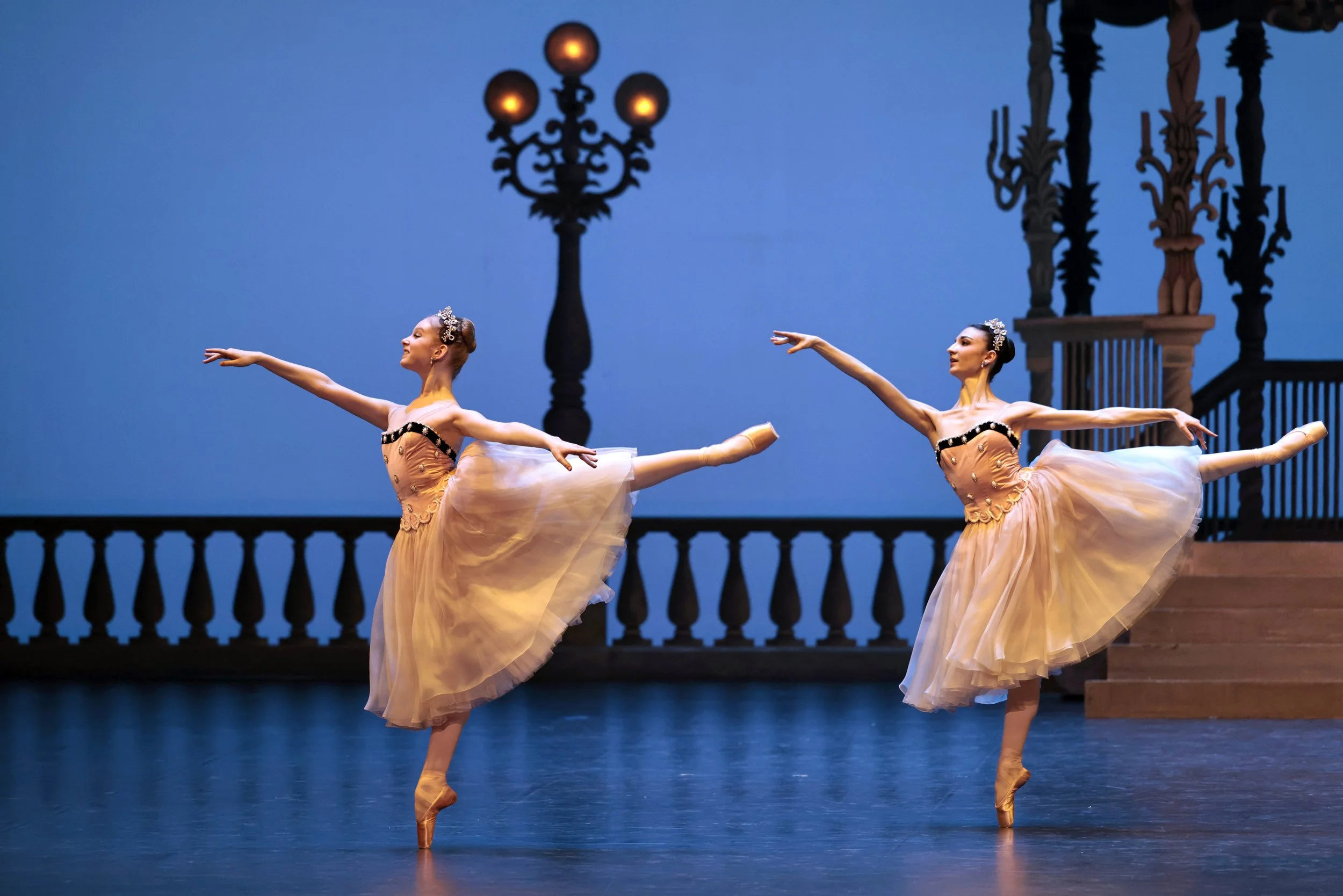
Soir de Fête (Léo Staats), Chloe Helimets and Marie-Emeline Pelettier ©Svetalana Loboff
After a quick moment of admiration for the bright kaleidoscope of colours displayed on Marc Chagall’s 1964 ceiling painting, up goes the red and gold curtain painted in the trompe-l’oeil technique that fools the viewer’s eye into believing a painted surface is three-dimensional and real. And a feast for the eyes it revealed. Created by Léo Stats for the Paris Opera Ballet in 1925, Soir de Fête (“Party Night”) is set around a band stand before a midnight-blue backdrop. The pastel costumes are gorgeous: luscious multi-layered skirts, embroidered bodices, flattering headdresses.
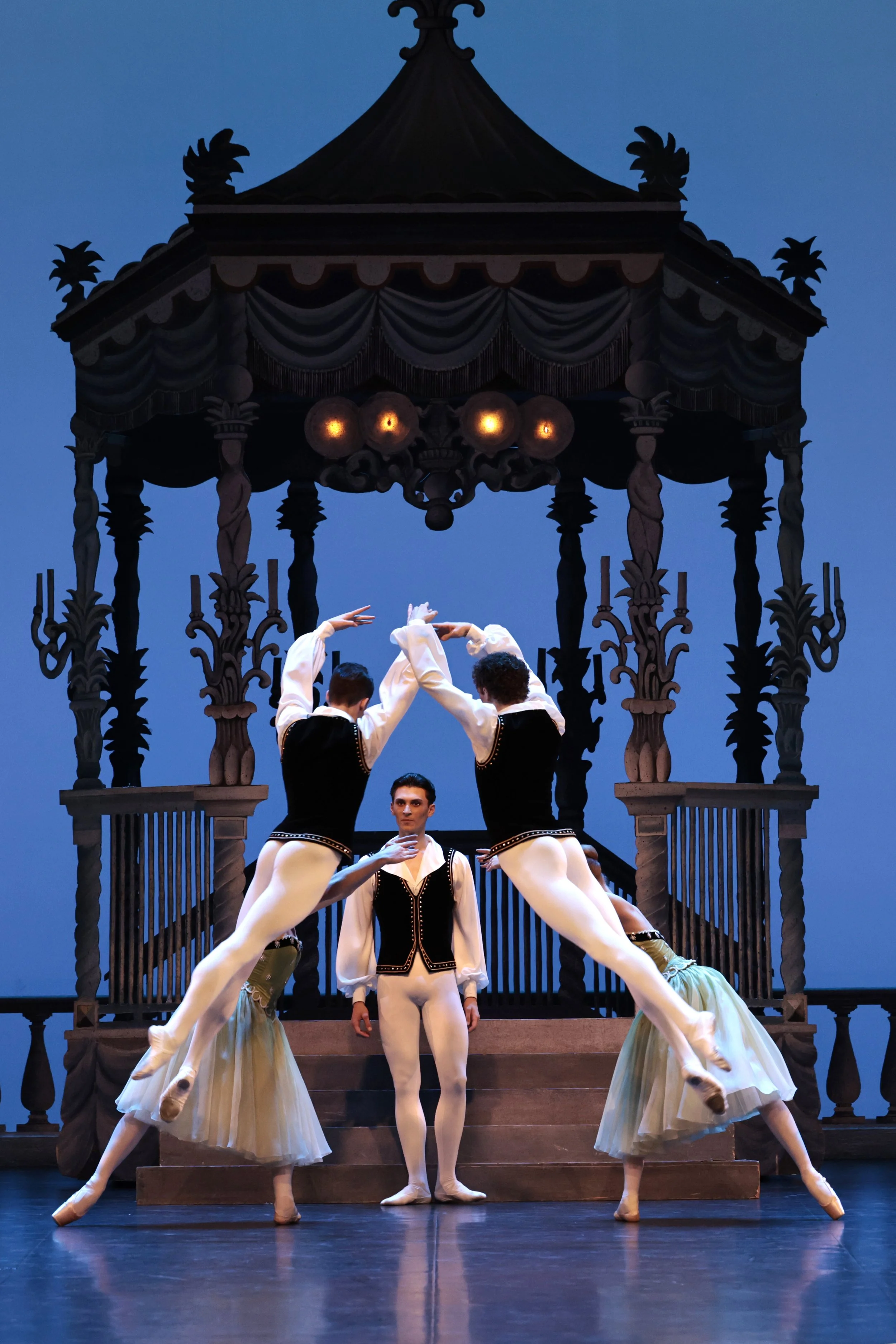
Soir de Fête (Léo Staats) © Svetalana Loboff
Deceptively light in tone and plotless, the piece captures the soul of the French school of ballet: its aristocratic elegance and inherent chic, the precision of its lower leg and footwork, its crisp petit batterie (small beaten jumps), its speed and precise execution. Performed by students of the upper divisions, it is not so much the leading couple that stands out, then the general excellence of every single dancer on stage. Particularly charming: the dancers in blue (Ana Picard, Colette Rieu), in pink (Marie-Emeline Pelletier, Chloe Helimets) and in green (Sofia Pavlovska, Pauline Warren), as well as the male trio of Maxime Colin, Benjamin Imerovski and Eric Poor.
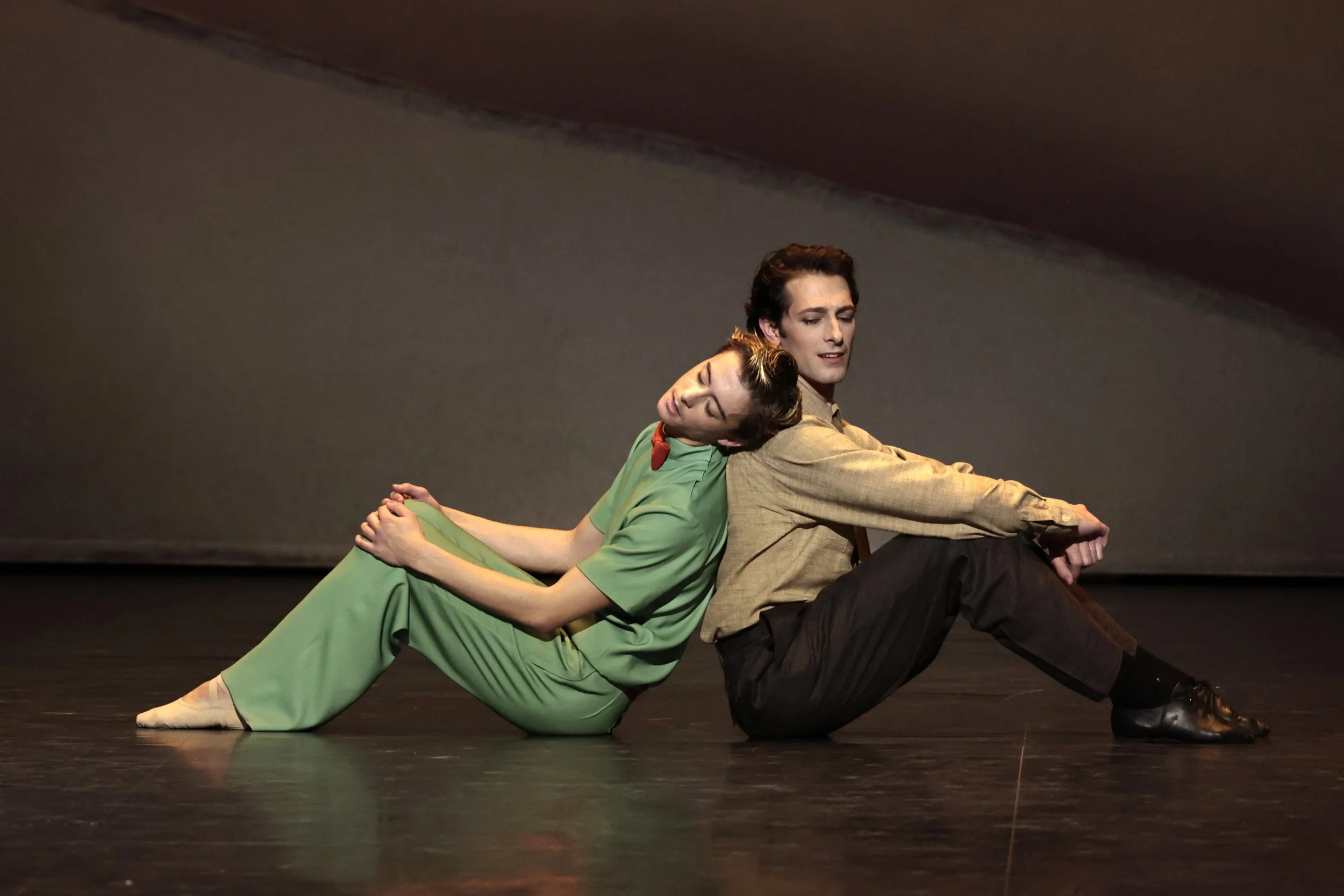
The Little Prince (choreography: Clairemarie Osta), Antonin Ange Boutet as Little Prince and Mathieu Ganio as Aviator. Photo © Svetlana Loboff
The evening consisted of three very different ballets united by a single theme: the passage of childhood. Every family has its own history, culture and language; Léo Stat’s ballet offered the students a chance to demonstrate their fluency in the “family language,” the schooling and style imparted by the Paris Opera Ballet School. Next on the program was a new creation by former student and Paris Opera Ballet principal Clairemarie Osta inspired by the French classic The Little Prince by Antoine de Saint-Exupéry. Set and costumes take us on a nostalgic journey through this philosophical childhood classic and its author’s illustrations. The ballet is constructed as a dialogue between the aviator – danced by the popular étoile (“star,” principal dancer) Mathieu Ganio, who recently retired from the Paris Opera Ballet, and the Little Prince, a student about to graduate, danced this evening by charismatic Antonin Ange Boutet. Standing out among the many characters brought to live by an enthusiastic cast: a mysterious Viktoriia Pirogova as the Lamplighter, and Prune Kaufmann as coquettish Rose.
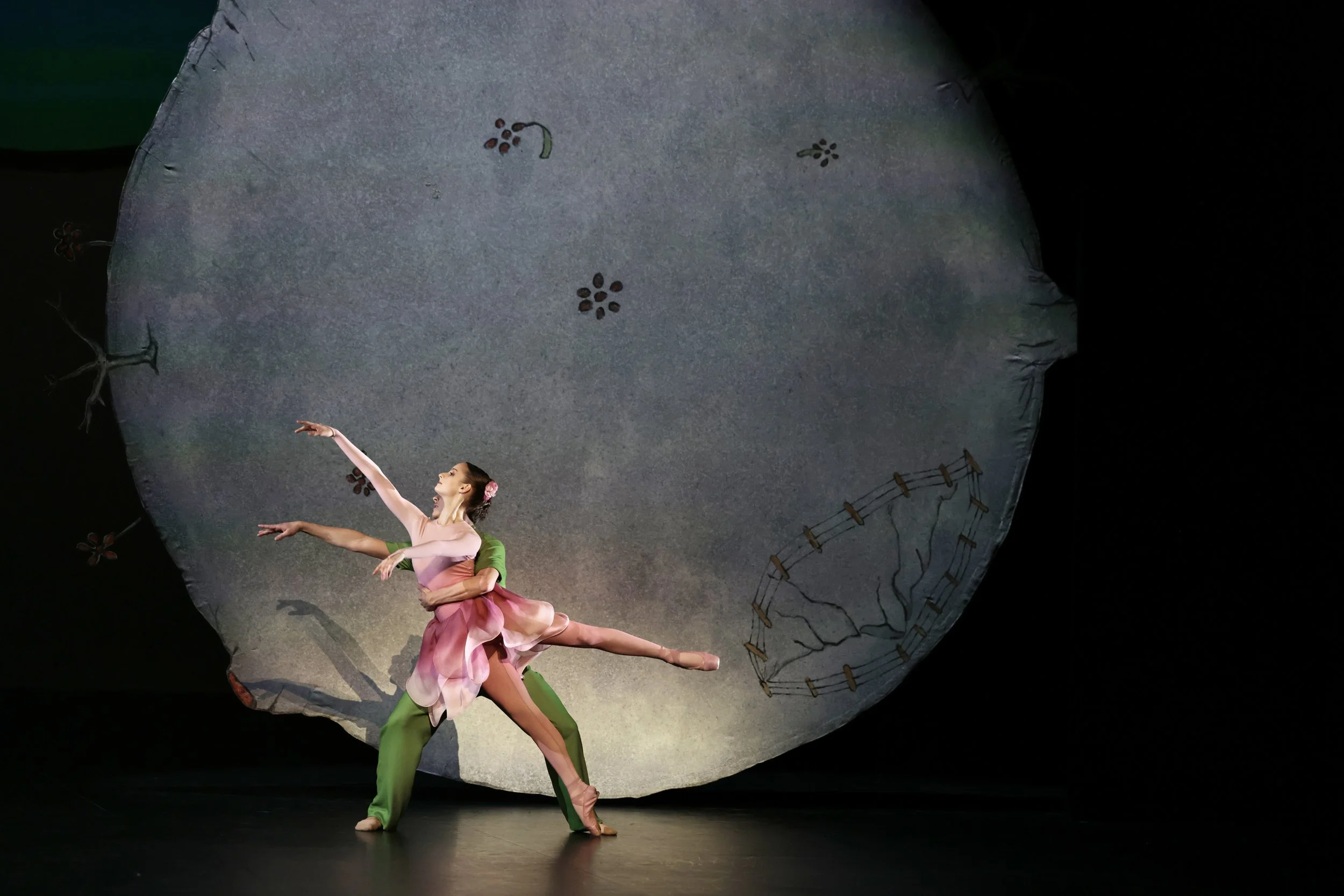
Antonin Ange Boutet as Little Prince and Prune Kaufmann as Rose. Photo © Svelana Loboff
The evening finished with a superb interpretation of John Neumeier’s Yondering to a selection of Stephen Collins Foster’s mid-nineteenth century American folk music songs recorded by baritone Thomas Hampson. The American pioneers used the term “yonder” to describe moving into unknown, distant territory. Neumeier created the piece for Canada’s National Ballet School in 1996, exploring the passage from childhood to adulthood in a series of dances ranging from the deeply emotional (Sacha Alié and a group of male students performing “Jeanie with the Light Brown Hair”), nostalgic, to funny (a special round of applause to Josephine van der Plas and Marcel Sardà Masriera as insistent young lover and indignant object of desire). Dancing before a blue backdrop in simple beige trousers and dresses, the young dancers completely made Neumeier’s neoclassical choreography their own, filling it with emotion and joy. The program clearly inspired the younger members of the audience, who could be seen twirling and jumping in hidden corners of the opera house during the two intermissions.
From Paris with love
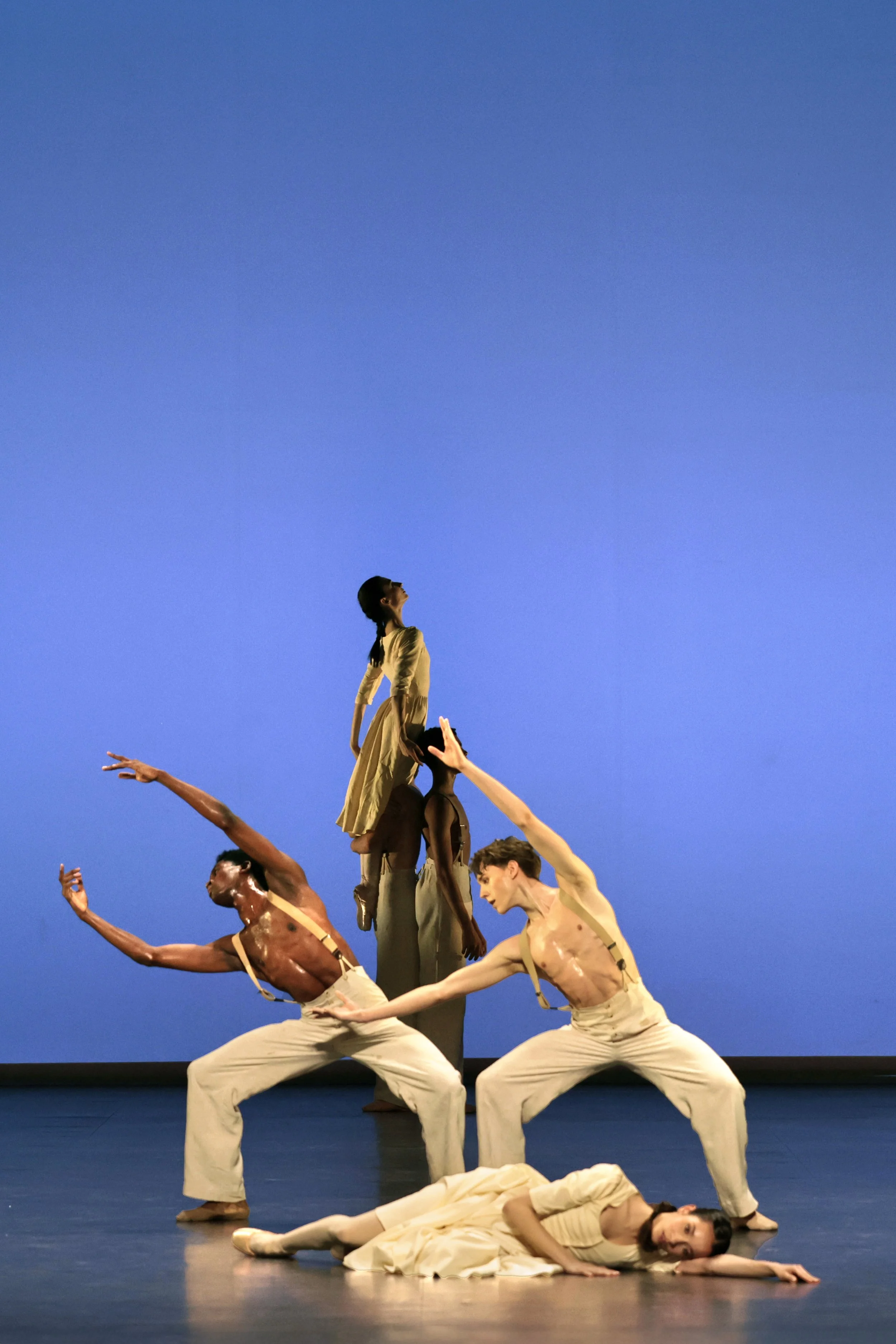
Yondering (John Neumer), photo © Svetlana Loboff