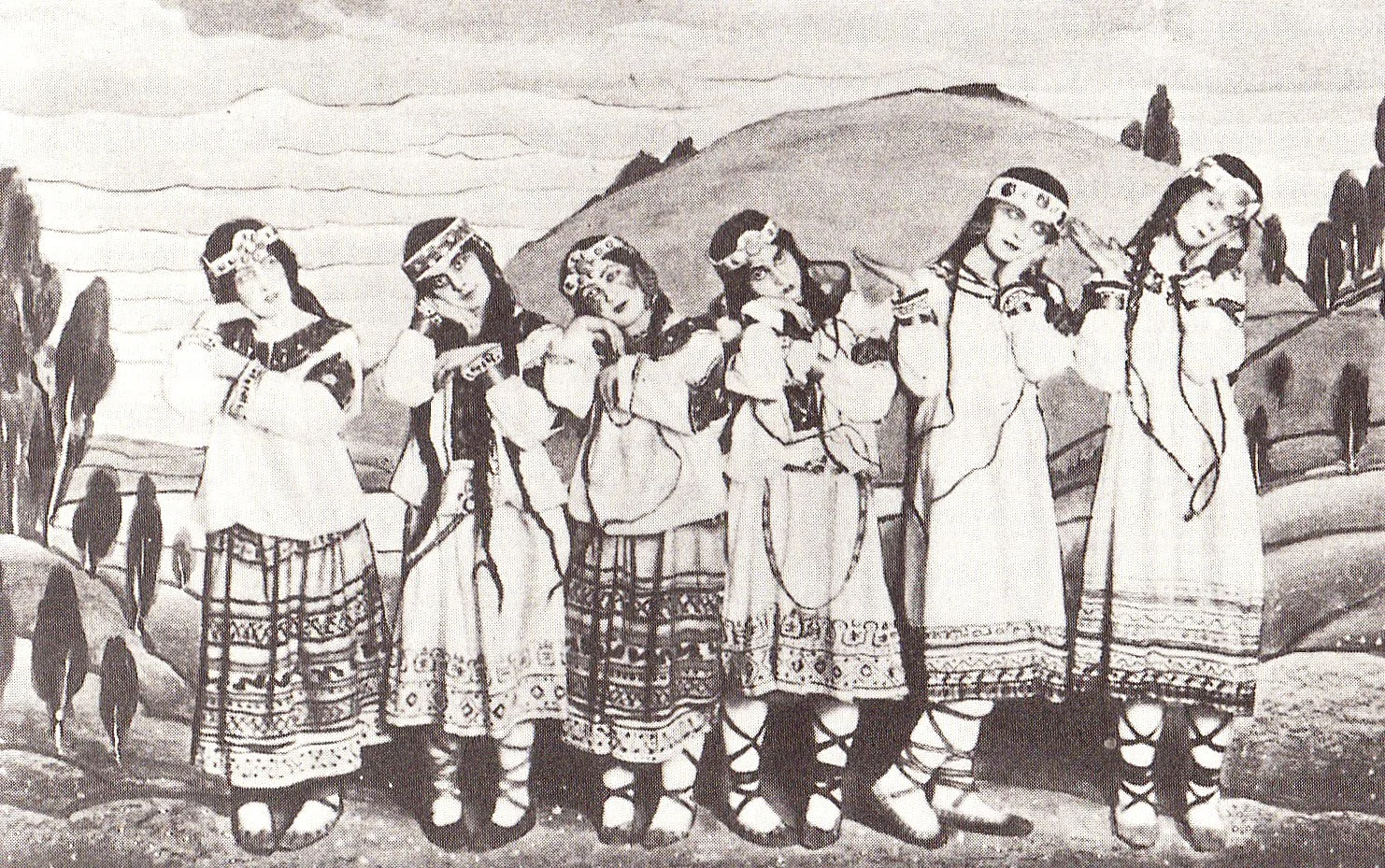
A posed group of dancers in the original production of Igor Stravinsky’s ballet The Rite of Spring, showing costumes and backdrop by Nicholas Roerich. Originally published in London in 1913 in the magazine The Sketch.
19 December 2025
Uproarious laughter, mocking heckles hurled at the performers, and fighting amongst the audience. These are some of the stories told about the night of 29 May 1913, when the famed Ballet Russes premiered a new ballet entitled Le Sacre de Printemps in the Parisian Théâtre des Champs-Élysées. The audience’s impassioned reaction and the media storm which followed it quickly passed into the world of legend, with precise details of who was actually there and what actually happened still a subject of scholarly debate. That night has since become one of the founding myths of musical modernism, a watershed moment for the development of composition style in the 20th century. Stravinsky’s score for Rite of Spring has continued to grow in status ever since, the inspiration of generations of subsequent composers and a starred entry in our musical history textbooks.
Yet as Stravinsky’s score was installed in the canon of the classical concert repertoire, adorned with this beguiling original story of scandal and uproar, the story of that auspicious evening in 1913 has been twisted and simplified. We are told of shocked reactions to the achingly high bassoon solo with which the score begins (Saint-Saëns reportedly quipping “If that's a bassoon, then I'm a baboon!”), and the incomprehension of the dissonant stabbing harmonies which begin the “The Augurs of Spring” section. In other words, just as Stavinsky’s score is what survives in our cultural consciousness from that original balletic production, so too does the myth aggrandize the musical composition as progenitor of controversy. But ballets are more than just scores, and musical performances are individual, idiosyncratic events not encapsulated by neatly edited orchestral scores. So, let's peel back some of the different layers which provoked that impassioned response to the premiere of Le Sacre de Printemps.
Ballets are by their nature interdisciplinary works. Much of the success of the Ballet Busses was due to its leader Sergei Diaghilev’s keen ability to bring together creative teams of composers, choreographers, and set and costume designers. The choreography for The Rite was done by the company’s lead male dancer, Vaslav Nijinsky, and was as radical as the ballet’s score. Nijinsky’s work has been referred to as “anti-ballet,” inverting the classical balletic aesthetic which highlights the beauty and elegance of the human form to instead explore a visual language of “ugly” forms and gestures. One anecdote from the opening night was an audience member heckling that the dancers in the opening chorus needed to see a dentist, as they moved around the stage buckled over with their fists held to their mouths. Sadly, Nijinsky’s choreography has not entirely survived (textual notation for dance being a perennial issue). However, it was reconstructed in 1987 by the Joffrey Ballet company, a performance of which is linked below. Even in the 21st century this dancing is strikingly original in its jerky, stilted, and angular style. You can understand why the 1913 audience were so scandalised.
There is also the question of what audiences actually heard that evening. With The Rite now an established orchestral work, we are treated to precise and near-perfectly executed renditions. I even heard an amateur orchestra play it commendably well recently. Safe to say this wasn’t the case when the score was a new and strange object in 1913, full of novel rhythmic and timbral complexity. Take the two recordings linked below as example – the first a modern recording, the most incredibly precise rhythmically that I’ve come across; the second is a recording from 1960 with Stravinsky on the conductor’s podium. Even 50 years after the piece’s original composition this performance feels uncertain, almost on the verge of disjunction. You can only imagine how the orchestra sounded in 1913. We might disregard Saint-Saëns’ remark, quoted above, as old-fashioned, but in all likelihood the bassoon solo did sound far from melodious. Even more fundamentally, contemporary accounts describe the uproar starting within the opening minutes of the ballet – it is likely most of the audience didn’t even hear most of the music over the din, and the performance itself must have been affected by this racket. It can hardly be said, then, that the score deserves full credit for the infamous audience reaction, and it is also a discredit to other aspects of the production, notably Nijinsky’s radical choreography, to claim so.
--
The 1987 Joffrey Ballet reconstruction of the original production of The Rite of Spring
A modern performance of The Rite, by Russian orchestra musicAeterna