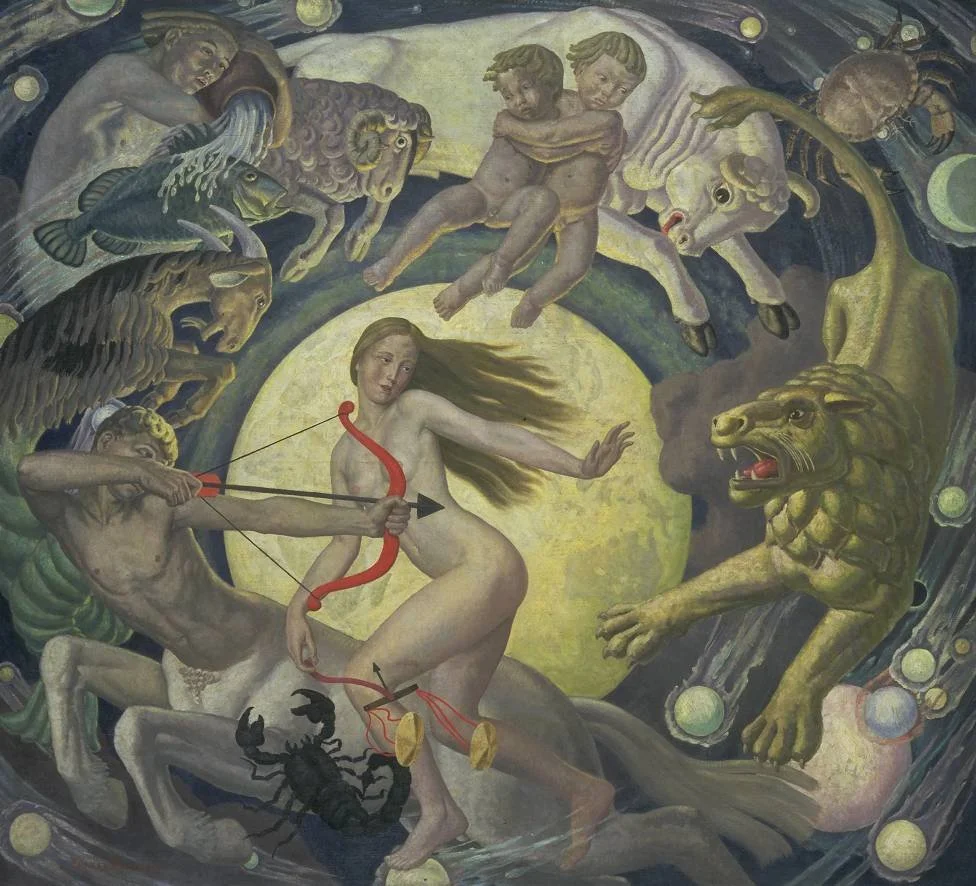
Ernest Procter, The Zodiac, 1925, oil on canvas. London, The Tate
19 December 2025
There’s a magnificent villa in Rome, nestled a few steps off the Tiber: the Farensina. Built in the early 1500s, the property belonged to none other than Agostino Chigi, banker to the Pope and one of wealthiest men of his time. (That explains how he could afford Raphael and Giulio Romano to paint his walls.) But there’s something else I find utterly fascinating–the villa’s blatant expression of astrology. Yes–astrology. The same “science” that powers Co-Star, the popular astrology app that predicts your day based on how the planets in your natal chart interact with their current positions in the sky, and the same one that makes you ask people about their Sun, Moon, and Rising signs.
As caricaturish as it has become today, astrology was actually integral to humanist education in the Renaissance. Just as learned men studied philosophy, literature, and history, they were schooled in basic astrological–later, astronomical–principles: the stars, constellations, and their interactions, along with their supposed influence on one’s life. Noble and patrician dynasties even employed astrologers, relying on their counsel to plan weddings, battles, processions, and, as it turns out, home decorations.
Take the Farensina, for example. The very room that houses Raphael’s The Triumph of Galatea is also home to Chigi’s natal chart, mapped out in allegorical code on the loggia’s vault. Rather than depicting the circular wheel that astrologers refer to as a “natal chart,” its scheme employs deliberate groupings of classical figures. Jupiter is, for instance, placed next to Taurus. The implication? Chigi’s Jupiter is in Taurus.
The rest of the chart follows the same logic: Mars and Mercury are in Scorpio; Apollo–the Sun–in Sagittarius; Venus in Capricorn; and, finally, Saturn in Pisces. In noticing these along the vault, the viewer becomes privy to the patron’s natal placements. For the astrologically literate, their prophecies also come out: wealth, analytical abilities, a lust for freedom, a love for security. Looking at the loggia’s vault thus yields a visual puzzle which, once deciphered, both predicts and justifies the patron’s success.
But this is no isolated example. Lorenzo de’ Medici’s villa at Poggio a Caiano also flaunts il magnifico’s horoscope to make a “star-crossed” claim of dynastic power. Most notably, it places Mars at the centre of the portico frieze, virtually mirroring the planet’s position in Lorenzo’s natal chart. By evoking the astrological midpoint, the so-called MC, the frieze then signals Lorenzo’s professional destiny–which conveniently pertains to political leadership and rule.
The rooms of his son, Pope Leo X, in the Vatican, also emulate this logic. But rather than presenting the pope’s horoscope with the scrupulous accuracy found in Lorenzo or Chigi’s villas, The Sala dei Pontefici rearranges the elements of Leo’s natal chart to spotlight its most favourable aspects. It’s no surprise that the Sun and the constellation Leo are given such prominence. This not only references Rome’s zodiac sign, Leo, but also recalls why Giovanni de’ Medici chose the name “Leo:” the constellation Leo shines most brightly in March, the very month he was elected head of the Papal State. The Palazzo Vecchio in Florence, the Palazzo Schifanoia in Ferrara, and the Palazzo d’Arco in Mantua, among many others, all adopt a similar approach.
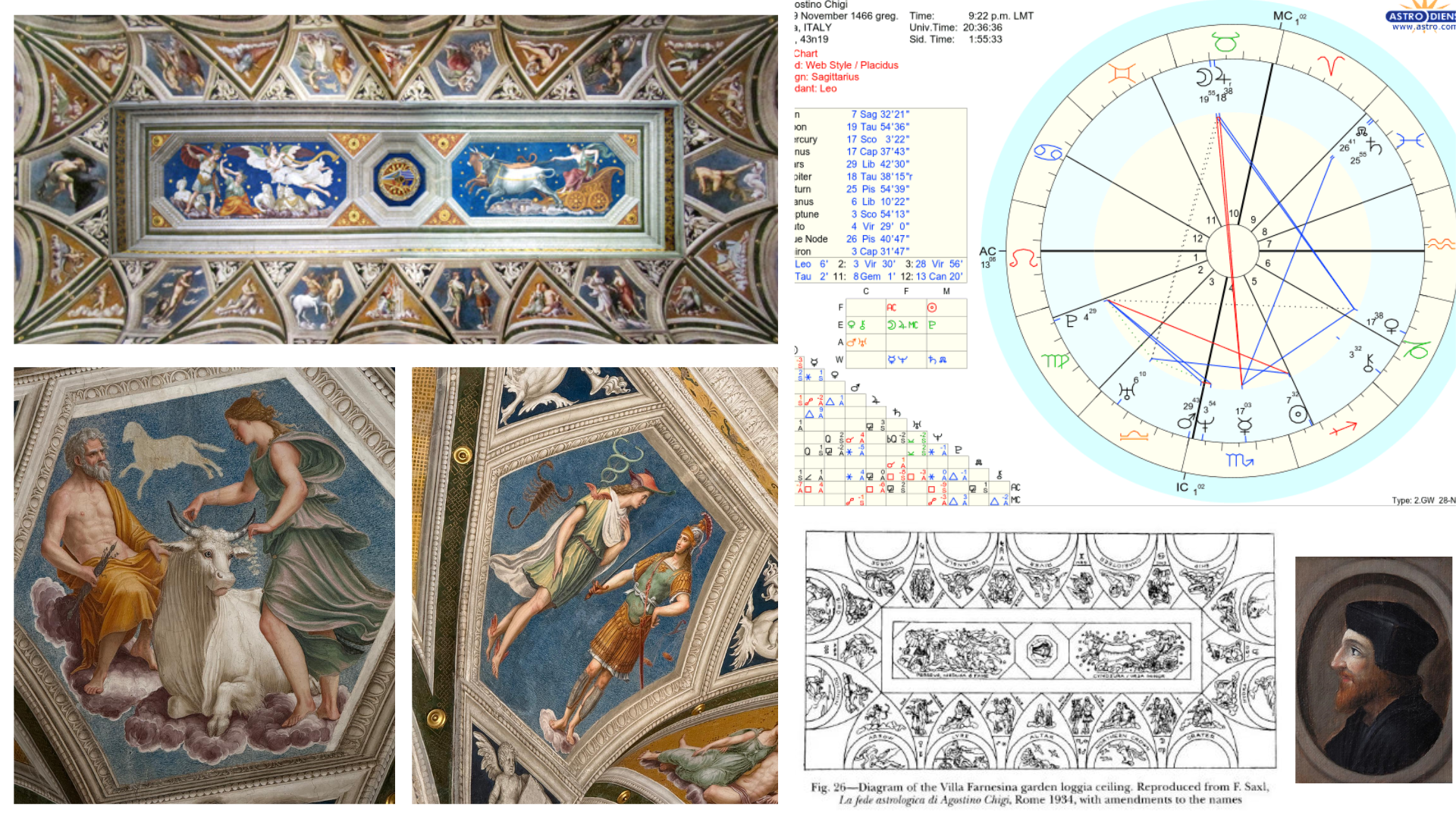
On the left-hand side: Details from the loggia at Villa Farensina: the whole ceiling (top), Jupiter in Taurus (left), Mars and Mercury in Scorpio (right). On the right-hand side: Agostino Chigi’s natal chart (top), the vault’s layout (bottom left), Chigi’s portrait (bottom right).
Now, this tendency to design your house around your horoscope may have waned over the centuries, but the interest in astrology certainly has not. The twentieth century was particularly fascinated with astrology: scholars such as Carl Jung explored its foundations to develop a theory of archetypes, while artists drew on them for creative inspiration. To say that a huge chunk of twentieth-century art was inspired by astrology is, then, a fair judgement. Just look at Ernest Procter’s The Zodiac, Alphonse Mucha’s work of the same title, Remedios Varo’s Microcosmos (Determinismo), and Hilma af Klint Group IX/UW, The Dove, No. 14. And of course, Salvador Dalí, ever attuned to the surreal potential of signs and symbols, produced a series of astrological prints in the 1960s, followed by a tarot deck for a James Bond film.
In turning to the zodiac, these artists weren’t indulging in whimsy so much as searching for an underlying structure, a rationale for the state of the world and their place within it. In the aftermath of two world wars, an epidemic, and rapid technological change, only a return to the archetypal, the mythical, and the deeply psychological, could provide a language with which to illustrate both collective catastrophe and its mark on man’s experience.
When you next happen to glimpse up at a Renaissance ceiling, a frieze, or even a modernist painting, bear this in mind: you might be also looking at the stars–or, at the very least, their position at a moment significant to the artist or their patron. And in case you want to check your Co-Star in public, perhaps don’t hide. Some great men–some of the greatest men–were clearly very public about their affinity to astrology, leading later generations back to the stars.
***** (If you’re feeling particularly curious, you can google Chigi’s natal chart yourself: 9:30 pm on November 29th, 1466.)