AI, Art, and Adorno
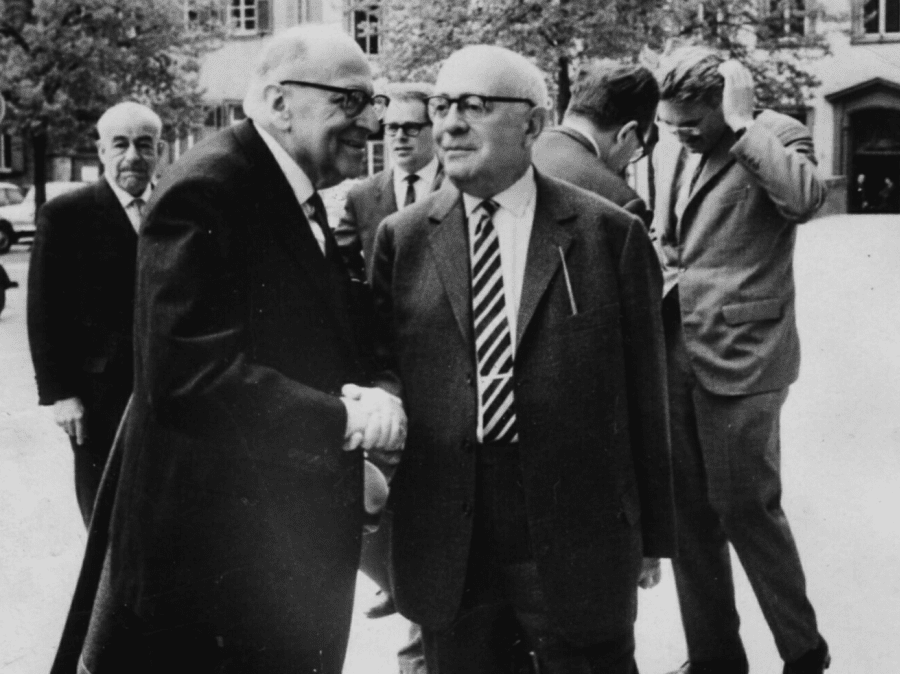
Max Horkheimer (front left) and Theodor W. Adorno (front right) at the Max Weber Sociologists’ Conference, Heidelberg, April 1964. Jürgen Habermas stands in the background to the right; Siegfried Landshut is visible to the left. Photograph by Jeremy J. Shapiro.
2 April 2026
I remember AI-generating music in early 2024, laughing at how wonderfully inept and ridiculous the music it created was. Now, of course, the majority of people cannot tell the difference between AI-generated and human created music; a distinction that seemed absurd a mere couple of years ago. Given this, there seems to me no question that AI can make music. But is the music it makes art?
Musicologist and philosopher Theodore Adorno (in)famously despised the popular music of the 20th century, and I am by no means endorsing his critiques here. However, his criticism of popular music, though grossly misrepresentative, maps remarkably well onto AI-generated music. Adorno argues that a key feature of popular music is standardisation, that is, the total construction of a piece out of easily recognisable, generally accepted formulae in a framework that remains essentially unchanging. The individual details that make up the piece, Adorno continues, are superfluous decoration; there is no interaction between them, and they take no influence over the structure or direction of the music. As he writes: “… the whole is pre-given and pre-accepted, even before the actual experience of the music starts…”
Now let’s think about how AI music generators work. The model is fed millions of (stolen) pieces of music and then asked to create an output reflective of a given prompt. In order to do this, the model must synthesise generic patterns from its training data. If I ask Suno to make a DJ Khaled-type beat, to “understand” what I mean, the model has to analyse Mr Khaled’s oeuvre, as well as thousands of other 2010s hip-hop tracks to find generic patterns. It is from this source material that it then directly constructs the output. Does this not sound like standardisation? Similarly, since the AI is working from high-order abstractions of source material, it is not “thinking” developmentally; individual details of the music are not expanded or influential in the music’s narrative direction. This is why AI-music sounds repetitive and innocuous (and importantly, unlike genres such as techno, this repetitiveness is not an aesthetic decision).
In Adorno’s mind, art must become conscious of and integrate into itself that which has been neglected by established structures — political ideology, artistic convention, social hegemony, and so on — and in doing so change these structures. In simple terms, art must be constantly undergoing change. Standardisation is in contradiction to this aim; it promotes stasis. And this is precisely the problem with AI-generated music, it too promotes stasis: it cannot produce anything radically new, only mix and match generic patterns from its training data. In order for Suno to create something new, something new — made by humans — would have to be added to its training data.
The common rebuttal that mixing and matching generic patterns from training data is precisely what human artists do is a gross misunderstanding of how art is produced. Though I concede that artists do this in a general sense, the actual process of creating art is a high-order intellectual endeavour: anyone or anything can conjure up a musical theme, but the artistry is in the development and evolution of this theme to construct a narrative. It is in the reason why those pitches or rhythms or timbres were chosen, and why they change that the art exists.
Presumably, Adorno would have had a conniption if he knew of AI generated music, and I stand firmly with him: AI music is not art.