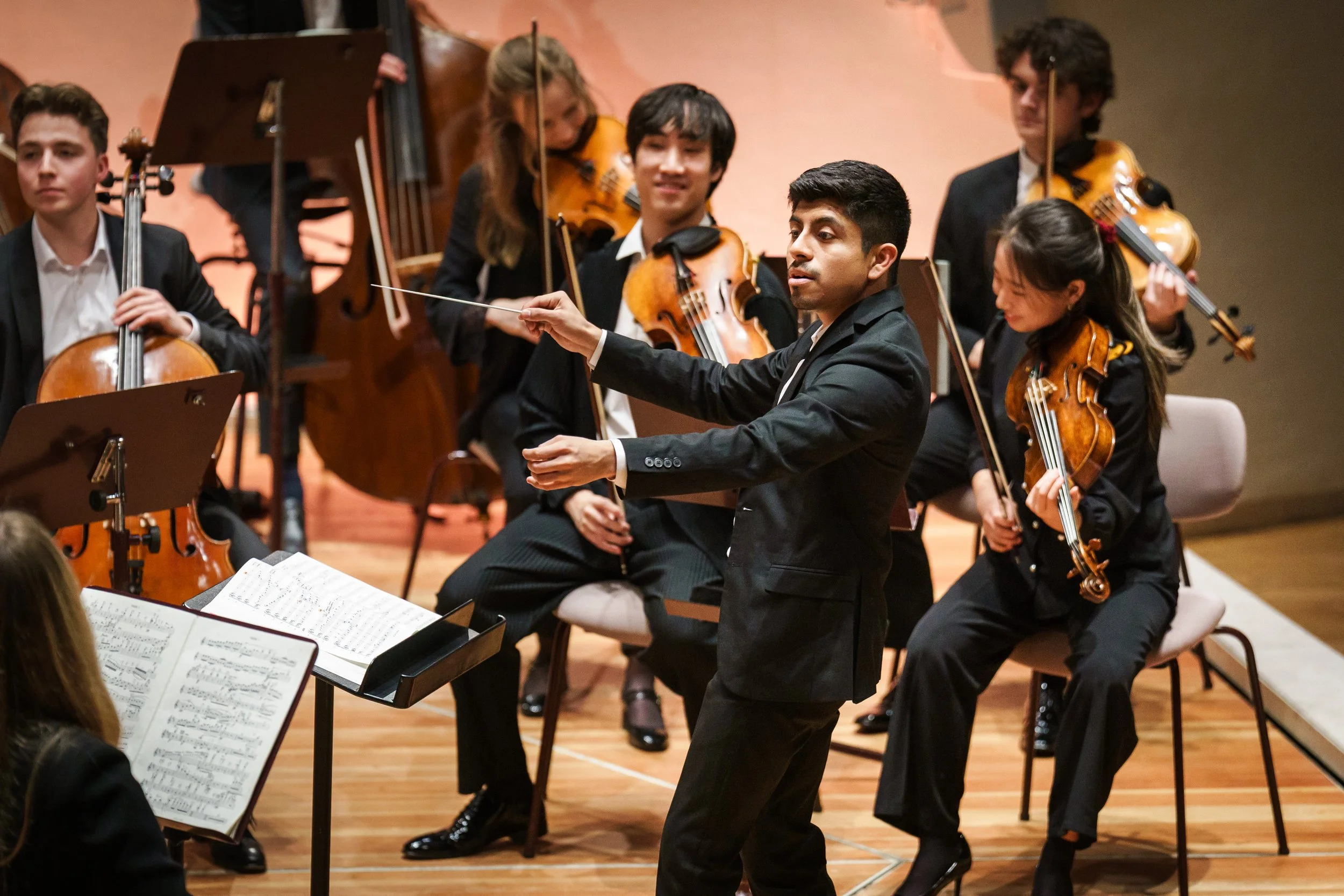
Dayner Tafur-Díaz conducting the Karajan-Akademie of the Berliner Philharmoniker. Photo @ Stephan Rabold
2 April 2026
There are differet paths to success, even in the world of classical music. Contrary to common wisdom, not everybody started practicing an instrument as a tender toddler and performed as a soloist before the age of ten. A case in point: Dayner Tafur-Díaz, who holds the Siemens Conductors Scholarship at the Karajan-Akademie of the Berliner Philharmoniker since October 2024, assisting his mentor Kirill Petrenko, chief conductor of the Berliner Philharmoniker. TWoA talked to Dayner about his path in music, moving from Peru to Berlin and much more.
What is your first classical music memory?
In terms of consciously listening to classical music: I was about eleven and had just gotten a new computer. There were some general music demos on the computer, including some classical music, such as, I think Johann Strauss Jr.’s Die Fledermaus (The Bat). I’m sure there was also some Mozart and Beethoven. In terms of making music: I was about thirteen, fourteen. A friend of mine invited me to join a classical music project which, as chance would have it, included some German volunteers. That was my first contact with this world, even though, initially, we were working on a small program of film music and Peruvian music arranged for a symphony orchestra, and only then, gradually, traditional classical music.
What was your first instrument?
At school, we had learned a bit of recorder, and I had about a month worth of guitar lessons and then continued to learn the guitar by myself. The first “official” instrument which I consciously practiced regularly was the trumpet.
When and how did you start conducting?
When I was fourteen, fifteen. Our conductor had to come from a different city two hours by bus. But in Peru, when we say, “we are leaving at 15:00,” it means you will leave a bit later. Most of the time, the conductor would be on time, but sometimes, he would be half an hour late. Nobody was there to lead the rehearsal, everybody was waiting. It really happened by chance: I just stood up in front of my friends and tried to conduct. I didn’t know how to do it, but the pieces were quite easy. I was just moving my hands and trying to conduct the rehearsal. Soon after that, when I was fifteen or sixteen, it was already clear to me that I wanted to be a conductor, even though I didn’t know how to achieve that.
When did music turn from a hobby into something serious?
When I was about fifteen, it was clear to me that I wanted to study music properly. But I was also thinking about studying medicine. I liked the idea of medicine, more than the reality of it. I was also interested in biotechnology, I even took an exam, but then decided that I would rather study music, because I felt more at home in music.
You first went to Germany on an orchestra exchange. How did this exchange pave the way for your move to Germany?
The exchange was with the orchestra of the Droste-Hülshoff-Gymnasium in Berlin Zehlendorf. The orchestra had visited my orchestra in Peru before I joined, and my orchestra had visited the orchestra in Berlin; they had played a joint concert at the chamber music hall of the Philharmonie Berlin. I joined the second trip of the orchestra to Berlin in 2016. The goal of this exchange was to introduce the musicians from Peru to German culture, to find out how musicians played in a different part of the world, to experience performing at the Philharmonie Berlin. We were in Germany for a week, and in Switzerland for a week. I played the trumpet.
My first impression was that the German musicians were playing better, even though we were almost the same age. They had a cleaner technique. There was an even bigger difference between the strings, even though it was the best orchestra of our music school that had gone to Berlin. My other impressions: We went in February, so it was cold. That was a bit of a shock. Public transport – inner-city overground and underground trains, we didn’t have that in my hometown in Peru. Language: we were all staying with host families. My family was extremely nice; we are still in touch. But they didn’t know Spanish, and I didn’t speak a word of English. I had learned a few words of German just for the trip, so that I wouldn’t starve.
You decided to move to Germany for good shortly after that. What made you take that decision?
There are less years of school in Peru. I had already finished school in 2014, I was sixteen. After school, I applied to the conservatory, but I was there only for a few months. I then continued in the music program that I had been studying with, because I felt I was getting more opportunities there: I got piano and trumpet lessons, I played with the orchestra; the conservatory wasn’t offering me that. The conservatory was primarily offering theory lessons. At the project, there were also volunteers from Germany, one of them was from Berlin. She told me that her school – the Georg-Friedrich-Händel-Gymnasium - was looking for a volunteer for their music program for 2017. I had already been looking at options for moving to Germany as a volunteer in other areas, for example, as a caregiver, but I couldn’t find a position. It took eight, nine months until I got the papers to volunteer at the Händel-Gymnasium.
What was the biggest challenge after your move to Germany?
Initially, I spent a year in Berlin at the Händel-Gymnasium. After that, I started studying in Dinkelsbühl at the “Berufsfachschule für Musik” (vocational college for music), which was really good, and then in Stuttgart, where I’m in theory still enrolled. The biggest challenge was the language. During the first year, I wasn’t totally alone because I was staying with a host family, and I could speak German to them. But at school, I wasn’t a student, but I also wasn’t a teacher, I was somewhere in the middle. It was a new experience for the school; they had never had volunteers before. There were two of us, one German and me. I only had contact with the people making music, so I wasn’t able to practice speaking so much. This was the biggest challenge.
Getting a visa – it is quite complicated to get a visa in Germany when you just arrived, there is always a “but,” there is always a document missing. After that, it gets easier. Another difficulty was that I didn’t have trumpet lessons for a year. That was a challenge because I wanted to study conducting, but I knew that I was lacking piano, I was lacking trumpet, I was lacking theory knowledge in German, I was lacking everything. That’s why I chose the vocational college because that was a preparation for studying.
What advice would you give to other young people who are considering moving to Germany to study classical music?
I have a few friends who wanted to move to Germany and who are here now. The first thing is language: when you know the language, it is a bit easier to understand how the culture functions. In the case of music: study as much music theory as possible and already try to do so in German. It is not that difficult, because the music stays the same, one just has to learn the terms. Music history is already another story, that’s difficult for me even today. Secondly, I think it doesn’t matter whether you go to Germany or France or Latin America: life is a roller-coaster, one has to be prepared for that. Something might not work out the way you wanted, but you have to keep trying because a path might show itself suddenly, and every time, you have to be ready to walk through that door.
Of course there were many things that didn’t work out for me. Before Stuttgart, I applied to Weimar, this was my goal. When I arrived in Germany, Weimar was the best university for studying conducting in Germany. This might be a bit different today, because the professor left. There were many places I applied to, and they rejected me. Shortly before Berlin, I also applied to another academy, but they didn’t invite me.
What would be your top three words of advice to young musicians to increase musical productivity?
In the evening, until today, I take stock. Not in the sense of “I must, must, must,” because I think that can become a disease. You have to be flexible. I mean it like this, for example: I’m a musician, I want to apply to conservatory for the first time, and I need to learn piano for that. I make the plan to practice piano every evening for thirty minutes, regardless of whether I feel well or not. Simply thirty minutes. In Spanish we say, to try to make a new link in a chain, to make “a cross” every day. In my case right now, I am doing that with languages. I have to learn languages for opera, and I have to improve my English. I try to keep up the chain. If on one day, it doesn’t work out, you start again the next. That is something that helped me and still helps me.
Secondly: read a lot. Not just about music. Even if you think it’s not connected to music, in the end, often there is a connection. Financial education, for example. I never studied how it works, also not at music school: we didn’t learn how to find an agent, or anything connected to finances, so you have to learn it somewhere else. Of course there is no specific book: “How do I fill in my tax return as a musician,” but you can learn different things from different places. Thirdly, it often helps me to work against the clock, for example: thirty minutes piano, and when the thirty minutes are up – finito!
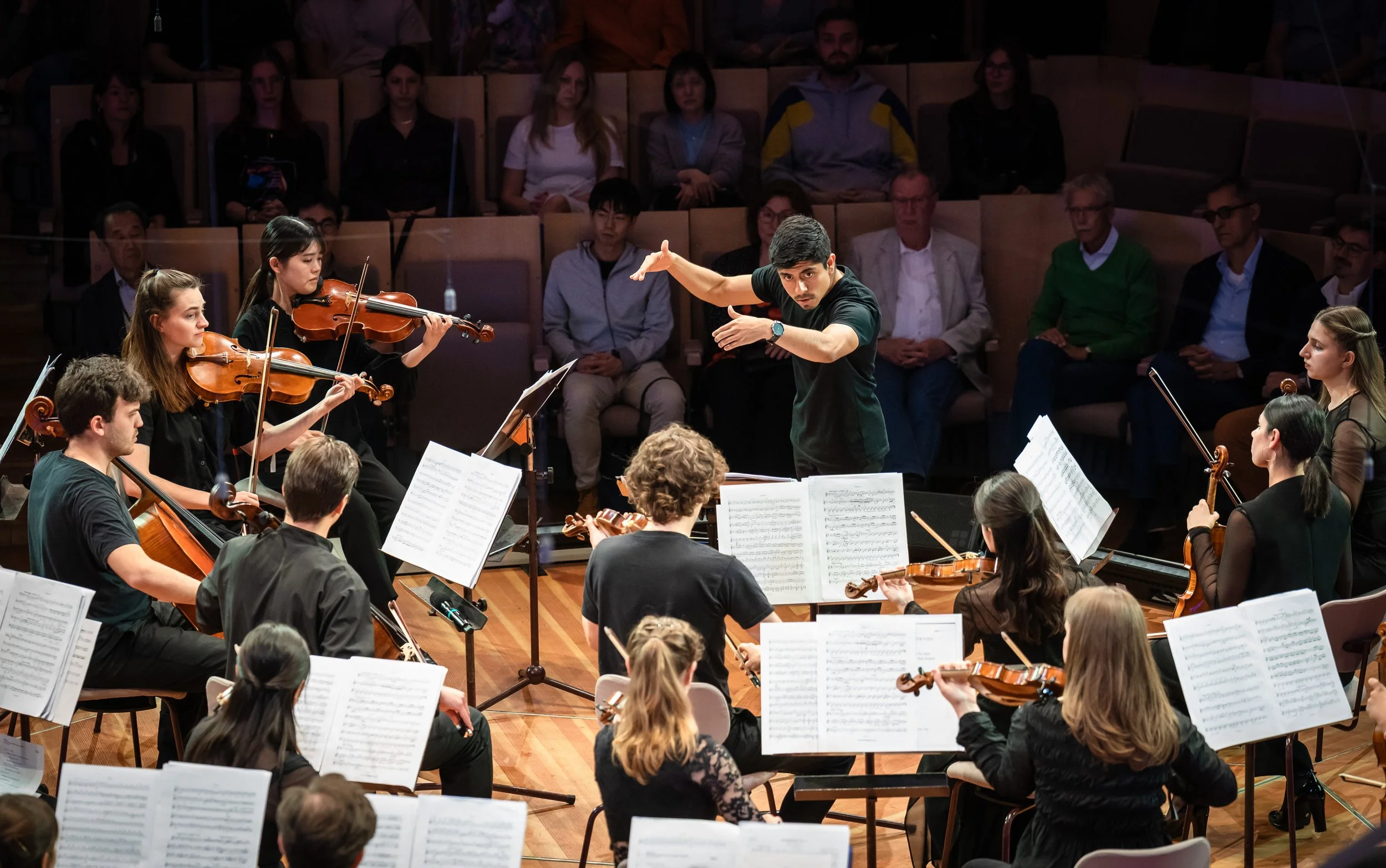
Dayner Tafur-Díaz conducting the Karajan-Akademie of the Berliner Philharmoniker. Photo @ Stephan Rabold
You started as a conducting scholar at the Karajan-Akademie in 2024. What has this been like?
Starting as a conducting scholar at the Karajan-Akademie in 2024 has been an incredible experience. Within the Karajan-Akademie, I’ve had the opportunity to attend workshops, from personal branding as a musician to musical interpretation. Another great aspect of the Karajan-Akademie is the close contact with the other members, with whom there is sometimes the chance to perform together in a concert once per season. For example, we once performed a concert called #Beethoven, which was mixed with rap music. The idea of this project was to bring in a generation that might had never experienced classical music and integrate them into this event.
Another concert I had the opportunity to conduct with the Karajan-Akademie took place in November last year. In addition to Prokofiev’s First Symphony, we performed music from the film Psycho by Bernard Herrmann together with the actor Martin Wuttke. Both were very enriching experiences, as they showed two very different ways of presenting music: one aimed at reaching new audiences through a fusion of classical and contemporary styles, and the other combining orchestral music with theatrical narration, bringing the dramatic power of film music to the concert stage.
Beyond this, there is an important distinction between me and the musicians in the Karajan-Akademie: we are all scholars, but I don’t have an official instrument, and the biggest difference between my colleagues and me is that they have regular lessons with musicians of the Berliner Philharmoniker —for example, the violinists get lessons with the concertmaster. In the case of the conducting scholar, the role is different and is more closely connected to assisting and observing the work of the conductor and the orchestra and learning directly from the rehearsal process with conductors such as Kirill Petrenko.
Finally, no matter the role, you learn about the specific tradition and culture of the orchestra you are attached to. Being with such a great orchestra as the Berliner Philharmoniker allows you to learn a lot from the orchestra itself —its character, personality, and sound— regardless of who is conducting or whether the music suits your personal taste. This approach and mindset can then be transferred to other orchestras.
What does a typical day as assistant at the Karajan-Akademie look like for you?
There is no real “typical” day, but in general, it works like this. Imagine, next week, a new symphony will be performed, for example Beethoven 1. There are two approaches: you could prepare Beethoven 1 as if you were going to conduct it, but I personally prepare differently when I am the assistant from when I’m conducting. I put different priorities. Usually, rehearsals start on Tuesdays, and Kirill Petrenko would hold the first rehearsal. Sometimes, the orchestra already knows the piece very well, other times, less so, so there are more mistakes, but some of these will be corrected during the first rehearsal. During the second rehearsal, I already start making a list. Usually, at the second rehearsal, I meet with Kirill Petrenko and have a discussion. Something that he always focuses on is balance. Since I know that he always works a lot on balance, I bring in other topics, like articulation, whether you need a slightly different colour. I can even tell him when I think that something sounds a bit strange, I can make suggestions. Kirill Petrenko is very open, sometimes he says: “Yes, I will try this.” Other times, he says: “No, I want it like this.”
There are also different situations. Last year, in Baden-Baden, we were doing Puccini’s opera Madame Butterfly. I was able to conduct a bit. Last January, Kirill Petrenko had to cancel a concert series, a whole week. He arrived on a Monday, and Tuesday morning he had to cancel. I had to cover for him a rehearsal with the orchestra.
So, there is no completely fixed schedule, it depends on what is happening. Generally speaking, you have to listen, write and speak.
You also have your own conducting engagements. How do you make this work?
I am expected to be in Berlin when Kirill Petrenko is here. When I started at the Karajan-Akademie, I could also observe some other conductors, like Harding, Barenboim Blomstedt, Dudamel. Nowadays, when Kirill Petrenko isn’t in Berlin, I have other concerts. Right now, I’m taking a longer break because the orchestra is going to Salzburg and I’m coming along, we are doing Wagner’s Rheingold. After two months in Salzburg, I will have other projects.
Was there a particularly important moment for you at the Karajan-Akademie?
As chance would have it, my first program. It was the perfect mixture of hearing the orchestra properly from the front for the first time, from the place where you work as assistant. Usually, the first orchestra rehearsal is closed, it’s only open to the orchestra, the conductor and the assistant. It’s only from the second rehearsal onwards that it might be open to others. Watching from the front changed my perception of how to work with such an orchestra. The program was also really good: Dvorak 7, Korngold violin concerto, I didn’t know it, it’s beautiful, the soloist was really good. I think it was the second time in my life that I was listening to the Berliner Philharmoniker. This time, I was close to the orchestra. I think one of the big strengths of the orchestra are its double basses. It’s very difficult to replicate that with a different orchestra. They are so good, and the instruments are so good, it’s such a full sound.
What is the most important thing you’ve learned here during your time at the Karajan-Akademie?
Of course, I learned a lot from the conductor, but in terms of the orchestra, the warm sound of the strings. It’s not so easy to imitate. It’s also connected to the hall. This sound for a Brahm’s symphony is very impressive, especially when you sit close to the orchestra.
Does your cultural background in Latin American music have any impact on how you approach classical music?
Yes: it’s the Latin American rhythm. I didn’t mention that I started with music like salsa when I started playing the trumpet at thirteen. Classical music came later. I wasn’t able to read music, I was just learning by listening and imitating my teacher. In salsa and Latin American music, there are always syncopations. If you translate that into European classical music: of course, in Mozart, there aren’t that many syncopations, in Beethoven, there are a few more. But right now, I am working on Puccini’s opera La Bohème. It doesn’t sound like Latin American music, but there are some hidden rhythms that go in this direction. Maybe it has something to do with Italian culture, I don’t know. It has a 6/8-time signature that is constantly moving, we say “two against three” in music. The rhythm shifts. I think to feel this, you need to have it in your body before you communicate it to the orchestra.
What advice would you give to your younger, sixteen-year-old self?
When you are worried about something, think about whether this would still worry you five years, five months, or five days from now. Sometimes it’s not worth worrying about. Sometimes, one has to think a bit less about things. Instead, build something steadily. No matter what you study, there is always a learning curve. There are people who are more talented, there is always somebody who is better. But one has to follow the curve, with its ups and downs. Just don’t give up, keep going.
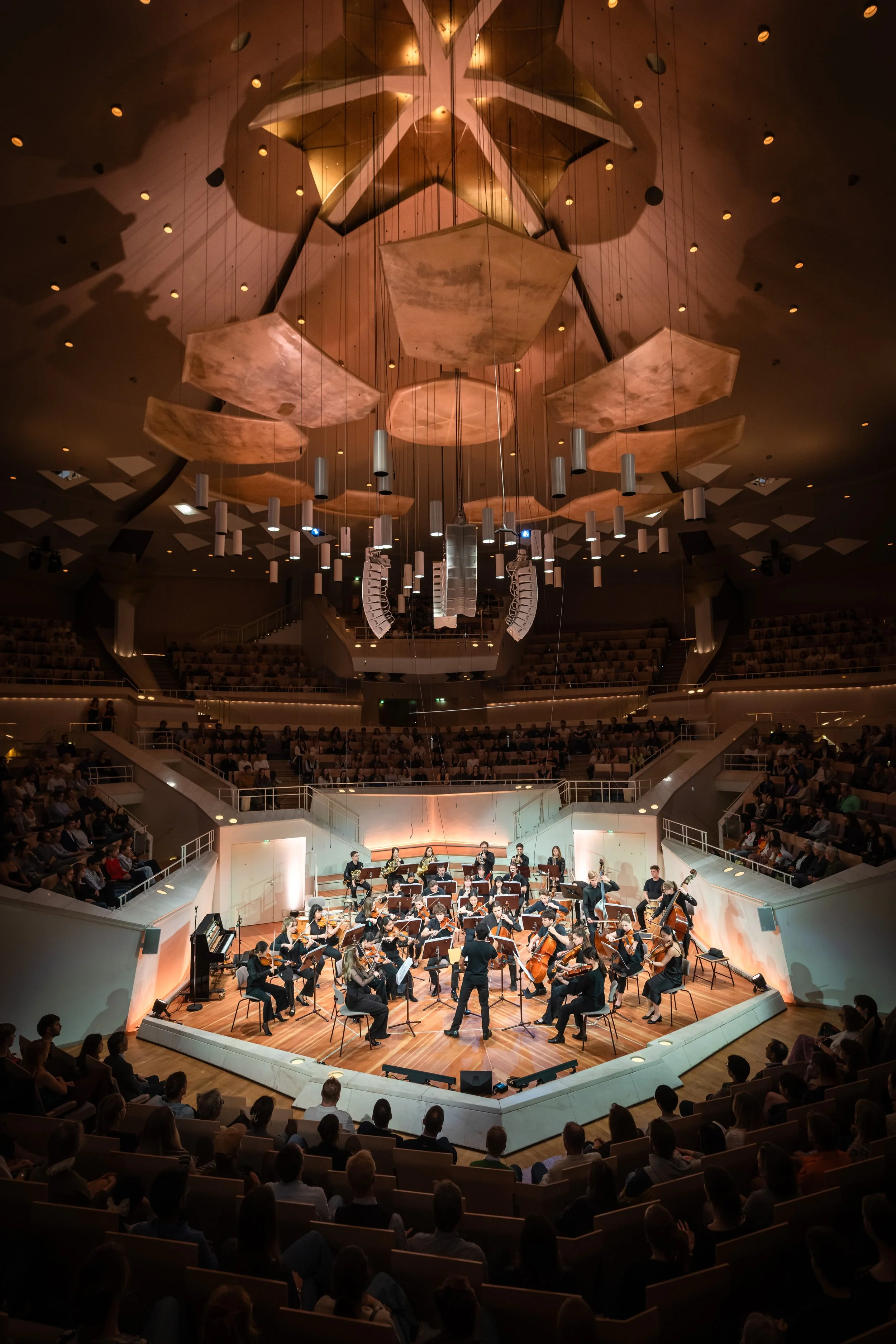
Dayner Tafur-Díaz conducting the Karajan-Akademie of the Berliner Philharmoniker. Photo @ Stephan Rabold