From Bruges with Love: Why Do Cities Love Refik Anadol?
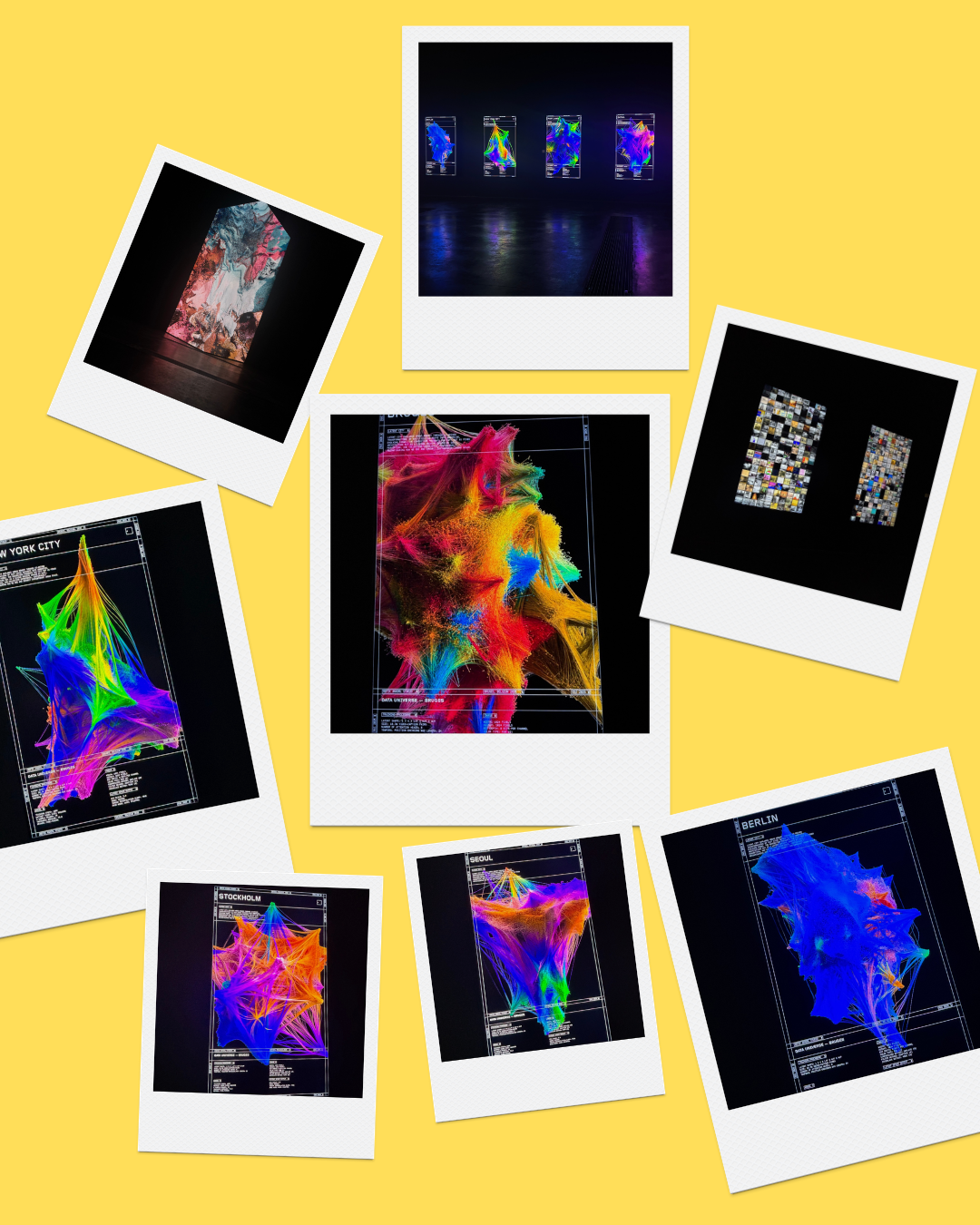
Refik Anadol. AI Data Paintings: Latent City, 2026, Bruges, Belgium. Photos by Melis Seven
5 July 2026
Dear Friend,
Stepping into Refik Anadol’s Latent City exhibition at BRUSK, the new contemporary art center at the very heart of Bruges, Belgium, I was filled with excitement and curiosity. I was expecting to see one of Refik Anadol’s fluid and colorful massive “data-sculptures” in the exhibition room. I was pleasantly surprised when I saw the data-sculpture, surrounded by different AI-data paintings. Data is flowing across screens, transforming Bruges into a shifting digital landscape. The experience is undeniably captivating. Yet Anadol’s growing popularity raises an important question: why are cities around the world so eager to embrace his vision?
Over the past decade, the Turkish artist has become one of the most recognizable figures in contemporary digital art practices. His large-scale installations have appeared in museums, public spaces, and cultural institutions across the globe. Often powered by artificial intelligence, and vast amounts of publicly available and accessible data, his works promise a new way of seeing the city, not through the gothic streets and buildings, but through information, memory, and algorithms.
Part of Anadol’s appeal lies in his ability to transform local history into spectacles. Drawing on archives, photographs, and datasets, he converts complex cultural narratives into immersive visual experiences. In Latent City, Brugge is reimagined as a fluid network of collected data points. The ever nostalgic atmosphere of the city transforms into a dynamic, futuristic, and malleable digital art sculpture. Its attraction is obvious. Anadol’s installations are visually impressive, accessible to broad audiences and are shareable on social media. At a time when museums compete for attention in an increasingly crowded cultural landscape, institutions that house digital innovations like BRUSK offer a powerful way to attract visitors.
The exhibition also places Bruges within an international network of urban narratives. Alongside Bruges, I encountered AI-generated data paintings inspired by cities including Seoul, Berlin, New York and Stockholm. Their presence aimed to situate Bruges within a global conversation about technology, memory and urban identity. However, as these digital landscapes flow into one another, their visual differences begin to dissolve and be unrecognizable. The same swirling colors, shifting forms and dreamlike aesthetics recur across each city, raising the question whether data-driven art reveals actual local identity. By the time I left the exhibition, Anadol’s depiction of Bruges slipped into a broad tapestry of cities and images, and it became difficult for me to differentiate the city’s distinct identity from the surrounding imagery of works.
This brings me to my next point on how Anadol’s popularity can not be naively accepted. Some observers, including the Artnet critic Ben Davis, describe Anadol’s work Unsupervised (2022) at the Museum of Modern Art in New York as an “extremely intelligent lava lamp,” hinting how his works are visually intriguing but in terms of meaning underwhelming. This reflects on how Anadol’s work can overshadow deeper engagement with the collected archival information that his projects draw upon. While Anadol’s installations are often rooted in these local archives, the resulting visuals risk appearing surprisingly similar to one another.
These tensions make the recent Latent City exhibition particularly significant for Bruges. By opening BRUSK with Anadol’s work, the city positions itself at the intersection of heritage and digital innovation. The exhibition reflects a broader desire among cultural institutions to appear future-oriented while remaining connected to the past. Perhaps this is why cities love Refik Anadol. His work offers an image of the contemporary city that is technologically sophisticated, visually intriguing and globally legible. Whether it also offers a meaningful understanding of local urban identity remains an open question.
From Bruges with love,
Melis
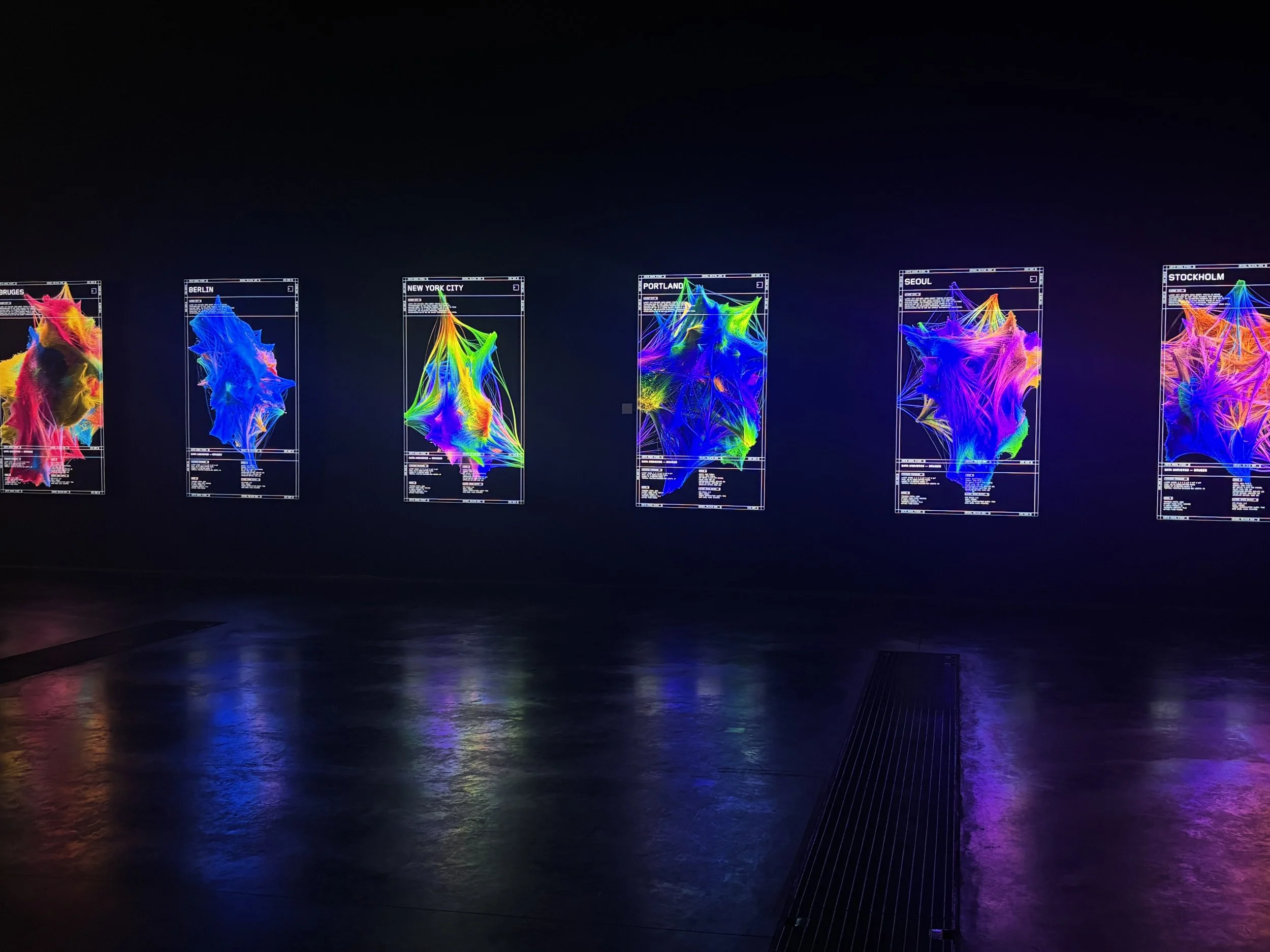
Refik Anadol. AI Data Paintings: Latent City, 2026. Cities from left to right: Bruges, Berlin, New York City, Portland, Seoul, Stockholm. Photo by Melis Seven
You might also enjoy. . .
From Riga with Love: On Singing, Soft Power and the Very Best Food of My Life