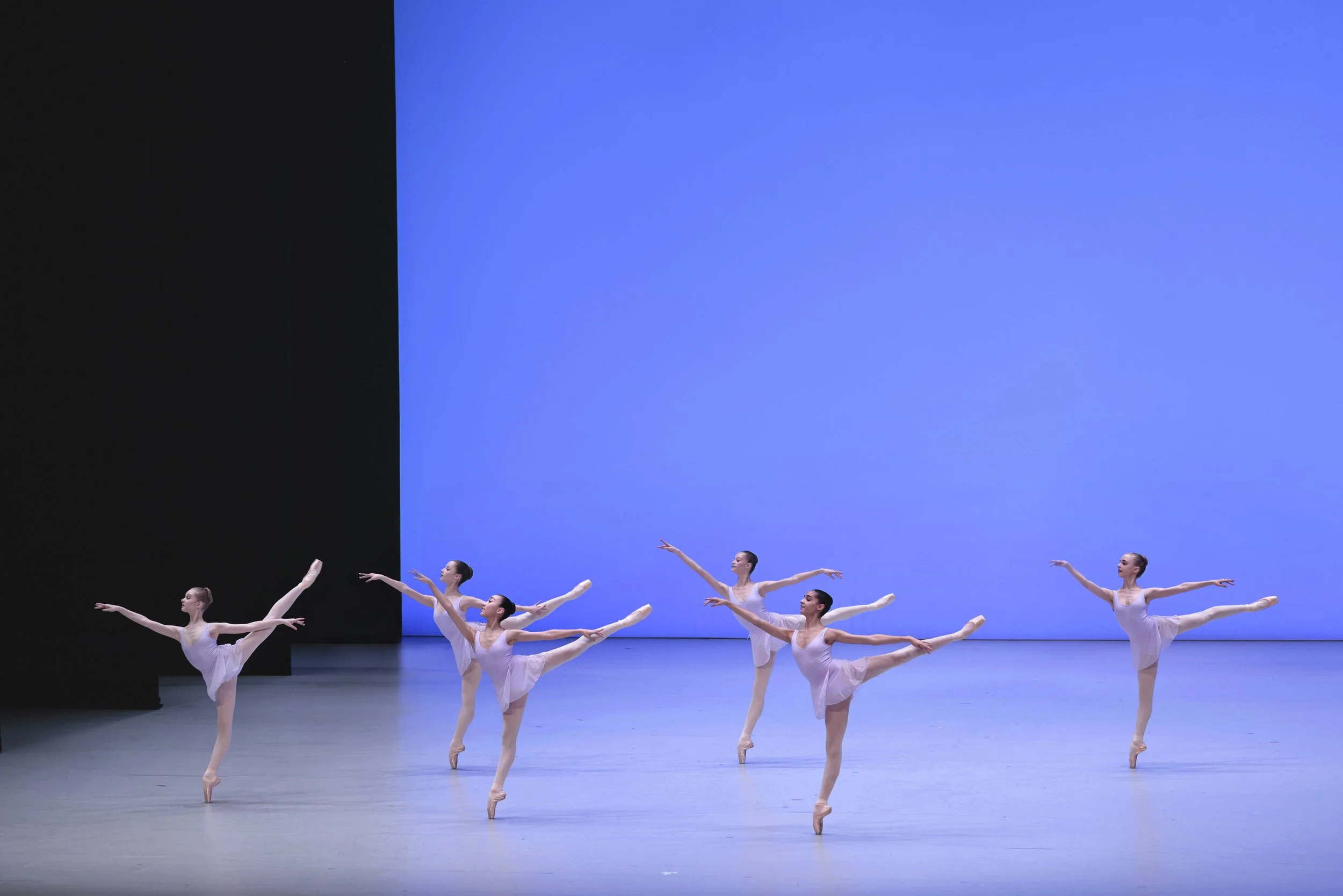
Démonstrations, Paris Opera Ballet School, 2nd division girls, class of F. Cerutti, December 2025. Chloe is on the far left. © Svetlana Loboff, Paris Opera
20 February 2026
One year ago, Chloe Helimets competed as a finalist at the Prix de Lausanne 2025. TWoA talked to Chloe shortly before the competition – and now caught up with the talented young dancer, who moved to Paris in the summer of 2025 to finish her training at the Paris Opera Ballet School.
You were one of the finalists of the Prix de Lausanne 2025. You are now at the Paris Opera Ballet School. What was the process for getting your place at the school?
The Prix de Lausanne organizes a Networking Forum where all interested candidates get a chance to talk to the directors of the competition’s partner schools and companies. The directors decide whom they might be interested in offering further training or a job opportunity. You get called up by whichever school or director wanted to see you. You go to their table. They would talk and review what they had noticed about you and propose an offer. You could say yes or no, or discuss or negotiate. This process would repeat itself again and again with however many people wanted to see you. After the Prix de Lausanne, I went to Paris and took a couple of classes for a couple of days. Ms. Platel, the director of the Paris Opera Ballet School, then told me that I would be accepted into the second division if I wanted to be there. We said “yes”!
You had several offers. Why did you choose Paris?
I liked that it was a very controlled environment, a very close-knit community. It also felt like the best option to really finish my training and become a fully-fledged dancer, not just a student who can do steps.
How was your move to Paris?
I live in Paris with family and I'm really happy to have them with me. I think it's made the transition a lot easier. We live close to the school; it’s around a fifteen minute walk every morning.
What was your first impression of Paris and of the school?
It's very European, whatever that means. I was really happy to see that everyone was very nice. It felt very accepting; they really made an effort to have a mutual understanding despite the language barrier. I'm getting better at French but it's still far from natural. I have to think a lot before I construct a sentence. It takes a lot of deliberation for most conversations, but it's definitely becoming easier to understand and to take corrections and follow directions. At the school, I noticed that everyone works so hard. It’s very inspiring and really motivates you to up your own game.

Démonstrations, Paris Opera Ballet School, 2nd division girls, F. Cerutti, December 2025. © Svetlana Loboff, Paris Opera
What about your academic studies?
I got my high school diploma last summer so that I wouldn't have to do academics here in a foreign language. So that part is finished, which is nice. I have a lot of free time in the mornings. I have French classes two or three times a week for around forty-five minutes to an hour and a half, to learn how to speak French and how to exist in a French environment.
What was your first day at the Paris Opera Ballet School like?
Frankly, it was a little bit confusing. There were a lot of things to get used to very quickly, and you really have to know where to go. I had one friend with whom I had taken a couple of summer intensives over the years. It was definitely helpful to have someone with whom you can speak and check information with, just to make sure that you are understanding everything correctly. The first day, I just did a lot of listening, a lot of observation to really make sure that I was doing the right thing at the right time in the right place.
What does a typical day look like for you now?
We're starting our rehearsals for the spring performances. My teacher is Madame Cerutti. Right now, we usually have one technique class in the early afternoon, and the rest of the day is rehearsals. We finish around 6:30pm.
When we are not focusing on rehearsing, there are a lot of great classes that are very enriching. Every day, there is something different. There are classes that aren't strictly dancing, like history of dance, anatomy, music, music theory. This helps me to have a deeper understanding of the way my body moves, and how and when. We also have extra technique classes, pas de deux, contemporary. It makes the weeks very interesting, to have so many different things to do, so many different things to study and learn.
I found the music theory classes really helpful. I found it very helpful for my musicality to be able to count the music and understand the time signature, the tempo and how that translates to dance. I found the contemporary classes a bit daunting because it was Graham technique, a technique that I'd never tried before and that is notoriously complicated, with the contractions and so forth. It was definitely a learning curve to feel natural in the technique, but once I got it, I actually found that it translated quite well to ballet with the breathing and the natural form of the movement.
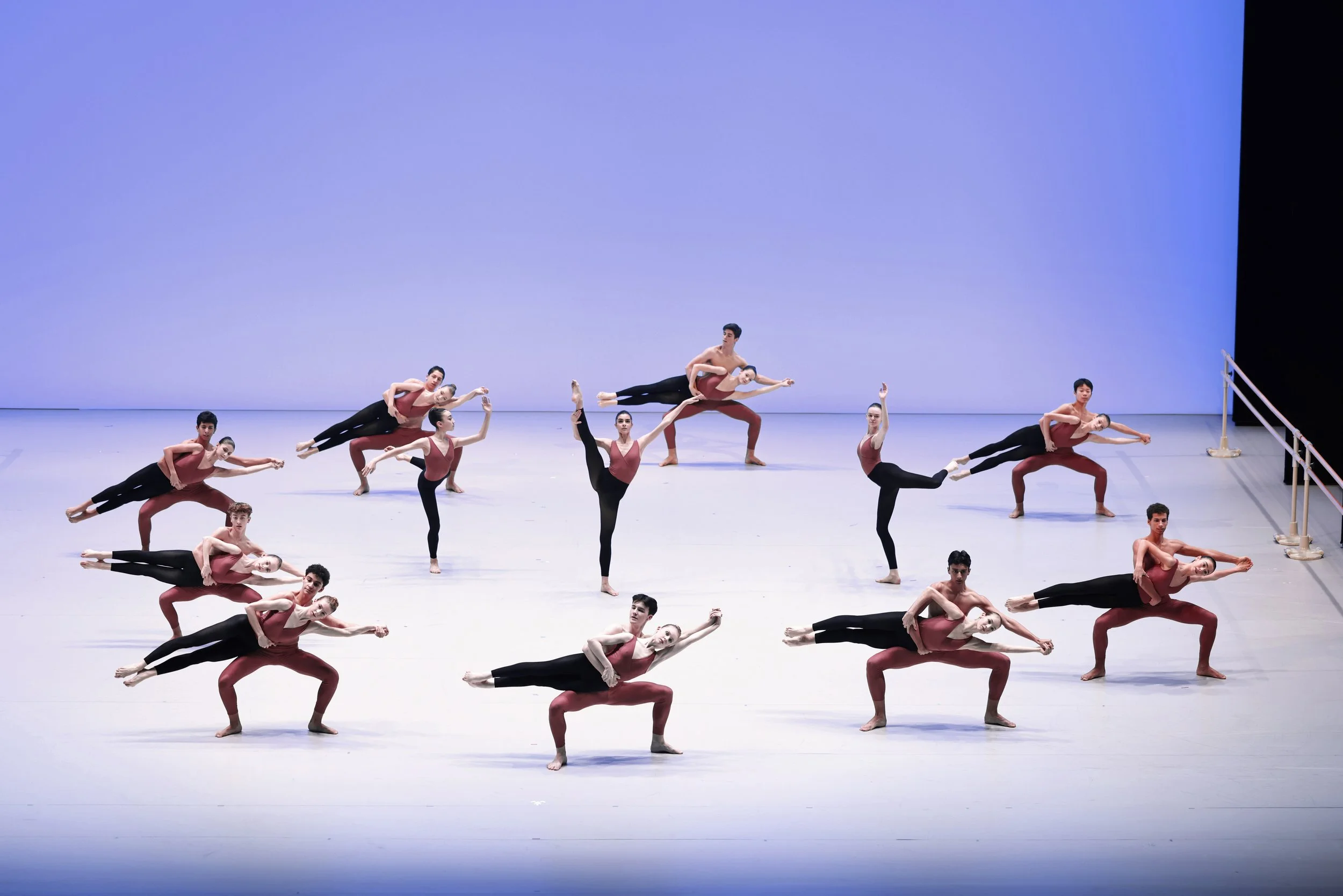
Démonstrations, Paris Opera Ballet School, 2nd division, contemporary, December 2025. Chloe is in the second couple from the left, front row. © Svetlana Loboff, Paris Opera
Before moving to Paris, you trained with Inna Bayer of Bayer Ballet in California, a school that teaches Vaganova technique. What are the main differences in style and emphasis that you have noticed?
I think the main difference between Vaganova and French technique is the emphasis on different parts of the class. With Vaganova, it's really a lot about the barre and the adagio and the particular placement of the head with the arms and the coordination of them. In French technique, I think it's a lot more about the feet and footwork, specifically the small jumps and the beats. It’s definitely a very different way of training from Vaganova, the class progresses much more quickly with a lot more focus on the footwork and the precision of the feet.
What are the dance qualities that you admire most about the students at the Paris Opera Ballet School?
One of the nice qualities of the French arms is their underlying elegance. There's a certain femininity to the gestures, the position of the head. The dancers who have been here for a long time really have that down pat. It's really nice to watch in my fellow students and to try and emulate.
Could you talk a bit more about the stylistic differences of the French and Russian arms?
I think with Vaganova, the arms are a lot more grand. They are more focused on the large, extended positions. I think the French are more focused on the line of the entire body, to really connect everything to everything else. The arms can be a little bit lower, but they are framing the chest and the face and the legs in a way that's very, very poised.
Do you feel you have already made some adjustments to your dancing?
I think the general quality of my movement has changed a lot. In French technique, there is this really nice juxtaposition between the arms and the legs: the arms will be very, very soft and elegant, and the feet will be moving so quickly, so rapidly, taking such clear pauses and positions. It is a difficult thing to learn in just a few months, but I do think that it's becoming more natural to me.
At the beginning of the school year, you took part in the iconic défilé at the Paris Opera, the opening of the ballet season at the Palais Garnier, where all the ranks of the school and company walk down the stage dressed in white, from the youngest student to the leading étoiles (principal dancers) of the company. What was that like?
The first rehearsals for the défilé were a little bit confusing for me. “Confusing” is the wrong word, but I didn’t entirely know what to expect and what it was going to be like. Almost everyone in that rehearsal had done the défilé five, six times already, depending however many years they had been in the school. They immediately knew what to do. It was a pretty steep learning curve for me: how many steps to take, how long to stay on stage. I just had to use peripheral vision. We have a raked studio in in the school, so about a month before the défilé, we had rehearsals, once or twice a week, just practicing the walk and the order of the people. We actually didn't have that many rehearsals at the Garnier. Once I understood what was happening, it was a lot more fun. I felt like I was able to really perform, even though you just walk down a stage and then leave. It is really, really inspiring, especially at the Garnier, the Paris Opera, itself.
The défilé looks stunning, it captures the essence of Paris Opera Ballet, even though the dancers just walk down the stage. What is the secret behind the walk?
You have to really turn out and lean back, the stage is so raked. If you don't lean back, you're going to tumble forward.
The second highlight of the school year are the “demonstrations” at the Palais Garnier before Christmas and the New Year.
The demonstrations are basically a performance of a technique class that each class does. It's a little bit more theatrical, a little bit more choreographed than a normal class. It's supposed to demonstrate what each class has learned since the beginning of that school year and showcase what they can do. It shows what the school is working on to a large audience. We definitely had a lot more preparation for this than for the défilé. There are six divisions (grades), and each gets about fifteen minutes. The top three divisions don't do a barre because they do their demonstrations on pointe, but the smaller girls and boys do have a section at the barre.
You have now started preparing for the school performances in April. What will be the program?
We will perform Leo Staats’ Soir de fête, John Neumeier’s Yondering and a new piece created by Clairemarie Osta, The Little Prince, based on Antoine de Saint-Exupéry’s story.
You have a year and a half until you graduate. What are your main goals for that period?
I would really like to try and master the French style as much as I can in this time, really working on footwork and precision and speed, especially as I don't naturally move very quickly. I think the French technique poses a lot of difficulties; there are a lot of things to work on which are going to be very helpful for me.
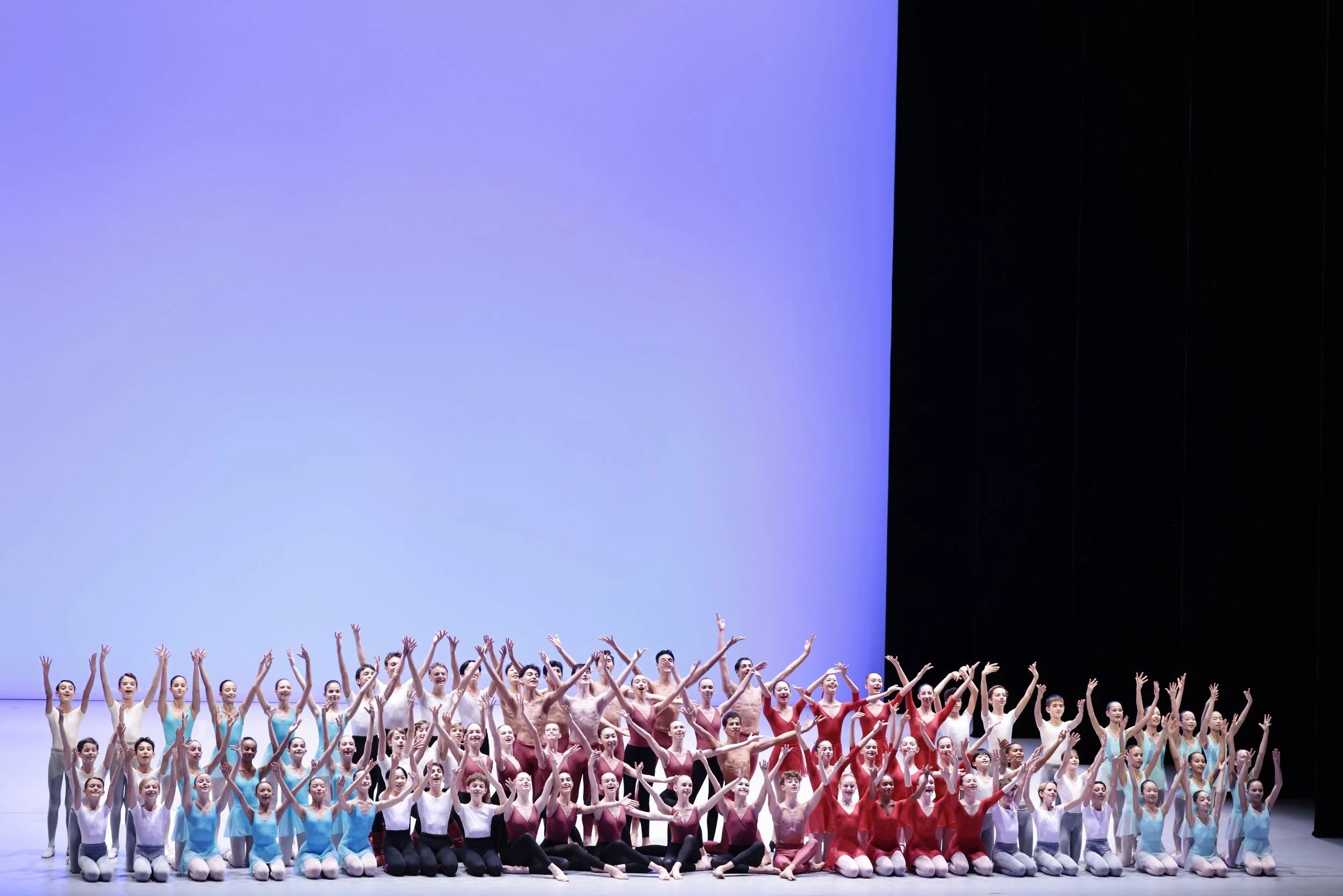
Démonstrations, Paris Opera Ballet School, December 2025. © Svetlana Loboff, Paris Opera