From London with Love: Is Lucian Freud Overrated?
1 March 2026
My dearest artlings,
To have your first paintings sold by Peggy Guggenheim is a feat in itself. It is, conveniently enough, also a whole lot easier if your last name is Freud, and Sigmund happens to be your grandfather. I’ve never really thought about Lucian Freud. When it comes to British artists, I prefer Stanley Spencer or Francis Bacon. His paintings feel flat to me, bland, and his subject matter–not too interesting. And yet, when a friend asked me to check out the National Portrait Gallery’s latest exhibition of his work, I could not refuse. I hadn’t seen her in four months.
So I dragged myself out and braved London’s coldest and rainiest February to date–at least in my experience. Doing that on a Wednesday, I hoped, would spare me the pandemonium of tourists that flock to Soho in spite of the weather conditions. I was, of course, wrong. Sidestepping one tourist to then be shoved by another, I spotted her at the NPG’s steps, the fur-leather jacket making her unmistakable. It was that cold.
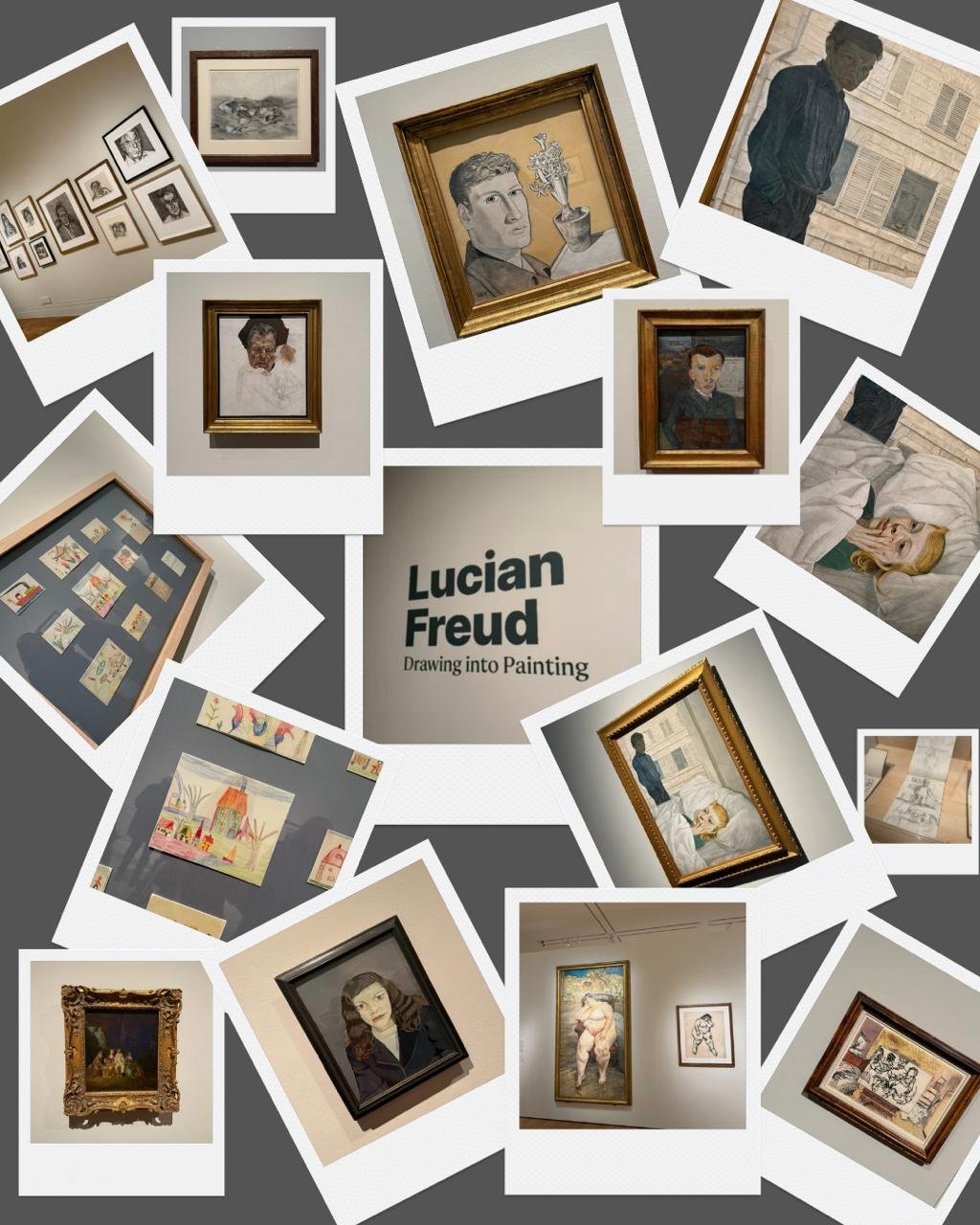
A hug, the routine bag check, and ten minutes of waiting later, we stepped inside “Lucian Freud: Drawing into Painting.” A wall panel clarified the focus of the exhibition: Freud’s lifelong preoccupation with the human figure–and, as per the title, the dialogue between his drawings and his paintings. Freud was a master draughtsman. Using pen, ink, and charcoal, he rendered the human body in all its states: contemplation, drowsiness, weariness, anguish. He worked from observation, regardless of subject; be it people, animals, or plants, he mimicked what he saw. This is, perhaps, what happens when your kin’s talents blend to birth your own: his grandfather was a notorious psychoanalyst, and his father, Ernst, an architect, who loved sketching.
I cannot say that I was impressed. The hallway boasted Lucian’s earliest works–the childhood drawings that delighted his mother and led her to submit his work to Peggy Guggenheim’s London gallery in 1938. If you saw them yourself, you’d probably think what I did: my baby sister could do better. Angular ships, two-storey houses, with a tree on their right, and the occasional twisted flower don’t tend to be portents of a great career. But, in his case, they were.
Studying under Cedric Morris, Freud quickly garnered acclaim: Kenneth Clark, then Director of the National Gallery, encouraged his work, and the Evening Standard claimed that he “promises to be a remarkable painter, intelligent and imaginative.”
Was he? Moving between his drawings and paintings, I felt underwhelmed. The portrait of his first wife, which was supposed to carry great psychological depth, felt shallow to me; I can find so much more tension in the figures of Schiele and Degas. His brushwork didn’t speak to me, either; it seemed too dabby, too lifeless for my taste. As for his draughtsmanship, it is excellent, but so is that of many lesser-known artists.
Is there anything that I will actually like, I wondered. We were breezing through the exhibition and, as two art historians, we don’t usually do that. We take hours. Here, we only needed minutes.
Eventually, we stopped before Hotel Bedroom, a painting of a woman stretched out in bed as a man lingered by the window, his eyes trained on the viewer. I like this, I said. His eyes should be drawn towards her, though. My friend nodded. With its city background, the canvas reminded me of Edward Hopper, and his work’s implicit loneliness. The woman’s face confirmed this. As her fingers clasped her cheek, she stared beyond the picture frame, her inward, hollow gaze revealing tension and isolation. It felt as if the man were leaving her, stepping out of the suspended time of the hotel room and into the city beyond the open windows, while she lay alone, abandoned and motionless. I felt that.
The pictures in the next room compelled us a little more. Showcasing Freud’s portraits of Old Master paintings, they revealed the artist’s influences–and made us remember our college essays. His painting after Chardin, drawing after Constable’s Elm, and reimagination of Watteau’s Large Interior W11 were a breath of fresh air. So were his portraits of friends and dignitaries, the late Queen Elizabeth II included.
But we’d had enough, and we both preferred the brisk London air to these dark, crowded rooms. The exhibition was anticlimactic. It could not hold us, at least not as the Lee Miller show had, or the Jenny Saville one before it. The cold was suddenly refreshing, and my gallop up Charing Cross Road warmed me up. Dodging one tourist after another, I tried to hang onto my impressions. I had a City Letter to write.
More soon,
Maya