Ballerina in Flames: The Tragic End of Emma Livry

“Théâtre de l'Opéra: Accident of Emma Livry During Rehearsals for La muette de Portici,” E. Roevens. Le monde illustré, 1862, Paris
September 2026
On 15 November 1862, twenty-year old Emma Livry was shaking out her skirt in the wings of the Paris Opera, ready to make her entry during the dress rehearsal of the opera La Muette de Portici. The young dancer failed to pay attention to the gas light in the wing. In 1822, the Paris Opera had been the first to introduce gas lighting to the opera and ballet stage. Stage lights could now be dimmed, paving the way for the poetic moonlit scenes of the Romantic ballet.
Emma was considered the heir apparent of the great Romantic ballerina Marie Taglioni, but now her life was in danger because of a technical innovation central to the Romantic ballet. The brisk movement of the skirt roused the gas flame; it darted over its guard, licking the dancer’s highly inflammable skirt.
A fireman shouted: “Don’t move, mademoiselle!” Frightened, Emma turned around, realised that her costume was on fire, and ran on stage in a panic. The gush of air dramatically increased the height of the flames. A fireman rushed towards the screaming dancer with a safety-blanket, throwing her to the ground and extinguishing the flames by rolling with her on the boards. Emma was carried out on a stretcher; extensive burns covering her thighs, loins, back, shoulders, and arms.
Romanticizing Death

Portrait of Emma Livry, Musée Carnavalet, Paris
Ballet historian Ivor Guest described the eight months of agony that followed: “For more than four months, [Livry] remained lying face downwards with her arms outstretched,” her doctors prohibited her “to speak, and even to groan or weep or make any movement at all, for fear that the feeble tissues that were being encouraged to cover her sores might be damaged.”
Emma Livry died on a summer night in July 1863. Her signature role had been Farfalla, a princess turned into a butterfly by a wicked fairy. French poet Théophile Gautier, co-librettist of the ballet Giselle, remembered the dancer while describing the funeral cortège weaving its way to the Montmartre Cemetery.: “She had an imponderable lightness, and her silent flight traversed space without our hearing even a thrill in the air. She imitated the butterfly in ‘Le Papillon’ – a butterfly that poses on flowers and does not bend them. And alas! like one, she burned her wings in the flames; and two white butterflies, as if they wished to escort the funeral cortège of a sister, winged their snowy way to the cemetery.”
Reality Check I: The Price of Beauty
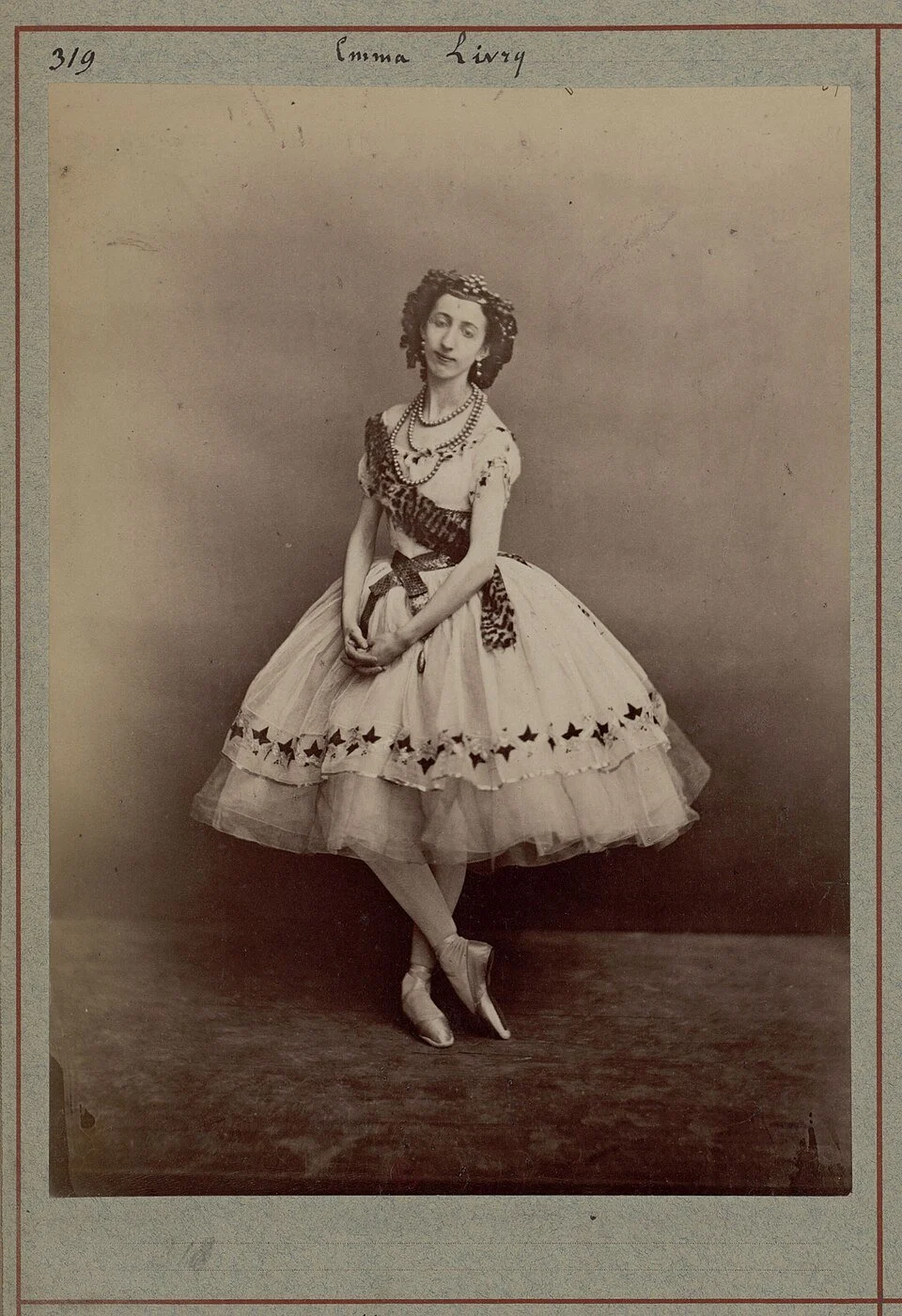
Emma Livry, photographed by Atelier Nadar
Livry’s tragedy was a haunting example of life imitating art. On the surface, it perfectly corresponded to Gautier’s poetic vision of the otherworldly Romantic ballerina: a weightless, fragile creature, an ideal beyond the reach of mortal men, doomed to an early death. But the dancers who created this ethereal Romantic vision on stage were women of flesh and blood who had reached stardom on the stony path of a harsh reality. The introduction of pointe technique allowed the ballerina to create the illusion of gravity-defying weightlessness, but those first pointe shoes were not the hard pointe shoes we know today: the dancers merely fortified regular satin ballet slippers with heavy darning. Then and now, muscles of steel, chaffed skin and bloody feet were the reality behind the illusion.
The long Romantic tutu might have looked like a gauzy cloud, but it could become a mortal danger to its wearer. Reaching mid-calf, it was made of stiffened, highly inflammable Tarlatan. The introduction of gas lighting dramatically increased the risk of devastating fires and led to so many accidents, that the British medical journal The Lancet published an article on “The Holocaust of Ballet-Girls” in 1868, using the term “holocaust” in the original meaning of burnt sacrifice. But the success of the Romantic ballerina hinged on the illusion of weightlessness, and Emma Livry was not the only one to refuse to apply a flame retardant to her costume, even though a 1859 ministerial order had made this mandatory at the Opéra: the solution turned the fabric yellow and made it brittle. Like Emma, many dancers didn’t apply it to their costumes, because their art and livelihood depended on creating an illusion that, last but not least, might attract the attention of a powerful male protector.
Reality Check II: Male Patrons
The Romantic ballerina was an innocent airy spirit, more myth than flesh and blood, but the livelihood of the Paris Opera dancers often depended on finding a wealthy, powerful male patron. Emma Livry was the illegitimate daughter of Baron de Chassiron and the dancer Célestine Emarot. Emarot’s mother had been employed in the linen trade in Dijon but moved to Paris in search of a better life. Shortly after entering the Paris Opéra Ballet School, Célestine became the mistress of Baron Charles de Chassiron, giving birth to little Emma in 1842 when she was about eighteen.
Baron de Chassiron soon tired of his mistress. His place was taken by Vicomte Ferdinand de Montguyon. A hardened gambler with a painted face and powerful friends, Montguyon was a regular backstage at the Opéra. He became the perfect champion for his lover’s gifted daughter. Montguyon’s patronage enabled Emma to make her début performance in 1858 at age sixteen in a principal role: the titular Sylph in the first Romantic ballet, Filippo Taglioni’s La Sylphide, created for his daughter Marie Taglioni in 1832.
Reality Check III: Ballerina Solidarity, Not Rivalry
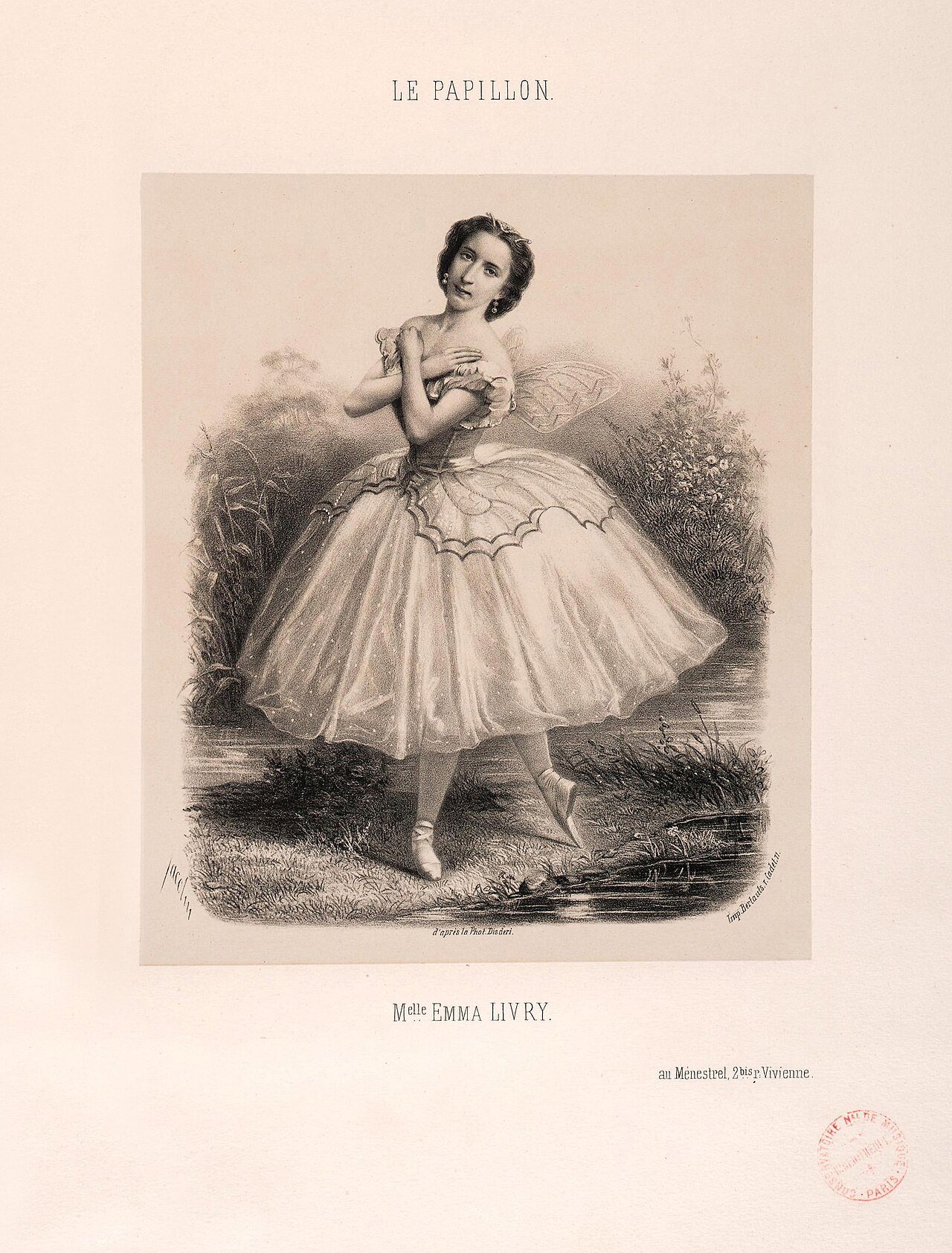
Emma Livry, Le Papillon, Wikimedia Commons
Emma was inexperienced; skinny and plain, she did not correspond to the beauty ideal of the age. The choice of the iconic La Sylphide was a risk because many remembered Taglioni’s performances. The ballerina had inspired such frenzied admiration across Europe that her fans were reputed to have eaten her ballet slippers. The gamble paid off. Emma’s debut was a triumph, inspiring Marie Taglioni to travel post-haste from distant Lake Como to Paris. The retired ballerina was overwhelmed: “It is true that I never saw myself dance but I must have danced like her.”
During the Romantic age, astute impresarios played off real or imagined rivalries between ballerinas to sell tickets, but far from criticising or envying the rising star, Taglioni wanted to give Emma her full support. Taglioni decided to come out of retirement to mentor the future star both as her teacher in the School’s classe de perfection and as choreographer at a time when choreography was very much a male domain. Determined to create a ballet that would showcase Emma and become her signature piece just as her father’s La Sylphide had become hers, Taglioni created Le Papillon (The Butterfly) for Emma, to a score by Jacques Offenbach and a libretto by Jules Henri Vernoy Saint-Georges.
The premiere was a resounding success. It was widely covered in the press, but dance historian Chloé d’Arcy has astutely noted that the male journalists were struggling to recognize the role of a female choreographer. Choreography was considered a male domain, reflected in the masculine French noun for “choreographer.“ The journalists never used the nouns “choreographer,” “composer” or “author” to describe Taglioni’s work, writing instead that she had drawn, arranged, composed the steps of the ballet.
If Livry had lived, maybe the male journalists would have been forced to adjust their language to the reality of a female choreographer: Taglioni was planning on creating another ballet for Livry when tragedy struck. Le Papillon was taken from the repertoire because nobody could bear the thought of seeing another dancer performing Livry’s part, relegating Taglioni’s choreographic debut to the annals of ballet history. Ballet had lost not only a great dancer, but also a female choreographer.