Art for the Invisible: On Childe Hassam’s Women
September 2026
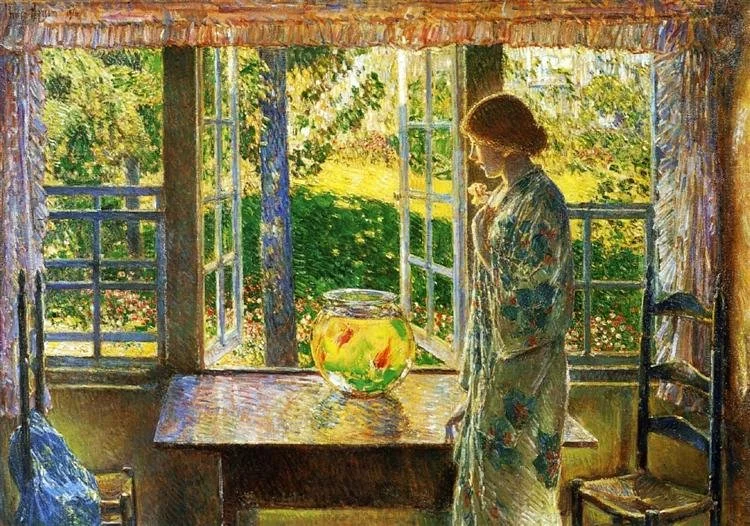
Childe Hassam, The Goldfish Window, 1916. Currier Museum of Art, Manchester, New Hampshire
It is a uniquely feminine experience, I think, to vanish into the home. Even for the homebodies among us, there comes a moment when domestic labour no longer feels like an enjoyable task but a tedious obligation, one that has somehow fallen upon us, and which no one else seems capable of performing. As we go about our household tasks we sense ourselves blend into it, and disappear, while our families continue to work, rest or enjoy themselves. No one seems to notice, except, of course, Childe Hassam.
Childe Hassam (1859–1935) was an American Impressionist painter, known primarily for his depictions of coasts and cities, and for his friendships with Mary Cassatt and John Henry Twachtman. But I love him for a different reason: unlike many of his predecessors or his contemporaries, he neither idealised women nor fought to liberate them. Instead, he depicted them as they felt and experienced themselves: invisible, demeaned, and tied to the home.
Turn to Hassam’s The Goldfish Window (1916) - see image above. Depicting a young woman by the open window of her home, the painting is at once lucid, bright, colourful – and sad. Instead of gazing out with the serenity of Hammershøi’s women, she looks down onto the fish tank. With her fingers clasped around her chest – a thoughtful, self-conscious gesture –, she appears preoccupied. As for the object of her fixation? The fish. With the yellowish blues of their water and the oranges of their bodies mirroring the colours of her robe, they imply she, too, is a fish in a tank. Her tank, however, is the home.
The composition, at least, suggests as much. Traditionally, portraits isolate the figure from its surroundings, giving it visual – and, thus, conceptual – significance. Many Renaissance portraits, for example, place their sitters against bland backgrounds. They also use props and settings to offer cues into the individual’s life and character. This work, however, does none of that. Instead, it depicts the sitter in profile, ensuring her body takes up as little space as possible; worse, by cladding it in a dress that matches the surroundings in colour, it ensures that the woman’s body blends into the background. Woman and home, then, become one. Looking at the work, we don’t feel tempted to dwell on her; instead, we perceive her as part of the environment, on par with the garden, furniture, and fabrics. She is almost an irrelevant fixture, encapsulated within the broader bowl of the home.
That’s no coincidence. By the early twentieth century, women’s bodies had become conceptually enmeshed with the home, an idea nowhere better explored than in the work of scholar Beverly Gordon. As she argues, the domestic interior was imagined almost as a woman’s second body, as indicative of her self and character as her flesh. The idea was this: as she furnished, dressed, and maintained it, she impressed her character upon its surfaces and transformed it into an extension of her – a physical manifestation of her psychological self. So far so good. But this entanglement turned problematic: if the home became an extension of the woman, the woman, in turn, became part of the home, her individual self increasingly absorbed into – and diminished by – its domestic identity. The conflation seeped even into language: women and windows were dressed and draped; tables wore skirts, furniture ruffles and shawls. It is precisely this ensnarement that Hassam captures: the process of a woman becoming so thoroughly identified with her surroundings that she disappears into them and experiences herself first as invisible, then as trapped – mirroring our own route of perception of this painting, as we first see her blending into the home, before the fish tank reveals that she is trapped within it.
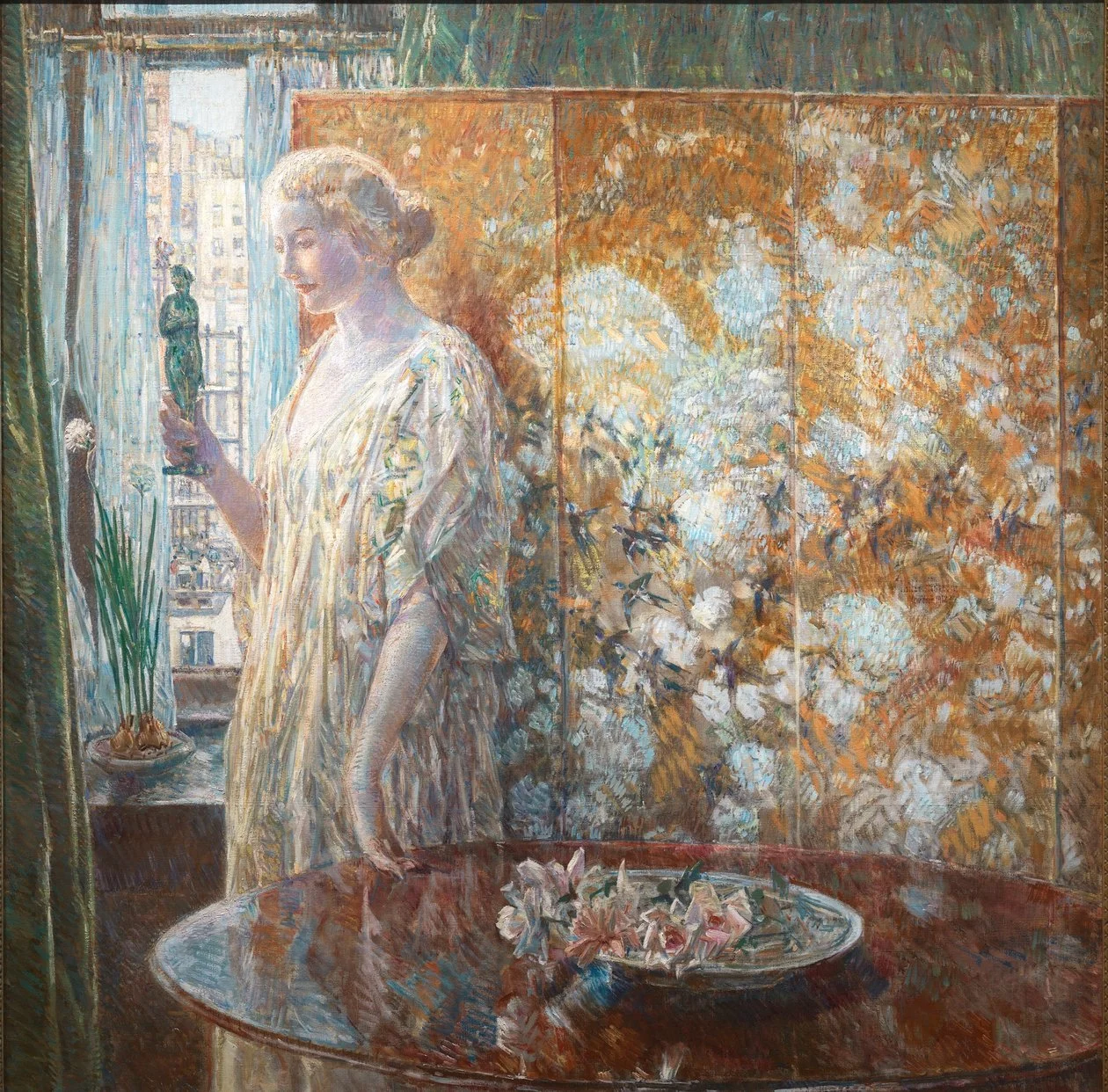
Childe Hassam, Tanagra (The Builders, New York), 1918. Smithsonian Art Museum, Washington, D.C.
This sense of enmeshment culminates in Tanagra (1918). Depicting yet another woman blending into her home, this time, almost disappearing into the floral folding screen behind her. The painting seems to suggest the next step of the process: what happens once a woman has been absorbed into the domestic interior. The small figurine she holds is crucial here. Tiny, decorative and quite literally possessable, it functions as the figure’s double, embodying what she herself is expected to be: beautiful, domestic, seen, not heard; an aesthetically-pleasing presence faithful to the home. And even though the tantalizing world of New York stretches out through the window,she faces no other possibilities; she is turned away from the window, in contrast to her counterpart from The Goldfish Window. Her home, then, becomes more than a reflection of her character; it appears as the force that has absorbed and subordinated her.
Perhaps that is what makes Hassam’s paintings so unsettling. His women are not imprisoned, at least not at first glance. They don’t face locked doors or boast miserable expressions, nor do they visibly plead for escape. But as they lurk in their beautiful dresses – and the environments that reflect them – they betray a sense of confinement, sadness, and isolation, which only another woman can sense.
It is because of this that I love Hassam. He illustrates the strange, burdensome, lonely, and occasionally suffocating feeling of being the feminine presence within the home; even more, he makes women feel seen by portraying the very moments when they aren’t. And manages it all without rendering the domestic environment an overly oppressive space. Instead, he simply documents these feelings, giving visual form to what many women have experienced but few artists have thought to depict.