Photos by Maya Stoilova
Published 3 October 2026
My dearest artlings,
It was a boiling summer day in London and like everyone in the city, I headed where I knew there would be AC. In my case: the Tate Modern, right across the river.
I deeply dislike the Tate Modern. Or at least this is what I have been telling all my friends. I’ve only visited it once, for one of those Tate Lates, where the ground level moves into a dance floor, and the pristine museum light gives way to blues and purples and pinks, with everyone under it bumping into you, shouting, and sweating. The only way to hear your friend is if they scream right into your ear over the blaring, bad music. Anyways, I don’t think I’ve been to the Tate since – that Tate Late was that awful. But that day a new Frida Kahlo exhibition had come to town, and I, as a loyal fan of Salma Hayek, decided not to miss it. (It also helped that there was air conditioning and Borough Market right across the bridge.)
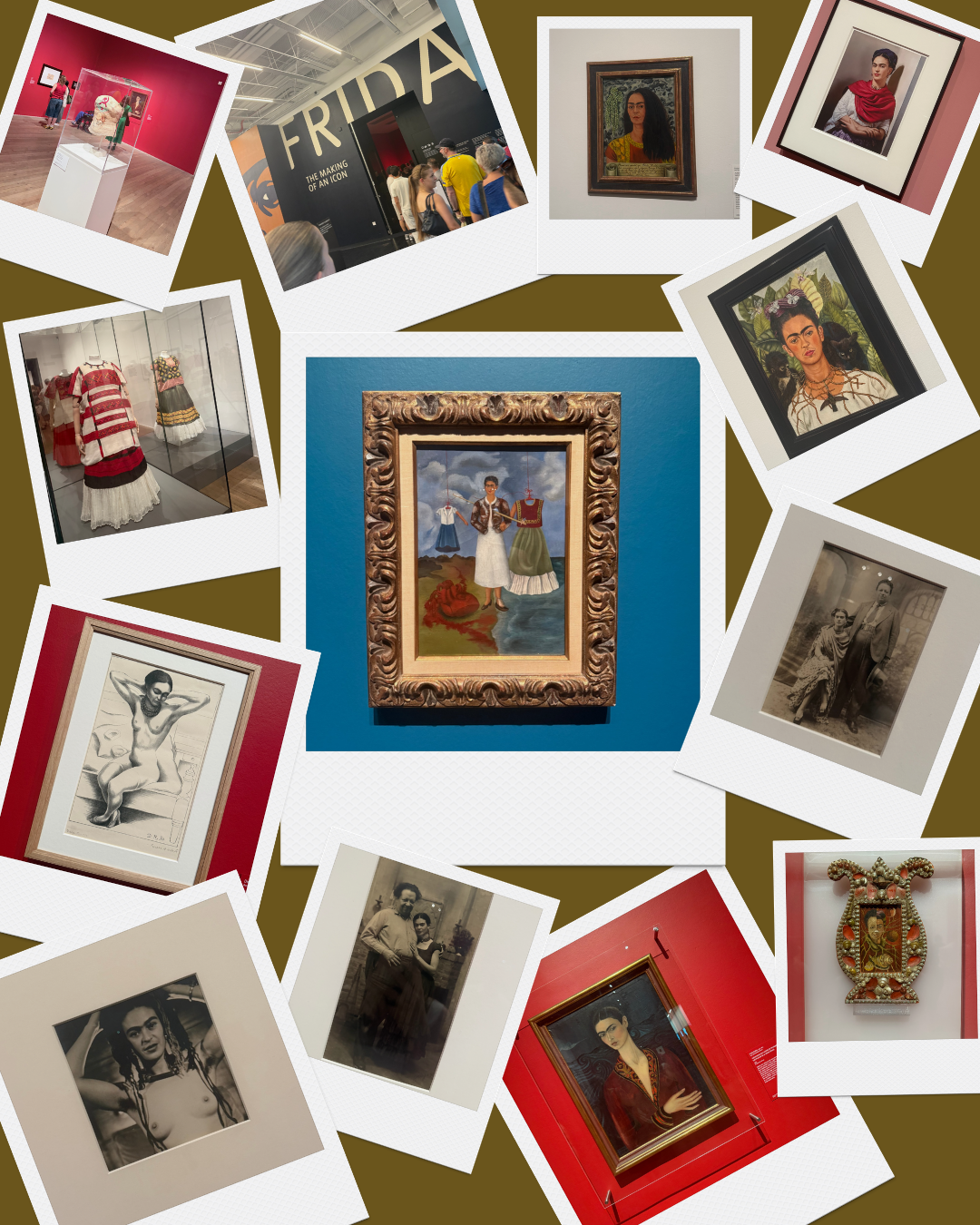
Titled Frida: The Making of an Icon, the show aspired to trace the painter’s ascent to stardom and her influence on the generations of artists who came after her. It followed Frida from a relatively unknown, self-taught, disabled Mexican artist to her invitation to join the Surrealists in Paris and, eventually, global fame. Along the way were her jewellery, clothing and more than thirty original works, alongside many more by the artists she inspired. There was also her social activism – her politics, feminism and Mexican-American civil rights advocacy. And, finally, the phenomenon that eclipsed all of it: Frida herself becoming a product. The final room, aptly titled “Fridamania,” displayed the endless commercialisation of Frida’s face and image. And then, with almost comic timing, it led us straight into the gift shop, to buy that very face on all manner of souvenirs. The irony, I suppose, was unintentional.
Strolling through the rooms, I found myself overwhelmed by the number of works plastered on the walls; and underwhelmed by their quality. The show felt too cramped, busy, and difficult to follow. As much as I tried to look at everything – the precursors to Frida’s work, her dresses, her photographs –, I found the sheer volume of exhibited material discouraged close looking. Worse, it felt scattered, irrelevant, and distracted from the exhibition’s purpose.
So I did what everyone else seemed to do: I only looked at Frida’s originals. Stopping before El Corazón (The Heart), a small picture in the middle of the show, I glimpsed at yet another self-portrait of the artist – and wondered just how fixated she was on her own image, given her accident, the bodily disfigurations that followed, and all the provocative photographs that seemed all but an attempt to reclaim her physical beauty and sexuality.
But to return to this self-portrait. It is yet another rendition of Frida’s two selves – the most famous example, though not currently present, being The Two Fridas. Frida occupies the centre of the composition, standing atop the division between sea and earth. On her left, above the water, hangs her traditional attire, representing her maternal Mexican heritage; on her right, above the soil, looms her German self, represented by a blue-and-white European outfit. Both “selves” reach towards her, and both are tied to the empty void in her chest. Her heart, seemingly ripped right out of it, lies enlarged and bleeding in the foreground. Blood runs from either side, further splitting the picture in two. Frida appears torn between Europe and Mexico, father and mother, earth and sea.
And yet, the Mexican side pulls her closer. Its dress is not only larger but nearer to Frida’s body, while an arm actually reaches out to touch her empty sleeve. It appears to be the identity she embraces more closely. With this implication, the work transitions from an exploration of heritage to a claim of Mexicanness. Even so, the division remains incomplete, the two selves perpetually enmeshed in one another. Notice how the green of the Mexican dress reappears in the German soil, while the turquoise Mexican sea echoes the blue of her European clothes. The colours cross the very boundaries the composition creates, intertwining the two selves even as everything else pulls them apart. The message? Frida may belong more closely to one, but she cannot rid herself of the other. It is this perpetual tornness that leaves her heart bleeding between the two.
This very painting, I think, made the whole exhibition worthwhile. Everything else seemed to pale in comparison, at least to me. Even though Frida is indeed impressive, especially for a self-taught artist of her time, the way this exhibition presented her did her few favours. There was simply too much Frida around to really look at Frida.
But perhaps you have a different opinion. Perhaps you’ll enjoy it more than I did. Perhaps you’ll hold onto its thread of meaning where I lost it somewhere between the photographs, dresses, artworks and Frida-branded merchandise. If you do, reach out. I’d genuinely like to know.
Until next time,
Maya