"Every Faculty Used in the Worship of God": Ann Lee's Triumphant Choreography
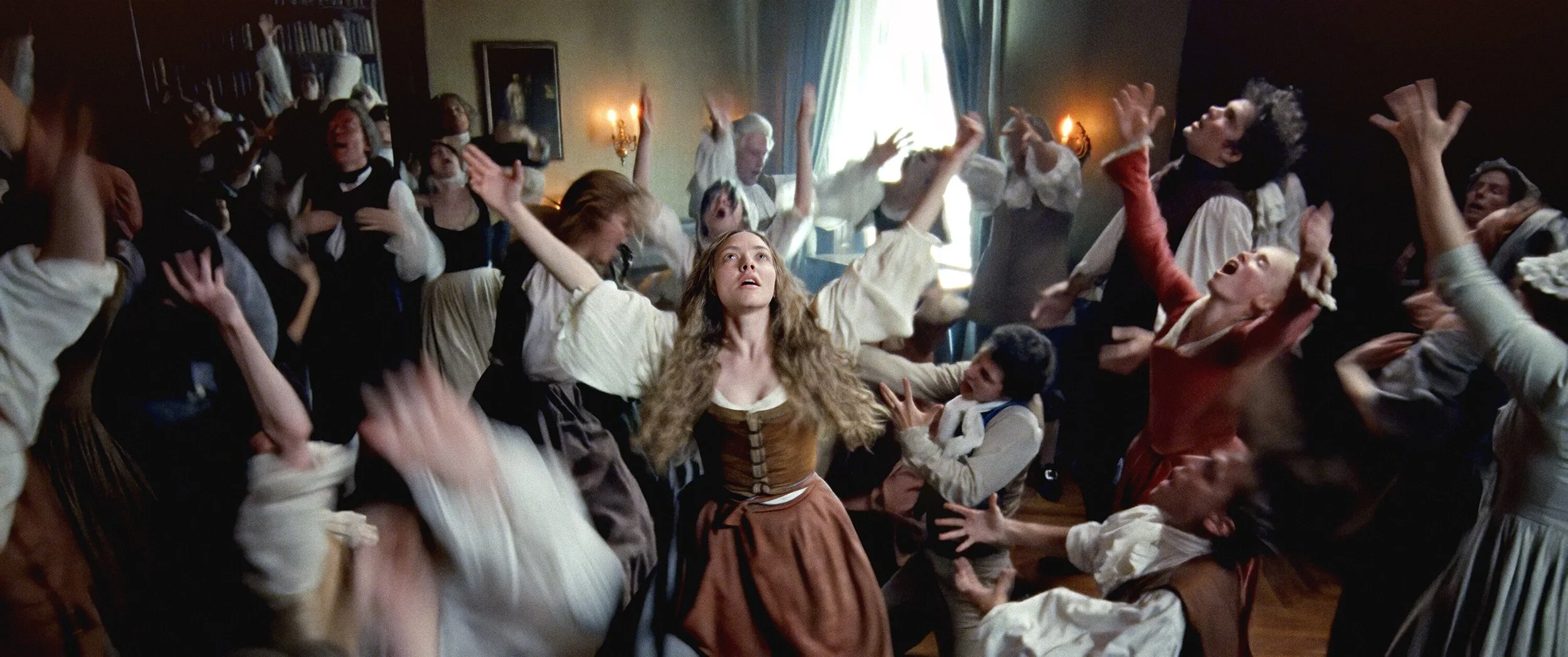
The Testament of Ann Lee. ©Disney
6 March 2026
Ann Lee, played by Amanda Seyfried, dances with wild abandon, her wavy, blonde hair strewn across her peaceful face, head tipped back, arms slicing through the air, hands grasping heavenward. This image, refracted throughout the film, defines The Testament of Ann Lee, writer-director Mona Fastvold’s (co-writer of the 2024 film, The Brutalist) dance-forward portrait of the mother of the Shaker movement.
Ann Lee, born in Manchester, England in 1736 and a forgotten founder of a nearly extinct branch of Christianity, is an unusual subject for a bio-musical. Fastvold’s account of Ann’s life, therefore, is not a typical movie musical, but an experimental dance film. The movie weaves Ann’s story — from her factory childhood, to her transatlantic journey, to her founding of a robust religious community in America — through thrilling choreographic sequences and vibrant, lyrical cinematography scored by original music and Shaker hymns. The film is a beautiful examination of the seriousness of Ann’s faith, occupying the space of both a factual biography and a compassionate artistic interpretation of a woman’s singular commitment to her unshakeable beliefs.
In Manchester, Ann began attending worship meetings at the home of Jane and James Wardley, a “shaking Quaker” group, where she first encountered the practice of dancing and chanting as part of a spiritual community. She embraced this mode of worship, and believed herself to be the Second Coming of God on Earth, whom the Wardleys had foretold would be a woman. With messianic confidence, Ann — who was illiterate, and would remain so all her life — began preaching publicly, and quickly amassed a following, many of whom attested she was able to perform miracles. She was imprisoned several times for blasphemy; once, in jail, she had a religious vision wherein Adam and Eve warned her that sexual relations were the source of all evil, urging her to commit to complete celibacy. Ann, then married, had four children, all of whom died in infancy — a sequence Fastvold’s film depicts with heartbreaking, graphic realism. This trauma may be what led Ann to embrace celibacy as a core tenet of Shakerism; the film closely examines the image of Ann as a mother, her title among her followers. In 1774, she and a select group of Shakers traveled to America, both to escape religious persecution and to settle a continent whose soul had not yet been colonized by one religion. Once in America, her husband rejected the ideals of celibacy that had become integral to their faith, and abandoned her. Undeterred, Ann and her followers settled near Albany, New York.
Another consequence of celibacy was that there was no natural proliferation of the Shaker faith; all new members had to be recruited. During Ann’s lifetime, she and her followers traveled throughout New England on missionary trips, which continued after her death in 1784. The Shaker movement continued to grow without Ann's leadership, and peaked in the early nineteenth century, with over twenty American Shaker communities and a population between 2,000-4,000 worshippers. The Shakers, needing a source of income to fund their growth, became known for their simple, lovingly crafted artisan furniture, a style that is mass-reproduced today. Their peak population dwindled quickly, however, and today the estimated number of practicing Shakers in America is a mere three.
The sect’s very name came from a portmanteau (an abridged combination of two words) of the derogatory label, “shaking Quakers.” This “shaking,” an early version of what would later become codified dance forms, was sometimes called “laboring” or “marching,” and was a way of connecting, through body and prayer, to both fellow worshippers and to God. A source at the Enfield Shaker Museum in New Hampshire writes that: “It was the belief of the Shakers that every faculty should be used in the worship of God [...] The perfect rhythmic body motions of a worshipper, who combined this activity with a deep mental and religious fervor, developed within himself a great spiritual inspiration, almost impossible to understand or describe.” The inclusion of dance in Shaker worship ceremonies had both biblical origins and psychosomatic benefits, in that the bodily release found through the intense movement created in worshipers a sense of physical surrender to a higher power not dissimilar to the kind of transcendence achieved in any rigorous dance form.
Much like any dance form, Shaker dancing evolved over time. In the “shaking Quaker” days of the faith, the dances were more expressive and unstructured. Worship often lasted for days on end in rave-style marathons of dance and prayer. In America, the dance forms grew more formal, as the group built larger houses of worship to contain large, circular dance formations. “Marching” — a “bounding, elastic step” that was bestowed upon the group in a heavenly vision — grew popular as many early Shakers aged, as it was an easier movement for older members to perform; the group’s commitment to egalitarianism dictated that all must be invited, and therefore physically able, to participate. Specific hand movements and clapping patterns grew into set choreography, and Ann Lee’s successor Mother Lucy Wright introduced matching the movements to the lyrics of worship songs, with “the primary gesture a ‘shaking off of sins.’” Outside of the Shaker community, both celibacy and dancing were controversial. After Ann Lee’s death, the group underwent a number of “dance reforms” to shed this reputation.The accusation that the Shakers were transgressing something fundamentally Christian, fundamentally American, by rejecting marriage and choosing to express their prayer through embodied practices, lingers to this day, wherein their dancing is second in reputation only to their furniture.
The dancing in The Testament Ann Lee is both a storytelling device, moving events and characters forward through time and place, and a diegetic — occurring in the story itself, not just the heightened, musicalized version — element of Ann’s life story. The choreography, by Celia Rowlson-Hall, came from Shaker drawings, recreations of their actual dances, and her own imagination. Throughout the film, these dances are performed by a thoroughly committed cast of both “trained and untrained dancers,” shaking, quaking, and shedding their sins. Amanda Seyfried, whose searing performance as Ann Lee is the most subtly thunderous of the year, described the process of preparing for the film’s extensive dance sequences as “life-changing” and “liberat[ing],” due to the extreme presence of mind and body required. Rowlson-Hall described the choreographic process as finding “the container,” which each performer then fills with their individual experience, real or imagined. Director Mona Fastvold rejected the idea of presenting the audience with “a snappy number,” and instead emphasized the individuality of each person’s experience inside of the performance. In many ways, the dance was as spontaneous on set as it would have been in an actual Shaker context, with formal rigor giving way to communion with some kind of creative divine.
Content advisory: The Testament of Ann Lee is rated R (sexual content including sexual violence, nudity, violence, bloody images).