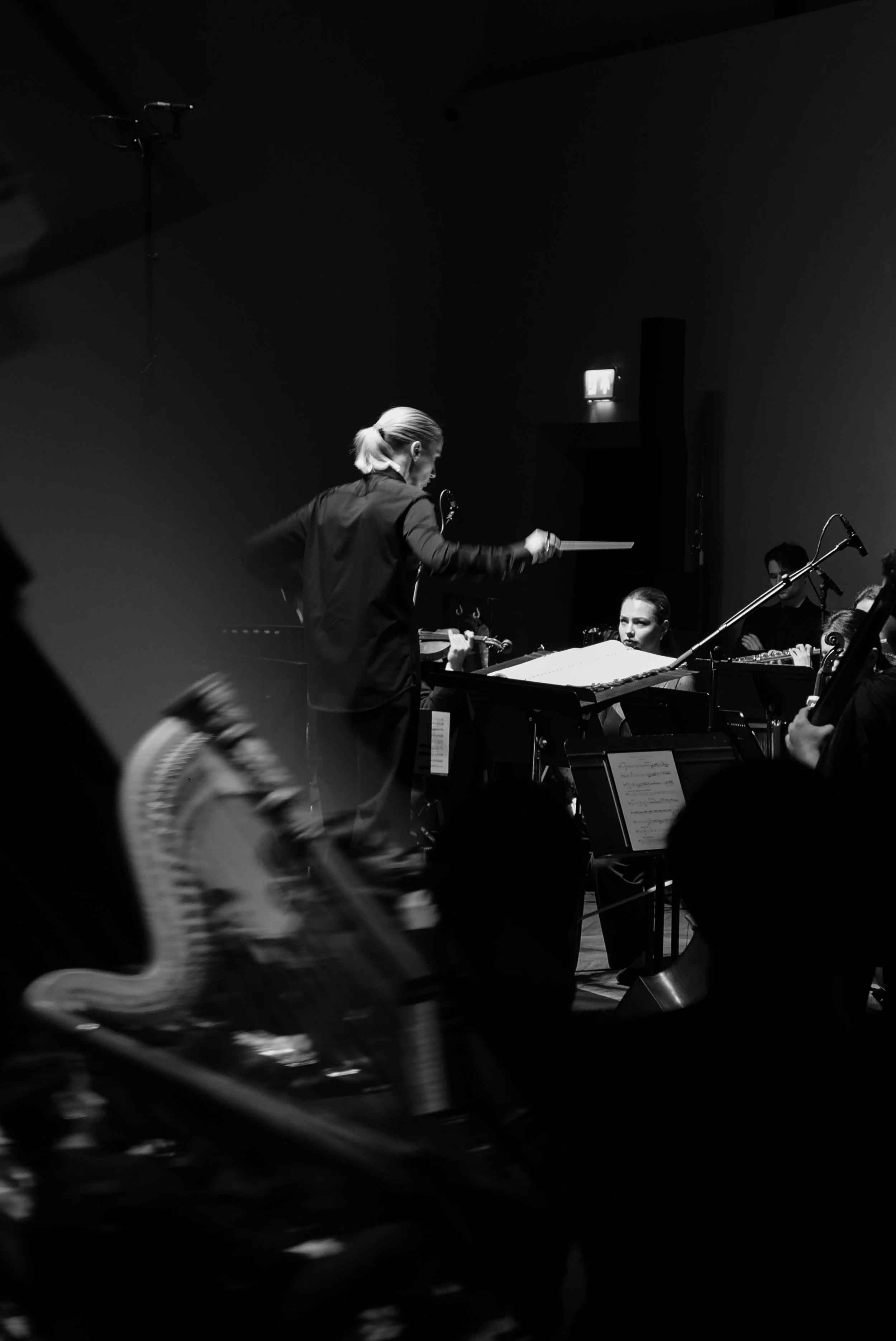
Margarita Balanas conducting ANONIMI Orchestra. Photo by Kevin Kremer
26 June 2026
Margarita Balanas is a conductor, a cellist who performs worldwide as a soloist, and the founder and chief conductor of the London-based orchestra ANONIMI. She is also Latvia’s first woman to conduct symphony orchestras, and she and her sister violinist Kristine Balanas are the first Latvian artists signed to Decca Classics. TWoA talked to Margarita about performing rock and roll for a live audience as a toddler, busking as a pathway to London’s Royal Academy of Music, about becoming the assistant conductor to Paarvo Järvi at the Tonhalle-Orchester Zurich, founding ANONIMI and much more. This is part II of the interview. For part I, click here.
You have founded a chamber orchestra, Anonimi. What do you think are the biggest challenges and what are the biggest opportunities for the classical music industry right now?
The industry has changed a lot, and quite a few times, throughout my career already. Before the internet, your role as a musician was to perform. You didn't need to do anything else. Nowadays, because you have so many platforms, you need to make sure that you're engaging with your audience. Social media is such a powerful tool. I remember the days when people frowned upon it and said: “Oh, you do this?!” But then Corona happened, and there was no way of reaching anybody, you could not share your music in person. You could not connect with anybody. This gave a boost to social media. I often meet people who follow me on socials, who come to my concerts. Recently, when I went to Korea for the first time, assisting Paavo Järvi with the Tonhalle Orchestra, there were people looking for me even though I was not on stage. They came to see me, and when I asked how they knew I would be there, they answered: “We follow you. We wanted to see you here.” It is such a powerful tool, and it doesn't cost anything. It takes time, but if you slowly build it, people want to see the updates, and they want to engage with the music.
Nowadays, everything is so fast. It takes a lot of effort for somebody to go to a classical music concert. For them, to just see twenty seconds of something can be very empowering and enriching. There are many aspects, nowadays, that we can and should take advantage off. There was a lot of noise about Timothée Chalamet’s comment that ballet and opera are barely alive and that nobody cares about them. I totally don't think classical music is dead, millions of people follow classical music on social media. I don't feel we need to defend classical music. It's like great literature. It's there: it's like air; there is the sky, there is the ground, there is classical music. It’s just there. It's one of the pillars.
It’s just about a person being curious and willing to go out of their comfort zone. It’s quite intimidating to go to a classical music concert for the first time, but there are several ways you can be lured to it. A lot of places are doing different projects to bring in a new audience. I actually started my orchestra because I wanted to bridge this gap, to keep the quality of the music while involving more young people and people who usually don’t have access to classical music.
Our rehearsal and work environment is also quite relaxed, even though it is very structured. I still have my plan; I know exactly what we're doing within a certain time frame. But somehow the atmosphere is less pressured. Our performances are much more open-minded. I talk to the audience. There are some laughs, there are some giggles. It's very free. But we still performed Mahler’s fourth symphony. I invited the male, Venezuelan soprano Samuel Mariño to perform it with us. I like to come up with some interesting aspects, and I think about the program length. I like to experiment to see what works.
But people want to come to music, it's just about making sure that they know what is happening! We all get so much information all the time. If you only have a website, nobody will actively go and look at your website. Only the people who know they want to go and see you will look at the website. Social media helps. You need to find ways to somehow feed a little bit of classical music to your audience. We have so much more going on nowadays, and also in our careers, there's so much more that we need to do. Everybody is facing the same overload.
The problem with social media is that you see all these things happening on socials, and you think that everything is so easy for everybody else. But no! Everyone is working hard, but you only see the result, you don't usually see the process. The process usually takes much more time than the performance of twenty, thirty minutes. It's very daunting for young people nowadays to always see their peers doing stuff. I didn't see that growing up. I was just doing all these rock and roll performances or busking or practicing. Nothing else, just reading in my free time, nothing more. Times change.
What about the next generation?
Music education is very important. It depends on the country you live in. In Latvia, for example, it is government subsidized. Everybody sings; everybody dances. Everybody sings in choirs from a very young age. We have a song and dance festival where around 20,000 or 30,000 people sing on stage. All of them have to audition within their own choir. The whole nation sings. You have an audience of around 100,000 people. You get almost one tenth of the population in one place singing, and the rest of us are singing at home or in the streets while watching the concert. It's the mentality. In Latvia, everybody goes to classical music concerts. It's such a normal thing. Going to a concert is a major activity, it’s a very natural, second nature thing to do. It starts from your exposure as a young person. If education cuts this out, it becomes much harder, because then your only source is the screen. And if you, as a classical musician, manage to somehow connect with them in the few seconds social media gives you, they will come. Otherwise, it is much harder if kids are not exposed to it at home or at school. That’s the biggest difference, for example, between Latvian and the UK.
What advice would you give to a young person interested in pursuing a career in music but scared that this is too competitive and too difficult?
My advice to myself is to always ask yourself: “Will I regret it for a long period of time if I don't try this?” I always think about the following: what is the worst that can happen if I try something that I really want, whether it's an audition or application form or putting on a concert or asking somebody for advice or even a lesson or just reaching out to somebody. What is the worst that can happen? They'll say no, or maybe it won't be the way you imagined it. Then think about how trying something will make you feel? Will you feel great that you tried?
Believe me: You will get this energy from trying, and then you will want to keep trying. Yes, you will get rejections. This always happens; this is such a normal thing. You need to have many rejections so that you also get yeses. It's just a game of numbers in the end.
The most important thing is: will you regret it if you don't do it? Do you really want it? If you want it, just do it. There's nothing bad that can happen. We're not doctors, you know. If you want to play difficult repertoire, and hesitate, ask yourself: Do you like it? Do you want to be able to do it? Just go do it! Act like you're your own boss. Of course there are teachers, you need to know certain things, communicate and respect and value things. But still: you need to choose your own path. Live by your own rules and don't have any regrets. I'm very lucky: I don't regret any of the choices I made, that is the truth. The worst thing that can happen is a rejection. If it's a “no,” you'll forget about the “no” tomorrow. You will be on to the next thing. Just keep trying. The industry is not easy, but it's also very fun! If it was very easy, everybody would be doing it, and you would not want to do it, you know? It would not be so exciting. The struggle is the fun part.
You will always regret something that you wanted to do but didn’t dare. You will see other people doing it because they were not afraid. I learned very quickly that you have to seize opportunities, even when you feel you are not ready. When Paavo Järvi asked me to assist, I thought: “I'm not missing this opportunity.” Of course I wasn’t ready. I didn't know what the role was going to require, but I said yes, because I thought that if I waited, he might find another young conductor. I don't regret a single thing, but I know for sure I would have regretted it if I had said no to protect my feelings. You have to put yourself out there. You need to follow your dreams.
Click here for part I of the interview.
Antonin Dvorak, 9th symphony, ANONIMI concert at Ladbroke Hall in London, 25 Feb 2026.