The Political Power of Opera: Ideology and Fascist Control in Mussolini’s Italy
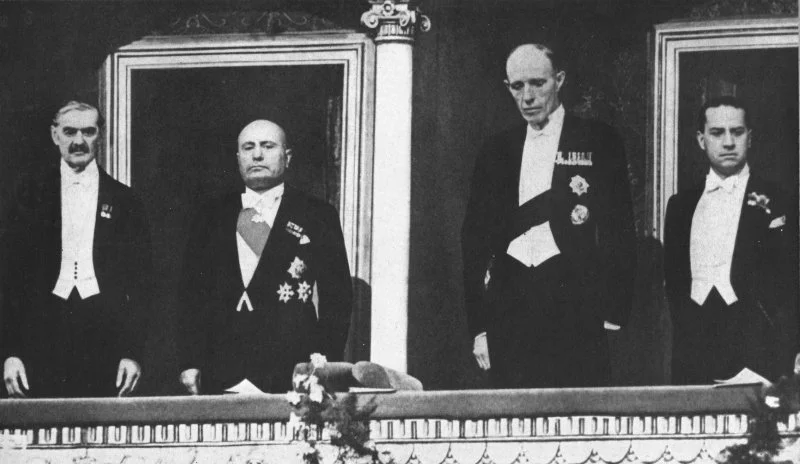
Neville Chamberlain, Benito Mussolini, Lord Halifax, and Count Ciano at the Opera of Rome, January 1939
17 April 2026
It has been many years since George Orwell’s essay Charles Dickens was first published in 1940. In this essay, he coined one of the most polarising phrases of the 20th century: “all art is propaganda.” Orwell, a committed anti-fascist, was deeply troubled by the rising nationalist currents among ordinary people in the mid-20th century. He stated that art is among the most potent forms of propaganda, inherently carrying political and ideological messages, dispelling the aesthetic myth that it was possible to have “art for art’s sake.”
Music—particularly opera—has certainly been exploited by totalitarian regimes to reinforce and mask ideological agendas in everyday popular entertainment. One example is Fascist Italy under Benito Mussolini. After taking power in October 1922, Mussolini launched numerous state-funded opera projects, beginning with a complete renovation of the Teatro Reale dell'Opera in Rome. Mussolini believed that to succeed in his reforms, he needed to revive national pride and love for the country, choosing opera as his means to do so. Opera was a proudly Italian art form that originated in late 16th-century Florence and has come to represent Italy's national character. Throughout history, it has also been utilised by various imperial dynasties, including the Bourbons and the Habsburgs, to showcase cultural dominance and to exert ideological control over their subjects. Mussolini, recognising opera’s Italian heritage and its potential for public influence, transformed it into a tool for spreading the ultranationalist and ethnocentric ideals of Fascism. This effort aimed to create a modern Italian empire.
Between 1928 and 1943, many operas performed at the Teatro Reale dell'Opera embraced the aesthetic of Romanità—a revival and glorification of ancient Rome. Shifting away from the operas of the Verismo or “realism” era, which showcased modest love stories about the peasant class, these works featured heroes from Roman mythology and promoted militarism and ethnic nationalism. During this time, the Ministry of Popular Culture and the Fascist Cultural Institute (INCF) controlled musical programming and opera production funding to ensure that the cultural sphere aligned with the party’s ideals. An illustrative example is Pietro Mascagni’s Nerone, which tells the story of Emperor Nero’s fall from power after falling in love with Egloge, a Greek slave. The opera not only perpetuates the notion of Italian superiority through acts of enslavement but also warns of the dangers of non-Italians infiltrating society, linking Nero’s downfall to his relationship with Egloge, a “foreign” woman. This kind of ethnic nationalism foreshadowed Italy’s racial segregation laws introduced in 1938 under Mussolini’s rule. Nerone serves as a prime example of how Mussolini’s centralised control of government agencies created operas that normalised and infused his political ideologies into society’s social and cultural fabric, bolstering acceptance and obedience towards his nationalist reforms.
While Orwell was certainly correct about art’s capacity to disseminate political ideologies during the 20th century, his words hold even more truth in today’s volatile political climate. Living in an age where art and mass media are intrinsically linked, it is now more important than ever to be aware of the art we consume and the subtle biases, ideological slants and hidden motives behind the melodies, images, and stories that we love. In today’s complex media landscape, critical engagement with art is essential to truly understand its influence and messages, because if you don’t think for yourself, someone else will think for you.