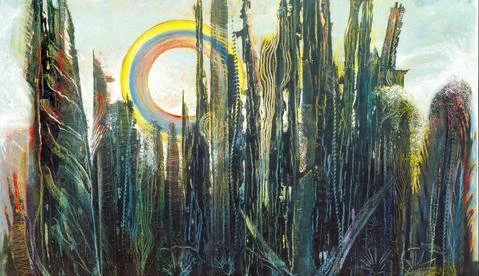
La Forêt (1927), Max Ernst. Well, not quite. This forgery by Wolfgang Beltracchi was part of the collection of the Max Ernst Museum in Brühl, Max Ernst’s birthplace. It sold for 7 million euros in 2006.
17 April 2026
At first glance, a painting hanging in a gallery might seem priceless, admired for its history, beauty, and the genius behind it. But what if we imagine that masterpiece is not what it claims to be? The world of art forgery exists in an ambiguous gray zone at the intersection of crime and creativity, where skill, deception, and psychology collide. Some forgers have been capable of fooling experts, collectors, and even major museums for years, raising a provocative question: Can a fake still be considered art?
Art forgery is an entangled process that is not simply about copying an image. The success of the forgers depends on their ability to understand not only technique, but also historical context, materials, and even the personality of the original artist. They thoroughly study brushstrokes, pigments, aging processes, and signatures. In some cases, to make the work more convincing, they use old canvases, frames, or even rub dirt and dust into the canvas, imitating centuries of wear.
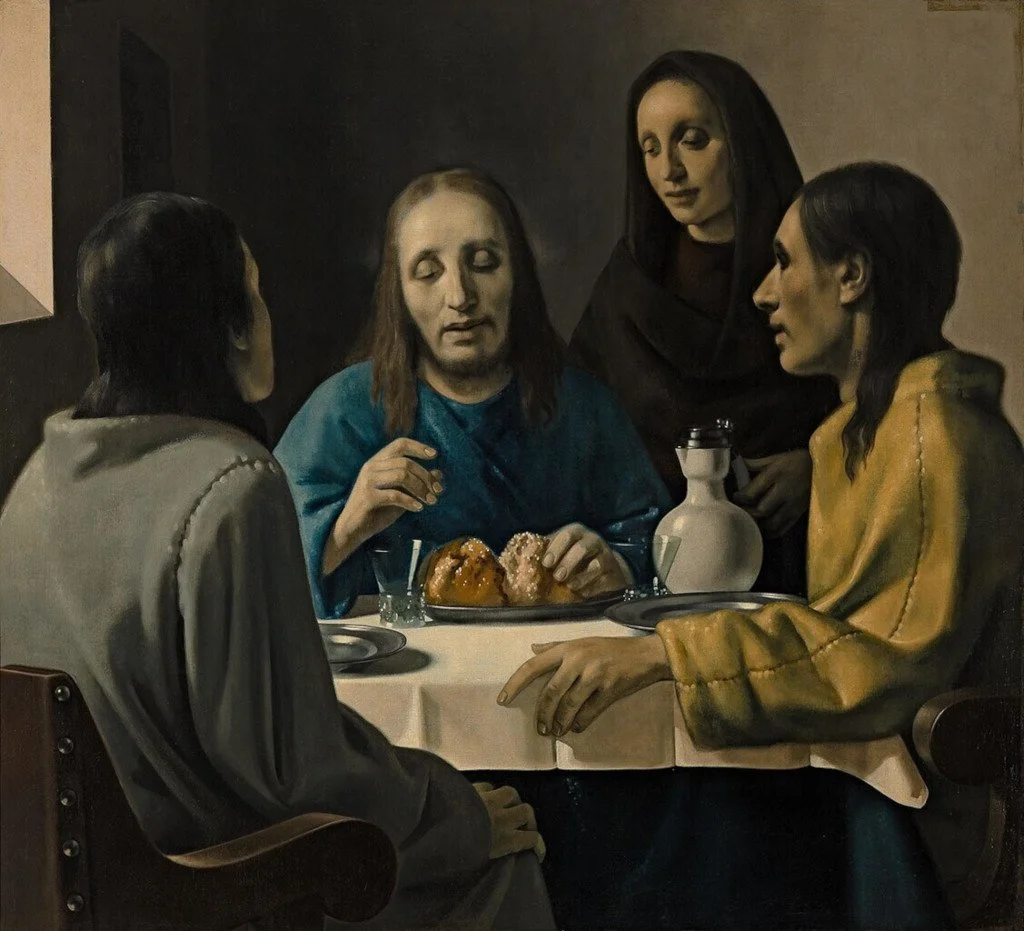
Han van Meegeren, The Supper at Emmaus, 1936–1937. Old canvas, relined, 115 x 127 cm. Museum Boijmans Van Beuningen, Rotterdam
Take, for instance, Han van Meegeren, a Dutch painter who forged works in the style of Johannes Vermeer. In the 1930s and 1940s, his paintings were so persuasive that well-known and respected experts declared them genuine «lost masterpieces». The proof of his complete approach is the utilisation of chemical techniques, such as a synthetic resin and even baking the canvas to achieve suitable artificial «aging» results. Interestingly, during World War II, one of his works was sold to a high-ranking Nazi official. After the war, van Meegeren was accused of supporting and collaborating with the Nazis by providing them with a national treasure. Proving his innocence, he perplexed the art world by confessing that the painting was a fake. Moreover, he reportedly claimed, «I painted it myself!» What wouldn’t someone say to save their own freedom, right? This confession protected him from a harsher treason charge and potential death penalty, but called into question the competence and expertise of the critics and professionals.
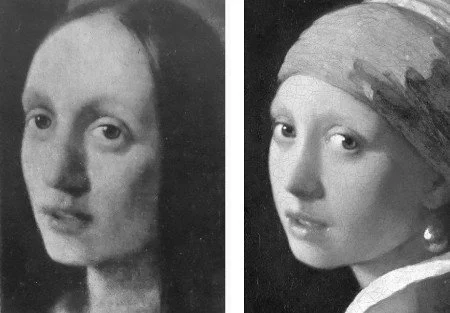
Forged version by Han van Meegeren and Girl with a Pearl Earring (Johannes Vermeer)
Wolfgang Beltracchi, a person who contributed to the world of art forgery by creating dozens of fake paintings attributed to artists like Max Ernst and Heinrich Campendonk, is another striking example (see header image at the top). In contrast to van Meegeren, he used a different approach: Beltracchi didn’t just copy existing works; he invented entirely new ones, imagining what these artists might have painted. Surprisingly, for decades, his forgeries were a part of the art market circulation through galleries and auction houses, being sold for millions. The blurred line between imitation and creativity is highlighted through Beltracchi’s statements, such as: «I only painted pictures that did not exist yet, but could have existed.»
Those examples pose a controversial question: why do people risk everything to forge art? For some, like van Meegerem, it was a form of «revenge» against critics who had dismissed his original work. For others, like Beltracchi, it was a beneficial financial opportunity that also gave an opportunity to outsmart the art establishment. Additionally, the psychological aspect, a chance of becoming someone else, adds another layer to boosting their motivation.
The process of identifying the fakes is a complicated procedure that requires the combination of science and expertise. In the case of Beltracchi, investigators managed to discover a modern pigment in one of the artworks, proving that it did not exist at the time the original artist was alive. To expose some of the inconsistencies or find modern materials, technologies such as X-rays and infrared scans are employed, making hidden layers beneath a painting visible.
However, science alone is not enough. Experts have to rely on their intuition and historical knowledge. Yet even experts can be wrong. The art world can be extremely precarious, depending heavily on trust, reputation, and authority. Forgers exploit this unsustainable system, knowing that confidence can sometimes outweighs evidence. So in the end, if van Meegeren’s «Vermeers» were admired before the truth was revealed, did they truly lose their beauty, or did our perception simply change?