Before the Met Gala, Power-Dressing Was a Matter of State. Here’s Why.
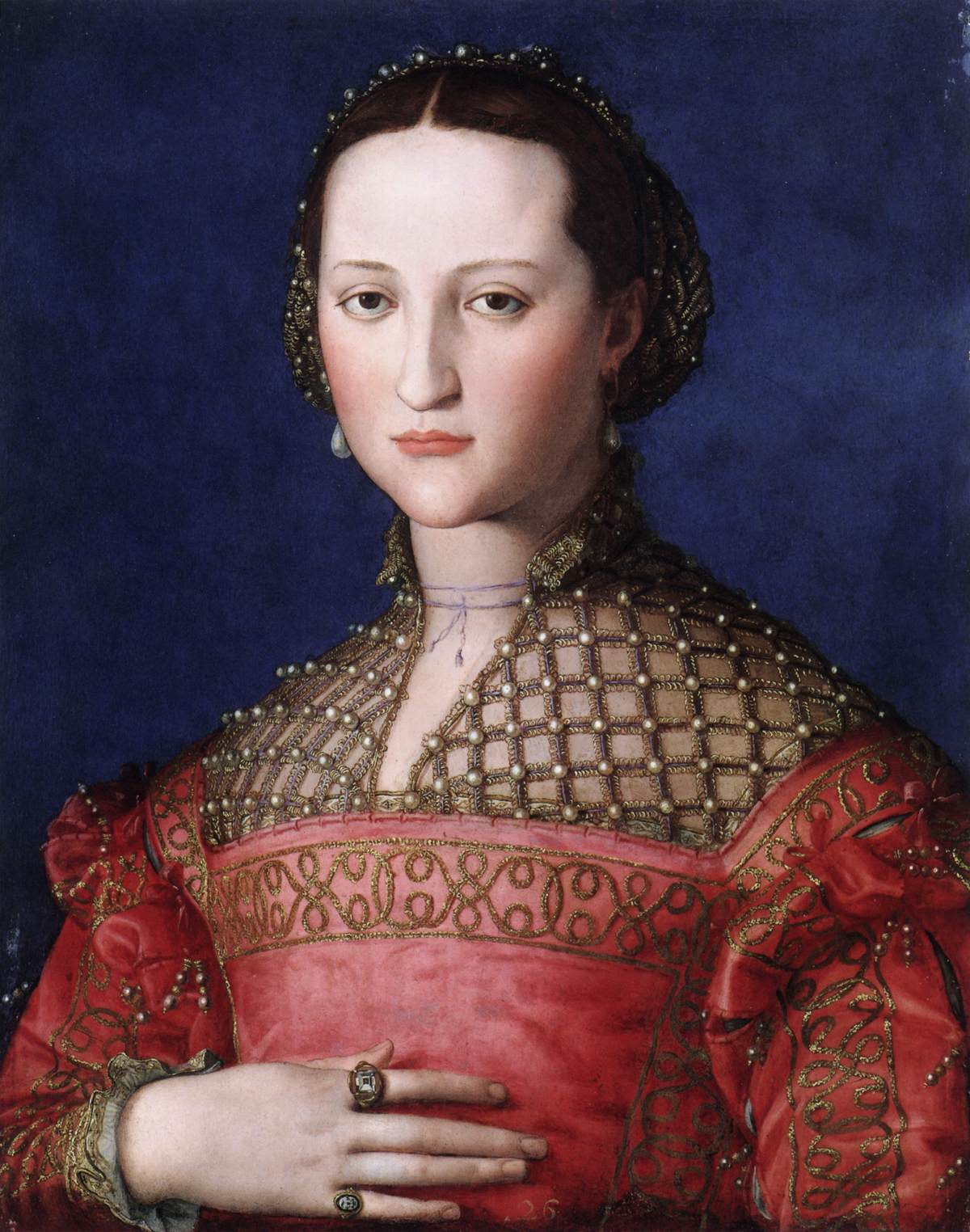
Agnolo Bronzino, Eleonora di Toledo as Bride, 1539, oil on panel. Národní Galerie, Prague
29 May 2026
A few days ago, I found myself fooled. Like thousands of mindless social media consumers, I awoke the morning after the Met Gala and reached for my phone. The first post I saw? Heidi Klum, veiled like Raffaelle Monti’s Vestal Virgin. Brilliant, I thought–her costumes never miss, not on Halloween, and certainly not at the Met. With “Costume Art” as this year’s theme, and “Fashion is Art” as the dress code, I was keen to see more reimaginations of the greatest masterpieces. And I did: Zendaya as Magritte’s The Son of Man, Jared Leto as a Koons dog, Kendall Jenner in Warhol’s Campbell's Soup, Donatella Versace in a Caravaggio-inspired Medusa dress, and Anna Wintour herself in a Mona Lisa gown. I was intrigued. The irony? I was stupid–or sleepy enough–not to immediately notice it was AI (see it yourself here). And I wasn’t the only fool this year.
Something even stranger came next. Looking at the real outfits of the Met’s attendees, in my battered pajamas no less, I felt underwhelmed–the AI reimaginations had set the bar far too high. So I wondered: is it possible that celebrities and their designers have less vivid imaginations, not to mention less awareness of art’s fashions, than the most prolific of AI users? That’s certainly possible. And, if that’s the case, it most definitely calls for a voyage back into the history of art and its greatest fashion moments, Madame X’s purposefully excluded.
Take Eleonora di Toledo, for example–the wife of the first Grand Duke of Florence, Cosimo I de’ Medici. Raised in the Kingdom of Naples as the daughter of its Spanish viceroy, Eleonora used fashion to political ends. Dressing in Spanish–alla spagnola–style, she signalled both her lineage and her husband’s imperial ambitions. Look at Agnolo Bronzino’s portraits of the Duchess–particularly Eleonora di Toledo as Bride, 1539. Bronzino not only adorns her with two rings–the diamond ring, inevitably associated with the Medici impresa of the diamante, and the antique cameo ring on her little finger, decorated with marriage symbols–but also clothes her in a dress typical of Spanish nobility. The gold embroidery on the bodice and sleeves, which would have extended across the centre front and the hem of the skirt, was even then described as alla spagnola. The same goes for the dress's partlet: netted from blue silk and gold cord, and intersected with pearls, it was typical for noble Spanish brides. The sleeves, drop pearl earrings, and matching headpiece (called cuffia) also appear distinctly Spanish in style. Along with the blue silk ribbon tying her partlet, they nod to the style of Eleonore d’Autriche, Queen of Portugal, later Queen of France, and a member of the Habsburg family. But why her? Well, not only was she, like Eleonora, of Spanish descent, but she was also the sister of Charles V, the Holy Roman Emperor. Dressing like her, then, was a subtle way to express personal heritage and political alliance to the very man who’d bestowed the Grand Ducal title upon Cosimo.
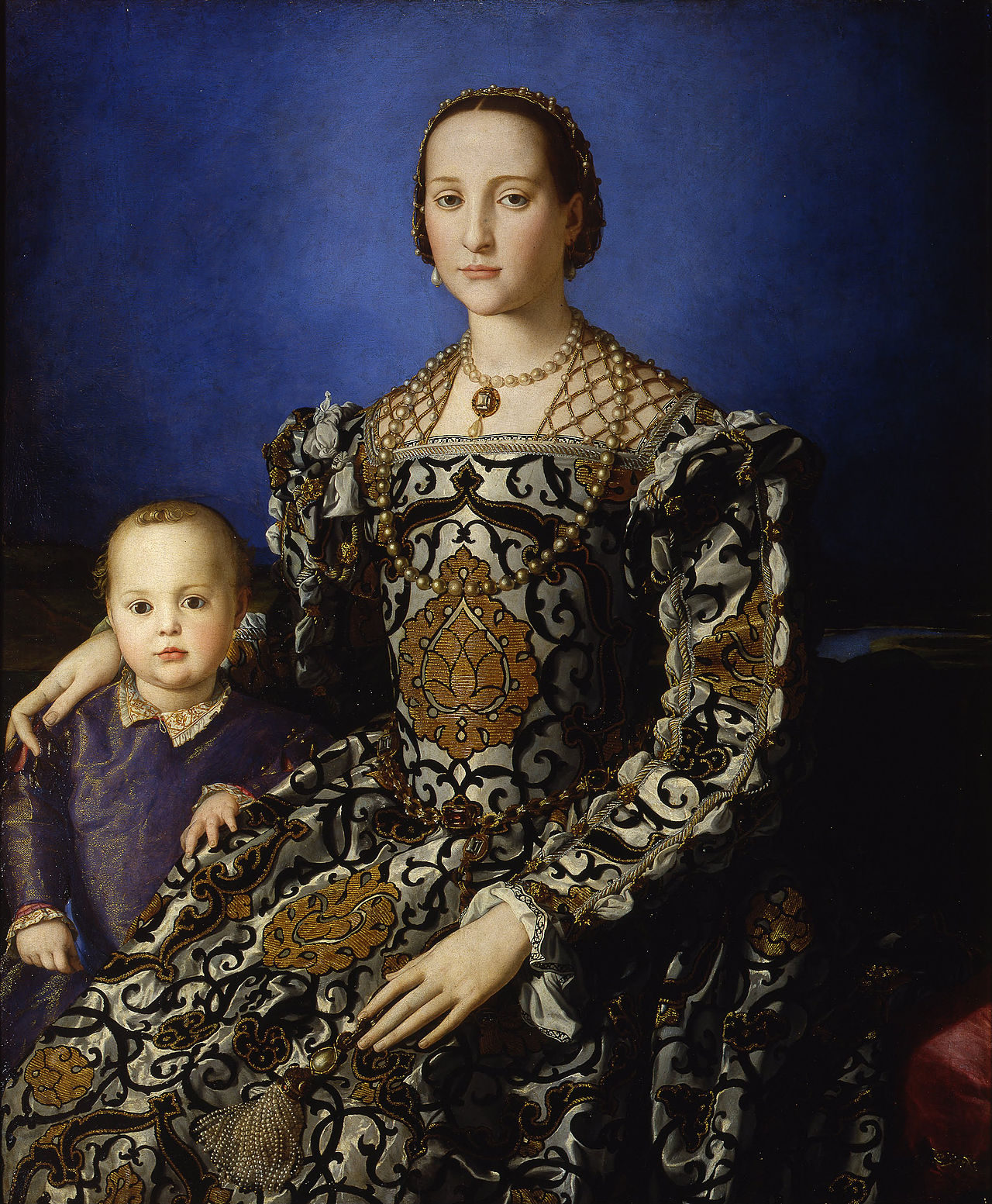
Agnolo Bronzino, Eleonora di Toledo and her Son Giovanni, 1545, oil on panel. Florence, Galleria degli Uffizi
Later came Bronzino’s portrait of Eleonora di Toledo and her Son Giovanni, 1545. If the earlier bridal portrait established her Spanish identity and political alliances, this state portrait made a starker assertion of familial legitimacy for the Medici, consciously positioning them alongside Europe’s ruling dynasties. Just consider Eleonora’s silk dress–in addition to implying wealth and nobility through its very material, it hints at Cosimo’s revival of Florence’s silk industry and the economic prosperity of his regime. And, in keeping with Eleonora’s established style, its individual elements remind us of Spanish court attire: the square-necked bodice, pearl-netted partlet, slashed sleeves, jewelled girdle, and black embroidered chemise all recall elite Habsburg fashions. At the same time, the dress’s pattern–flaunting large pomegranate motifs in gold-brocaded bouclé–engages the fruit’s dual symbolism to signal fertility and reference the personal device of the late Empress Isabella, the pomegranate. In this portrait, as in the former, fashion thus serves as a tool for political expression. In elevating the Medici family, still newly noble by comparison, to the ranks of the long-established Habsburg dynasty, it asserts their dynastic importance, continuity, and ultimately, their right to rule–at least to those with the eyes to see it.
But Eleonora was hardly alone in employing fashion to political ends. To see how fashion–and its relationship to art–acts as a political tool, just turn to the towering ruffs and pearl-laden gowns of Elizabeth I’s court portraits, which transformed the queen into an almost untouchable image of imperial authority and virgin purity. Or think of Louis XIV, who used towering heels, extravagant wigs, and embroidered silk to express his absolute power at Versailles. Even Jacques-Louis David’s portraits of Napoleon exemplify this tradition, highlighting the Emperor’s power through coronation robes, imperial insignia, and the visual language of revived Roman classicism. Fashion, for these people, and in these works, was not merely ornamental. It was an art form in itself, a political language that expressed power, legitimacy, wealth, and ambition long before a single word had been spoken.
You might also enjoy. . .
Wayne McGregor: “Infinite Bodies” - Dance, Technology and the Future of the Human Body