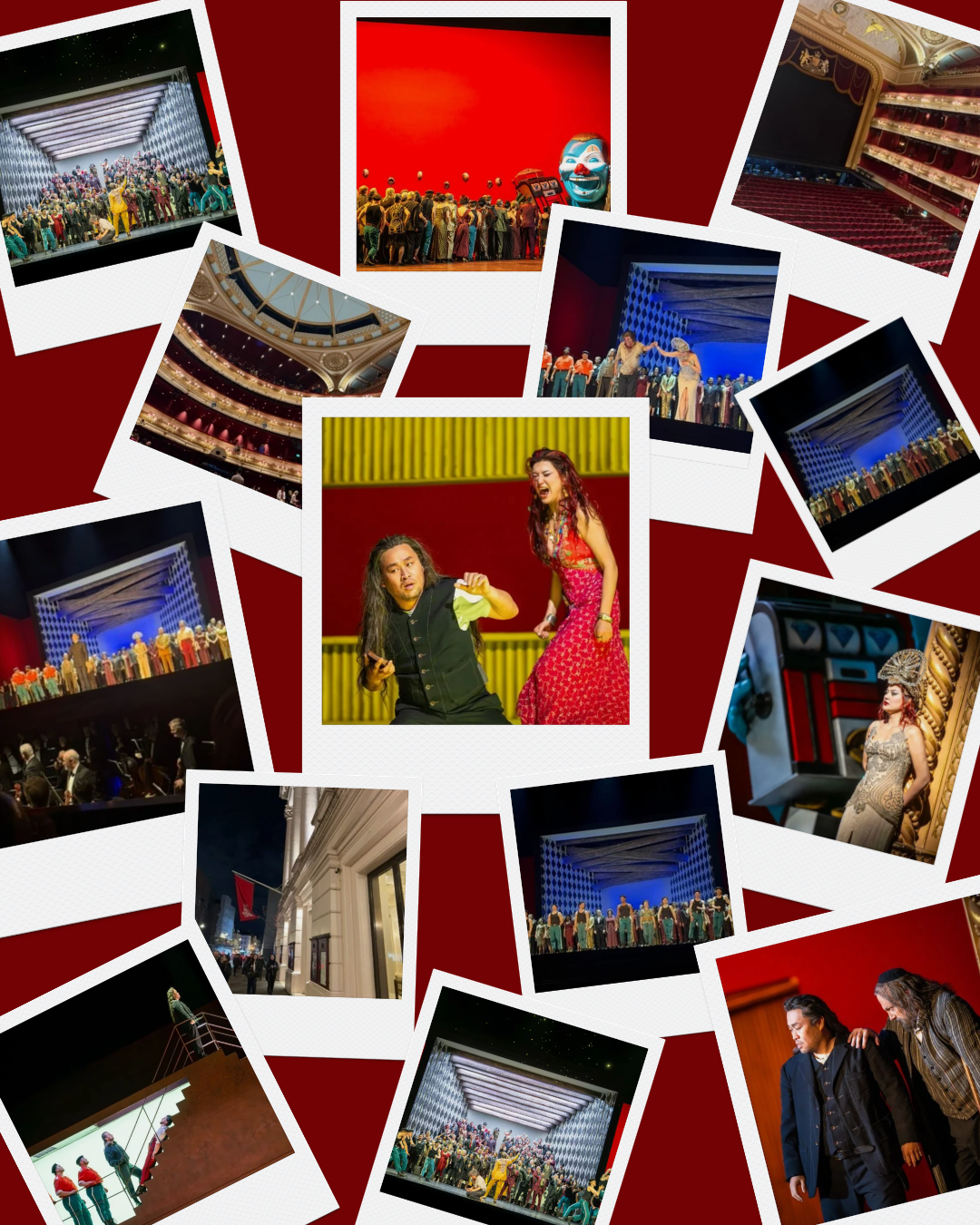
Mix of curtain call photos by Maya Stoilova and official photographs by Mihaela Bodlovic © RBO
7 June 2026
My dearest artlings,
There’s something ceremonious about attending the opera–and it’s not necessarily the performance itself (though, if it is that good, it might be). It’s the excitement before the show, the subtle way my spirit picks up in the afternoon, and the smile that settles onto my lips as I put my heels on, stuff my glasses into my clutch, and scurry for the door. Pulling it open, I realise not even one of the most temperamental of London Mays can ruin my mood.
I wish I could say the same for my hair, however. Dashing down Gower Street, I do my best to shield it from the hail; the attempt is, of course, unsuccessful. By the time I reach Bow Street and the hail gives way to rain, I find myself at the opera with an unwanted plus-one: the frizz I hoped I’d left behind. Smoothening a stand away from my eyes, I shake my head–and my umbrella–and spot my friend leaning by the RBO’s entrance. A glance, a wave, and a hug, followed by the routine complaint about the weather–a Londoner’s holy grail–, and we head inside, ready to see this season’s premiere of Camille Saint-Saëns’ most famous opera, Samson et Dalila.
Inspired by the Old Testament Story of Samson, the Hebrew hero whose strength lies in his uncut hair, and Dalila, the Philistine woman who seduces and betrays him, Samson et Dalila was first staged in 1877. Set to a libretto by Ferdinand Lemaire, the opera is spread into three acts. In act one, Samson inspires the Israelites to revolt against the Philistines. In act two, Delila seduces the male protagonist, leading to his imprisonment and blinding. And in act three, Samson makes one final reach for divine strength and destroys the Philistine temple, killing both himself and the Philistines.
Despite the plot’s appeal, the opera’s early reception was complicated. In the nineteenth century, biblical operas were unpopular in Paris: in addition to being an inappropriate place for Scripture, the opera, much like The Salon, the official exhibition of the Academy of Fine Arts, preferred historical, mythological, and romantic narratives. Samson et Dalila not only ignored these conventions but also struck a nerve: in the aftermath of the Franco-Prussian War and the collapse of the Second Empire, it became difficult to overlook the parallels between the oppressed Israelites and the defeated French. Because of this, and thanks to Franz Liszt’s support, Samson et Dalila found its first real success in Germany, premiering in Weimar in 1877. Whether tonight’s audience would prove more French or German in its sympathies remained to be seen.
The question fades as the orchestra begins tuning. A cello murmurs, a double bass growls, a violin screeches. And then my friend’s voice cuts through it all: “Guess what I’m wearing for my 25th birthday?” she beams, excited to pull up her phone and show me a floor-length gold dress that Dalila herself could claim. Encouraging and very much loving her nonchalance, I tell her to watch out for the costumes tonight; I hear that Dalila might be spotting some golden headpieces.
Before she can respond, the crowd settles and stills. A second, and the curtain goes up, revealing Samson singing. A rousing tenor, SeokJong Baek controls the stage–and his peoples, uplifting their spirit and urging revolt. Then enters Aygul Akhmetshina in the role of Delila, in a stunning gold headpiece no less, and I find myself enchanted–and seduced far more readily than Samson himself. The performer is a true siren: her voice, movements, and dances all urge submission, enticing us into her web. I guess I might have a thing or two to learn.
Over the next two hours, I forget all about the hail, and the rain, and the rushing, mesmerised instead by the performers’ palpable chemistry, by the scorpionic temptations and seductions on stage, by the story. When the famous Bacchanale begins, I can’t look away from the cast: even when moving in unison, they remain unmistakably individual. In the front, a woman’s forcefulness fosters her brisk, assertive movements–and the resolute expression on her face. Behind her, a young man springs into the air, as if powered by the crowd’s energy and his own savouring of the moment. He’s smiling, dancing, drinking it all in, and I think I even catch his gaze. And then, of course, there is the music–my favourite part of the entire opera. It’s the thread that binds everything together: dance, story, instruments, hall, and crowd. As it seeps into my pores, I can’t help but feel, first love for Saint-Saëns’ music, then gratitude for all this talent, and, finally, a deep sense of connection.
It washes over me–and, I think, everybody watching. As different and foreign as we may be to each other, we find ourselves in the here and now, together, grounded in a way only the arts may muster. Like the instruments in the orchestra pit, we’ve also synced, and now move to the same rhythm. The moment the curtain falls, for example, a brief silence settles over us. A beat, and the entire auditorium erupts into applause. We’ve just seen one of the very best productions in the UK, and we all know it. It’s been a blessing to be here, a ceremony for the soul, and the arts, and a privilege–my ultimate reason for loving London.
From London with love,
Maya
