The Sound of Sociability: The evolution of the string quartet
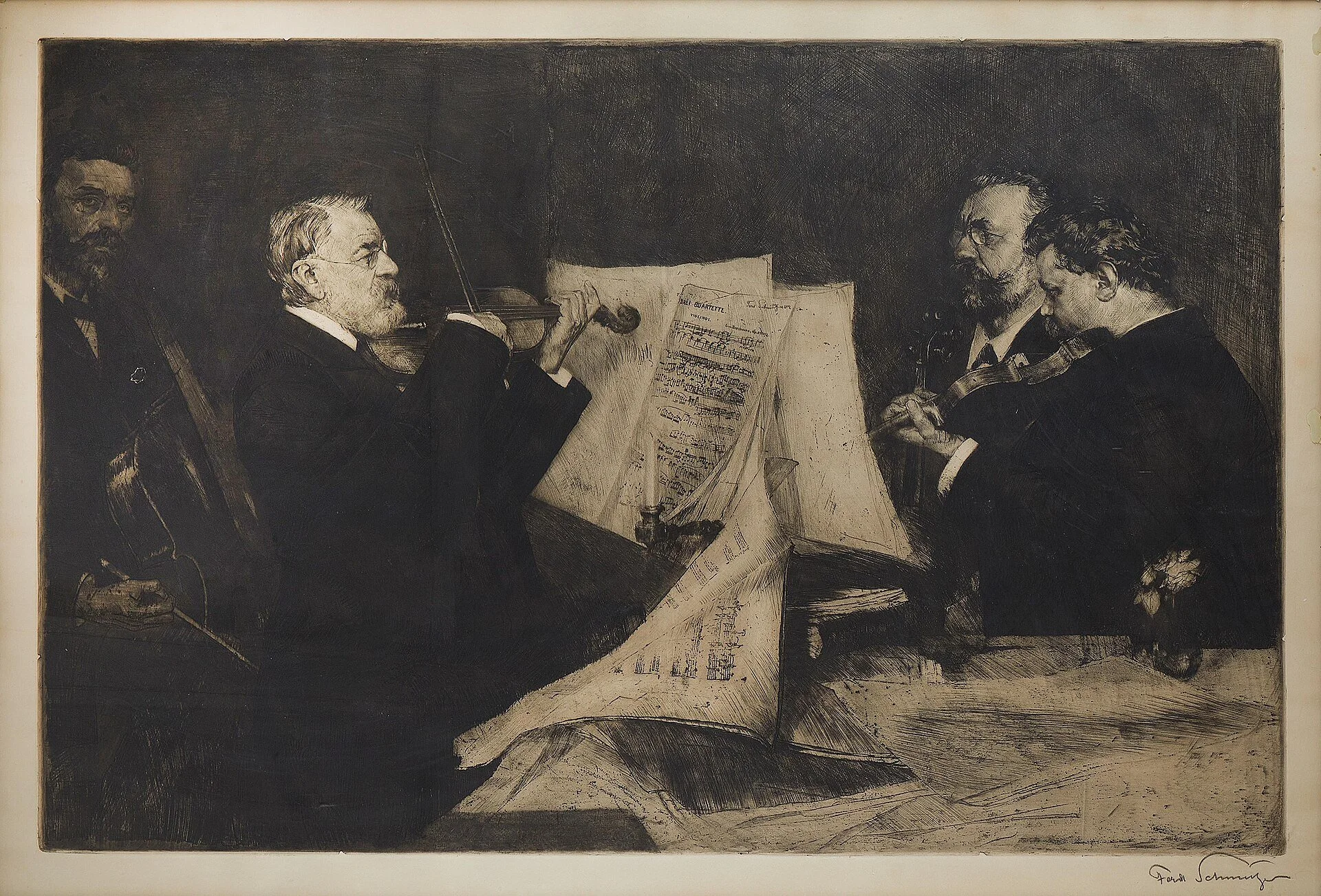
The Joachim Quartett, 1904. Wikimedia Commons
22 October 2026
The history of the string quartet is rooted in the 17th-century private salons of Vienna, Berlin, and Paris, where amateur players, and a select few observers, would gather, converse, listen, and play. At this time, words such as “sociabilité” and its cognate “society” came into being, and from its conception the string quartet as a form became entangled in notions of sociability: it was a metaphor for, model of, and stimulus to admirable social relations.
The string quartet was the bonding social gel amongst friends within the private salon, and even its musical syntax became bound up in ideas of social relations. References to exchanges of melodic material as conversational are fairly commonplace towards the end of the 18th century. The common musical forms that populated the string quartet at this time were also themselves dialogical (A:B constructions such as “periods”, a musical question-answer pair, and “sentences,” a different structure for developing a theme.) Haydn’s famous “Joke” Quartet, Op. 33 No. 2 ends with an incessant repetition of the opening motif to a humorous effect (or at least, humorous to the armchair music theorist), humour being, amongst wit, decorum, politeness, and exchange, a signifier of sociability.
Moving into the 19th century, the actual social bonds cultivated by the genre began to dissolve, and yet notions of sociability within the genre intensified into something more profoundly concerned with human connection and assimilation. The string quartet became less of a genre amongst intimates, moving its locale from the private salon to the public chamber hall. Similarly, with the repertoire having consistently increased in difficulty over the past thirty years, it became a business for professional musicians rather than amateurs and friends to play amongst themselves. Despite this, in 1810 we get Johann Petiscus coining the term “Viereinigkeit” (four-in-oneness) to describe, with divine connotations, the unity of quartet players. Similarly, A.B. Marx’s 1828 review of some of Beethoven’s late quartets describes the texture and performers as an “equal union” in a “brotherly embrace”; in 1829, Goethe also famously described the string quartet as “four rational people conversing”.
It is certainly curious that, as the modes of engagement with the string quartet moved away from participation into observation, the notions of sociability surrounding the genre became more idealised. And to some extent we can thank Beethoven for this (no surprises here), his late quartets marking a movement away from a texture dominated and led by the first violin to one shared equally amongst all four players. But then again, it was also in the early 19th century that a number of internationally celebrated quartets appeared, focused on, and in cases named after, the first violinist: The Schuppanzigh Quartet, named after the violinist and collaborator of Beethoven’s, Ignaz Schuppanzigh, The Baillot Quartet, after famed French violinist Pierre Baillot, and Karl Möser’s Quartetteabende series, which was indispensable in moving the string quartet into the public sphere.
It is difficult to square the preeminence of the first violin player, a fact particularly evident in contemporary reviews of Baillot’s quartet, with the idea that the quartet is a union of four equals. How, then, do we account for the idealisation of sociability over the turn of the 19th century? A possible reason was to cater Enlightenment ideals to the emerging Romantic philosophy. Another is perhaps simply because when an idea breaks down, the best fix is abstraction.