A London Odyssey
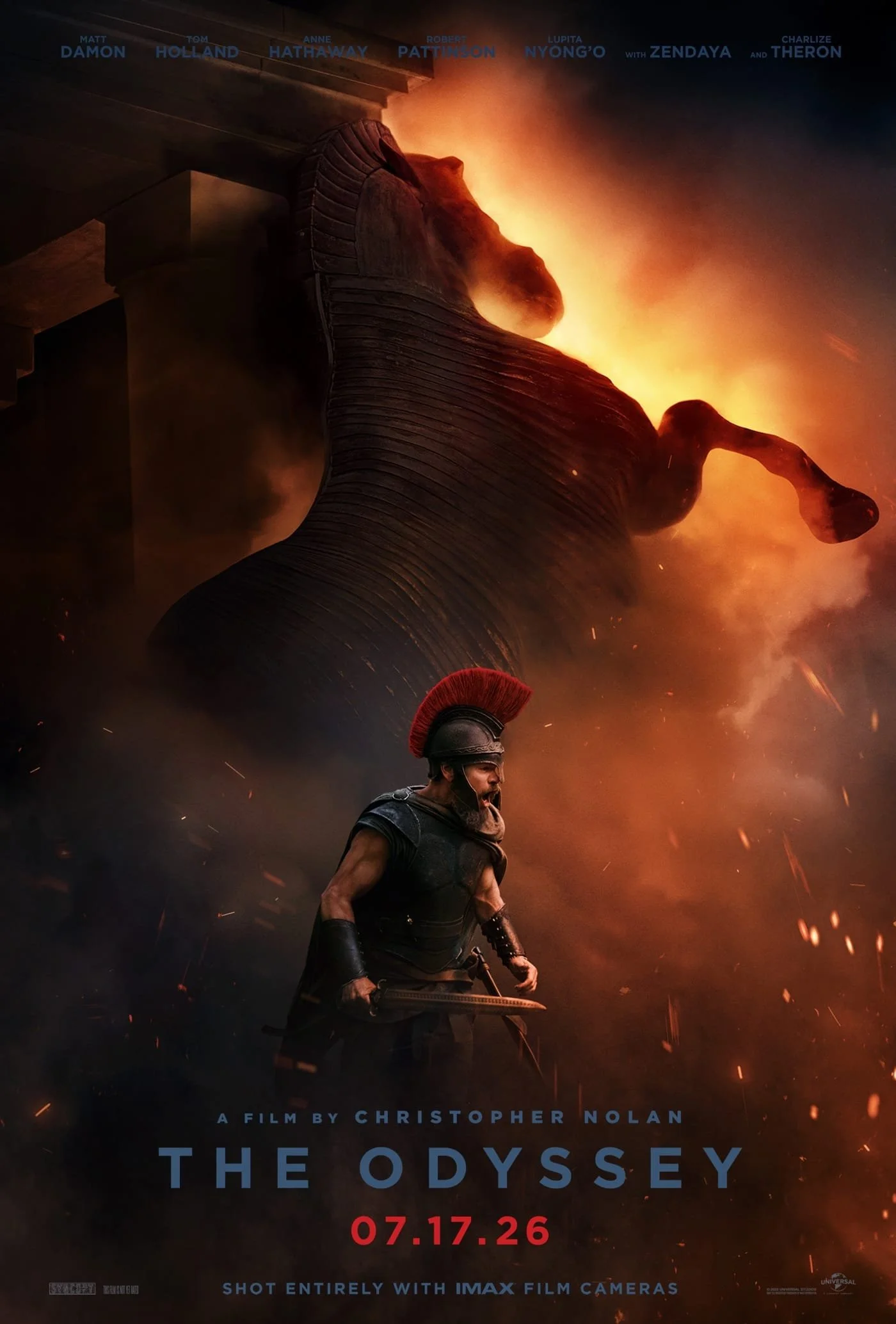
Official poster, Christopher Nolan, The Odyssey
24 July 2026
In recent weeks, the media has been abuzz with anticipation for Christopher Nolan’s new film The Odyssey. An “odyssey” is a journey filled with adventure and difficulties, you’ve probably heard the term used in speech before, but it originates from Homer’s Odyssey, an epic story composed around the 8th or 7th century BC about a war hero making his long and arduous way home after sacking the city of Troy. I have yet to get tickets - but here in London there are plenty of ways to get your Odyssey fix without seeing the film! Let’s start at the British Museum…
Wine anyone?

Siren Painter, Odysseus and the Sirens, c.480BC. British Museum. ArchaiOptix Wikimedia
The Ancient Greeks loved to depict myths on the sides of utilitarian objects like vases, containers and even wine bowls (yes, they drank out of bowls); they didn’t have endless scrolling “content” to entertain them whilst they ate their dinner. This large vase illustrates the episode in which Odysseus meets the Sirens. It is said that the Sirens’ irresistible song lures men to their dooms, and here you can see Odysseus tied to the mast of his ship to prevent him from succumbing, his frame poker straight, his head pointed up to the heavens, and the harrowed faces of his rowers ploughing through the treacherous waters. It is one of the most iconic moments of the Odyssey but perhaps not so iconic as his unfortunate run in with a one eyed giant…
A New Horizon
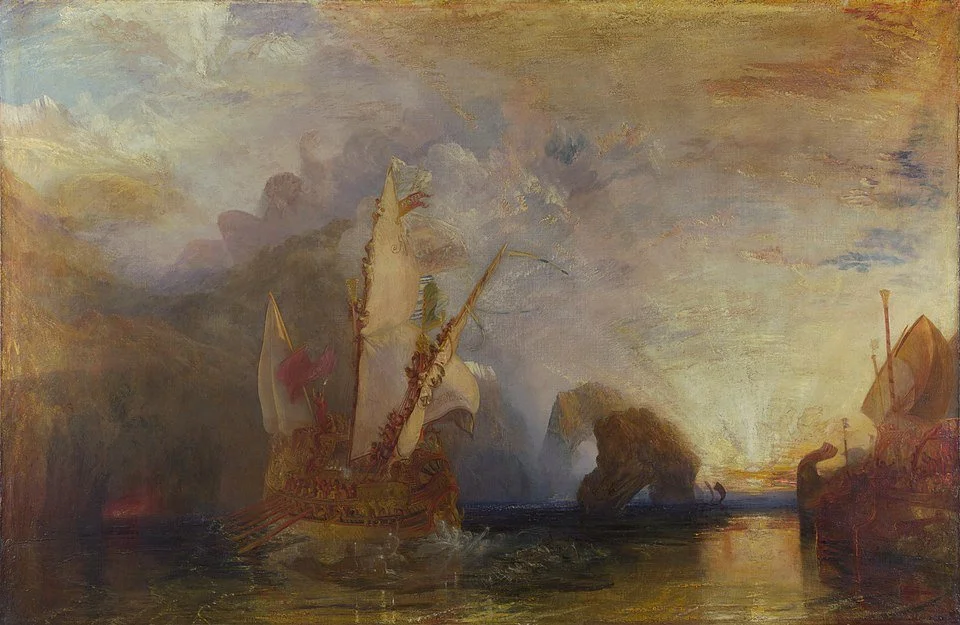
J.M.W Turner, Odysseus Deriding Polyphemus, 1829. The National, London
Let us “plough on” to the National Gallery to see J. M. W Turner’s Odysseus Deriding Polyphemus in which it is Odysseus’s mouth that gets him into trouble…
Having blinded the Cyclops Polyphemus and escaped under the belly of a sheep, Odysseus cannot help himself but call out:
“Cyclops! If any mortal asks you how
your eye was mutilated and made blind,
say that Odysseus, the city-sacker,
Laertes’ son, who lives in Ithaca,
destroyed your sight.”
A bad idea to have given his name as no sooner has he done so than Polyphemus prays to the Gods to enact vengeance and make his journey home torturous and long.
The British artist J.M.W Turner brilliantly captures the moment in his honey-soaked mythological landscape, the canvas alive with colour, the whole image bathed in ethereal light His kaleidoscope of colour was unusual for the often hyperrealistic historical scenes of the Victorian era. This painting marked a turning point in his body of work, as he developed his own unique style that relied heavily on colour and light. He was in fact on his own journey to find his sense of style and difference.
The Odyssey Reborn
Turning to the written word, a Charing Cross bookshop is the place to go for a copy of TheOdyssey itself (the translation I would recommend is by Emily Wilson as she manages to retain the lyrical style and the musicality of the original poem whilst using accessible language; also strongly recommend: the audiobook version of Robert Fagles translation, read by the incomparable Ian McKellen). A recent movement in literature that I particularly enjoy puts women at the centre of ancient myths. In 2005’s Penelopiad Margaret Atwood puts Odysseus’ long suffering wife Penelope in the foreground, recounting her life from the events of the Odyssey to her relationships with her family. It is a unique portrayal of a character so often pushed to the peripheries. Madeleine Miller’s Circe looks at the misunderstood sorceress Circe as she recounts her life with Odysseus and after. And Pat Barker’s Trojan War Trilogy looks at the whole story through the eyes of the women involved, starting with The Silence of the Girls. In reinterpreting these archaic myths these boldly imaginative women breathe new life into stories dominated for millennia by the male gaze and the male hero.
Pottery, painting and fiction, and I haven’t even started on the films! The Odyssey has permeated western culture for millennia and by the looks of it will certainly continue for the time being. Interesting in its original form but exciting in its ability to be retold and reimagined time and time again.