From Paris, with Love: Alexander Calder takes over the Fondation Louis Vuitton
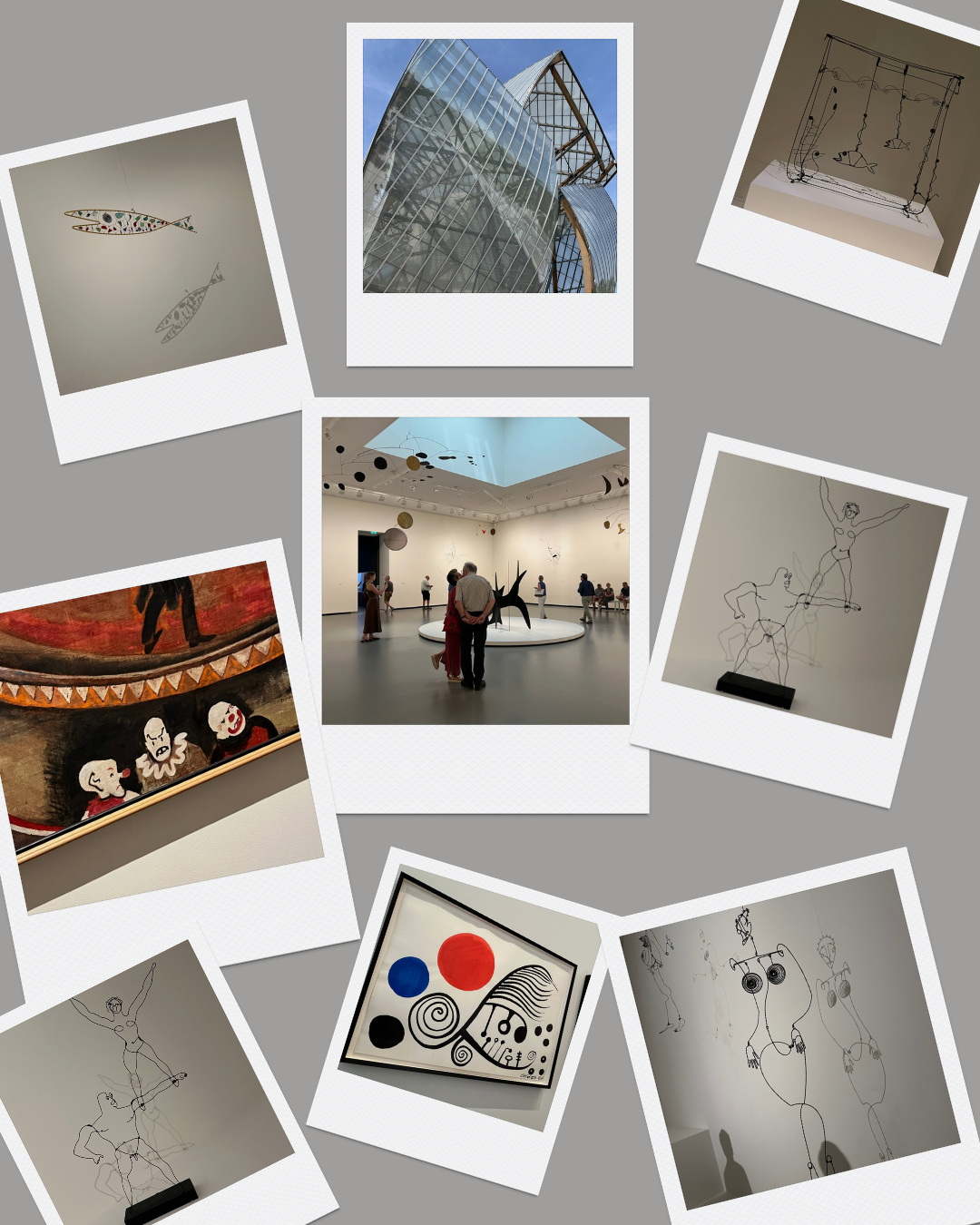
Calder. Rêver en Equilibre, exhibition at the Fondation Louis Vuitton. Photos by Kate Purdum
19 July 2026
Dear Reader,
During the hottest of Parisian heatwaves — the dry and relentless kind, beating the Bois de Boulogne into whitewashed submission — I braved the hourlong line outside of the Fondation Louis Vuitton. Sweat trickled down the back of my neck as I felt the skin on my ears gently frying. The staff were kind enough to take pity on us who waited, panting and sweating, for the love of art, apologetically passing umbrellas into our clammy hands.
And for what was I waiting so bravely? Not just the welcome cool air inside Frank Gehry’s carapaced museum building, but a celebration of Alexander Calder’s expansive body of work on the occasion of the centennial of the idiosyncratic sculptor’s arrival in Paris.
My previous exposure to Calder’s oeuvre, which runs the gamut in scale from towering steel to quirky diminutives, had left me familiar with both extremes: his incredible painted steelworks (called “stabiles” by Dadaist Jean Arp) at Storm King Art Center (New Windsor, New York), and the delightfully peculiar Calder’s Circus, in the permanent collection of the Whitney Museum of American Art in New York City. This exhibition more than fills in these gaps, leaving practically no stone unturned.
2026 marks both the centennial of Calder’s life in Paris, a city in which he would artistically “arrive” and thrive, and the fiftieth anniversary of his death. The exhibition traces not just those fifty frenzied years, but Calder’s earliest works and posthumous legacy; the entire museum has been filled to the brim with his work. The exhibition is incredible in its volume — Calder was prolific in mediums across painting, sculpture, design, and even performance — but also in its scope. In a brilliant feat of curation, Calder’s work and lifetime is situated within the context of his peers and collaborators. The galleries feature works by Duchamp, Mondrian, Miró and other artists who worked and socialized alongside Calder in interwar Paris.
The chronological curation emphasizes Calder’s early genius: the animal figurines the son and grandson of sculptors made at age ten were already brimming with the humor and flair of his later work. Childhood experiments with metal and wire, alongside a knack for oil painting, evolved as Calder matured, and soon acquired a special focus: the circus.
The circus is a recurring theme in Calder’s work, for reasons illuminated by the title of the FLV’s exhibition, “Rêver en Equilibre” (Dreaming in Balance).The strange delights and balancing acts of the circus worked with Calder’s playful sensibilities as he continued to experiment with mobility in his creations. This exploration eventually grew into the large-scale mobiles for which Calder would become best-known, with balance, play, and chance as much his mediums as wire or metal.
Climbing higher through the floors of the FLV building, we move forward in time as Calder’s work responds to the progression of the 20th century. Influenced by his peers in the Paris art scene, Calder began gravitating towards further abstraction in the 1930s. His scale also grew in this period, as his sculptures became at first more complex, then later in the 1960s, simpler but larger still. He was given several public commissions in his lifetime, and models and photographs of these are featured alongside his continual pursuit of oil painting. The snaking progression through Calder’s life is intercut with historical context as well as the work of his friends, all of whose influences can be seen on Calder (and vice versa). His work remains unclassifiable for us today, with labels like “dadaist,” “modernist,” and “surrealist,” each insufficient.
After some rooms full of strange, beautiful, ornate jewelry (including a beautiful pair of engagement and wedding rings Calder crafted for his wife, Louisa), the final room of the exhibition — which also features some of Calder’s largest sculptures outside on the lawn — is full of photographs taken of Calder by some of the most prolific photographers of the last century. In them, Calder in his studio, surrounded by cows, coils of wire, and scrap metal, is at home, a cheery and loveable grump.
Retreating to a shady Neuilly sidestreet for a crêpe, I am still marveling at Calder’s inventiveness and experimentation, traits that blossomed in Paris. In Paris myself, surrounded by great art, I understand what fine magic he felt in the air, and try to breathe it in.
This exhibit is on at the Fondation Louis Vuitton through August 16. If you’re in Paris between now and then, run, don’t walk!
A bientot!
Kate