Why Are Egon Schiele’s Women So Uncomfortable to Look At?
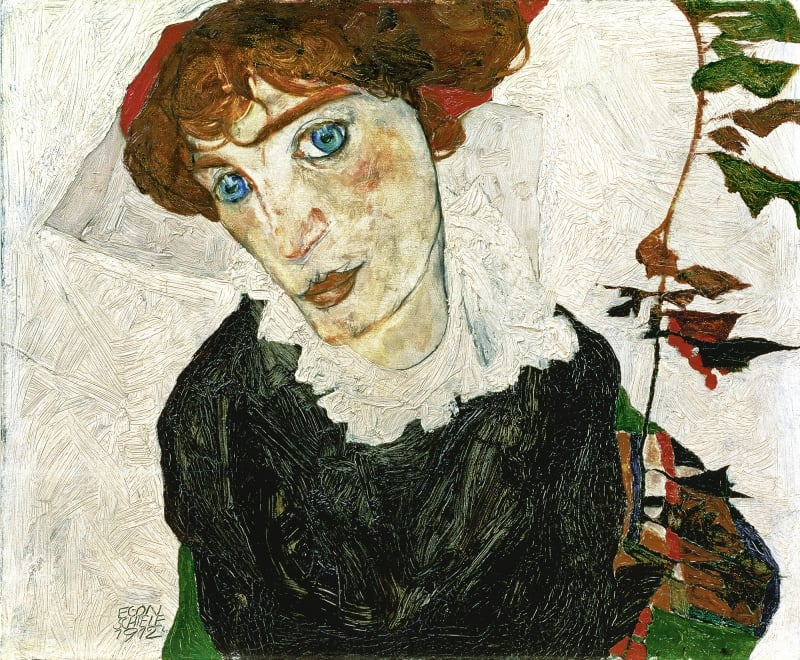
Egon Schiele, Portrait of Wally Neuzil, 1912, oil on canvas. Vienna, Leopold Museum
6 March 2026
There are countless ways to represent women: as muses and venuses, madonnas and odalisques. And yet, for most of art history, woman has existed primarily as an image–conceived in the male artist’s mind, and shaped less by her interior life than by his projections and desires. Look back to Shakespeare’s Sonnet 130. Writing of his mistress’ eyes, which are, by the way, nothing like the sun, Shakespeare was among the first to acknowledge men’s tendency to idealise women–and, in turn, to missee. Love, to him, began elsewhere: with the admission of imperfection–and the acceptance thereof.
But it wasn’t until centuries later that male artists caught up on this. Instead of mythological goddesses, the Realists turned to ordinary women, and sought to rebuke romanticisation. The Impressionists trained their eyes on street singers (a.k.a prostitutes), and abandoned it altogether. From these shifts emerged Expressionism, an early twentieth-century German movement grounded in a radical premise: the expression of internal realities over external appearances–women’s, finally, included.
Nowhere is this clearer than in the work of Egon Schiele. Though commonly recognised for its raw eroticism, expressive line, angular fragmentation, and anatomical distortion, his oeuvre boasts one other definitive quality: its honest, though not mimetic, representation of inner states. This is unsurprising, given the artist’s childhood: born in 1890 to a railway stationmaster in Tulln an der Donau, Schiele witnessed his father’s syphilis-induced mental and physical decline. His consequent death left Schiele the only male among women, a precondition that shaped his view on women–and initiated his lifelong fixation on rendering their emotional realities.
Four women were central to this process: the artist’s sister, Gertrude Schiele; his wife, Edith Harms; her sister Adele Harms; and his mistress, Walburga “Wally” Neuzil. He’s alleged to have had sexual interest, if not encounters, with all of them. But his work depicts more than that: it turns their dysmorphed, unidealised bodies into sites of psychological exploration, where both the sitters’ and the artist’s emotions may surface.
Turn to Schiele’s Portrait of Wally Neuzil, for example (see image above). Created in 1912, shortly after the start of their relationship, the painting bears a tightly compressed composition. It isolates Wally’s chest and head from the rest of her body, thereby bringing her uncomfortably close to the picture plane. As viewers, we find ourselves in Schiele’s position, looking down on his mistress from a slightly elevated viewpoint, as though standing directly over her. Aware of our presence, but not soothed by it, she sits coyly, her wary eyes and high collar introducing a sense of distance and physical restraint. Our encounter is thus not one of ease or comfort; it is, like the look in her eyes, shaped by vulnerability, disquiet, and emotional reserve. Even her tilted neck, a gesture otherwise associated with trust and tenderness, does not soften the underlying tension. Instead, it establishes a visual diagonal that divides the composition bilaterally, into two counterbalancing triangles, as if to introduce doubt. The portrait then reads not so much as a true–mimetic–representation of Wally, or an idealisation of her physical attractiveness, but a snapshot of an emotionally charged encounter–where artist and sitter felt torn, restrained, and hesitant, and now so does the viewer.
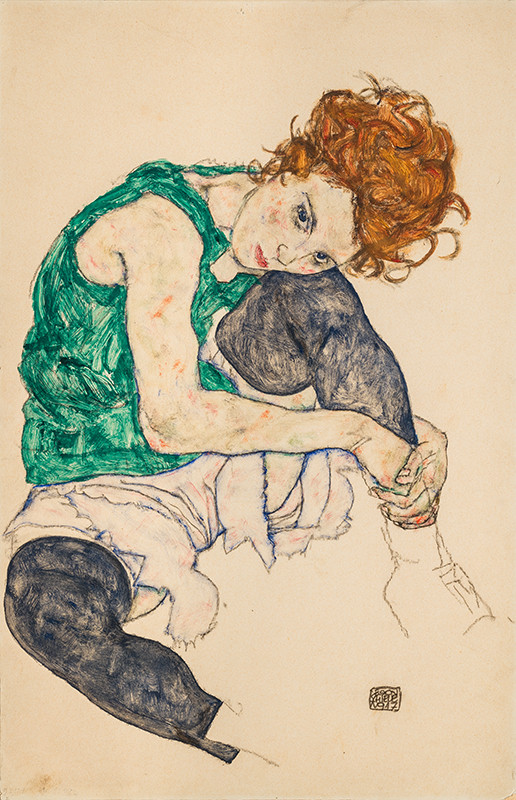
Egon Schiele, Seated Woman with Bent Knee, 1917, crayon on brown paper. Prague, Kinsky Palace
This restraint, however, is entirely amiss in Schiele’s portrait of Adele Harms, titled Seated Woman with Bent Knee (1917). Also viewed from above, Adele sits on the ground, one knee drawn sharply upward while the other leg falls open. This pose is at once informal–intimate–and insistently charged. Her petticoat is hitched high, her stockings conspicuously intact, and her hair is in disarray; thus, even when poised against an empty field, and stripped of narrative context, the figure nonetheless implies a story: an affair, perhaps. The assertive angle of her body, and the way she rests her head on her knee, further this reading, implying eroticism. But the eyes complicate this: she meets the viewer’s gaze directly, as in Wally’s case, but without invitation. The effect is one of guardedness and withdrawal, a psychological resistance that unsettles the overt sensuality of her posture. We find ourselves pulled in erotically, and intrigued, but we’re held at a distance–much as the artist may have been when gazing at his sister-in-law. The subject, then, becomes not a perfect, available woman; but, once again, a taboo, emotional relationship between sitter and artist, where overt eroticism dissolves into covert tension and self-consciousness.
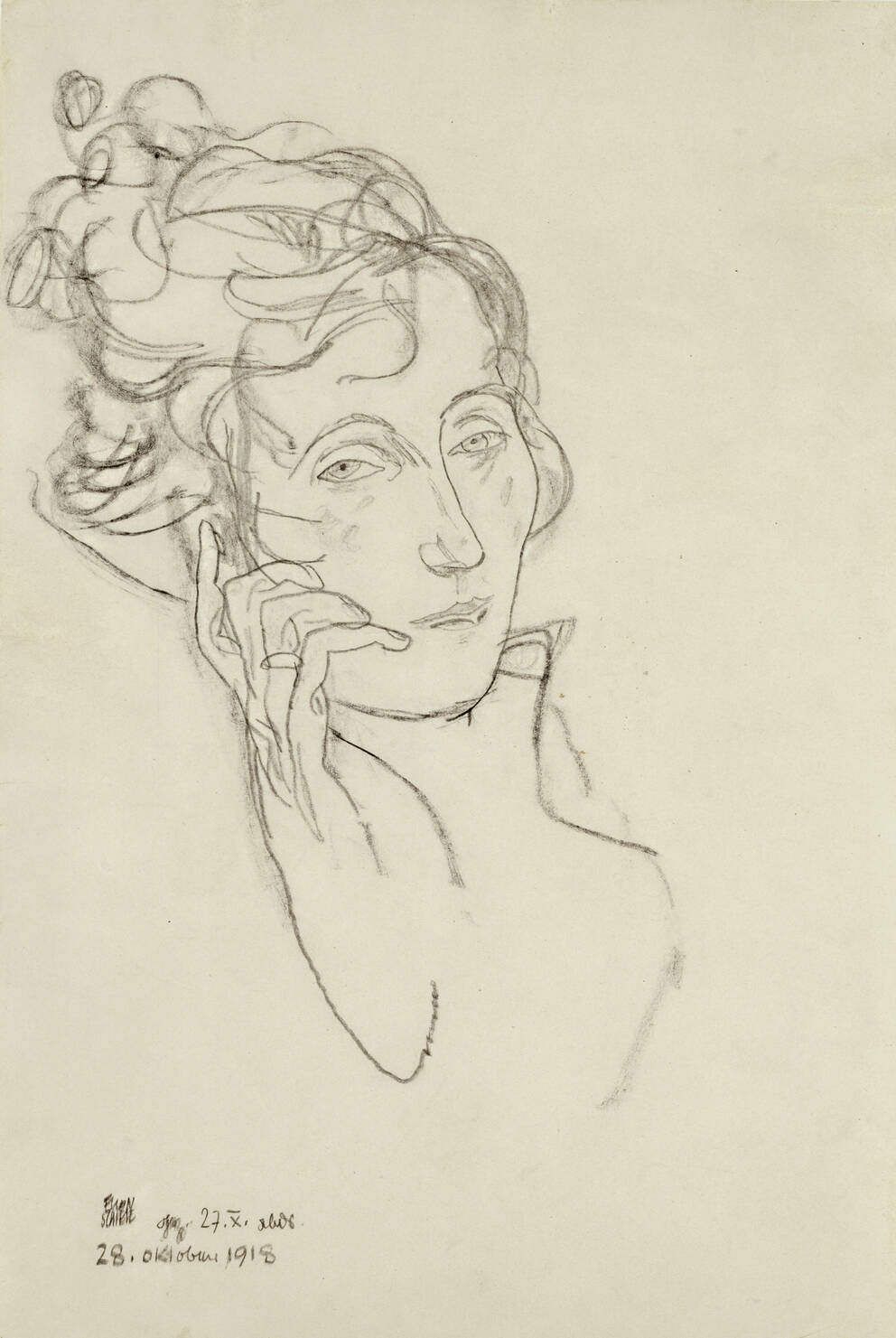
Egon Schiele, Edith Schiele, Dying, 1918, crayon on brown paper. Vienna, Leopold Museum
These works establish a theme, whereby Schiele’s women are not erotic projections but psychologically present beings, with their own, definite set of anxieties and concerns. One final work–and my favourite in his entire oeuvre–abandons these emotions altogether, allowing instead for vulnerability, fragility, and tenderness: the portrait of Edith Schiele, dying, six months pregnant. Drawn in 1918, amid the Spanish influenza, it renders Edith on her deathbed, her head propped against her right arm, her gaze serene yet knowing, and her eyes piercing the viewer. We see Edith as Egon did, delicate, exposed, her body traced in black crayon with deliberate care. Gone is the explicit sexuality of the artist’s earlier works, replaced by intimacy and the palpable awareness of impending loss. Here, Schiele becomes witness–mourner rather than provocator, voyeur, or transgressor, relinquishing erotic tension in favour of emotional presence. Within days, Edith would die, followed shortly by Schiele himself.
Looking at Schiele’s depictions of women is not an easy task; they stir emotions that are at once intriguing and unsettling. Yet this difficulty is precisely their power. Schiele’s women are, at last, permitted to feel and to be as they are: fractured, guarded, desirous, doubtful. They are seen not despite their internal tribulations, but through them. In granting women this psychological presence, which is neither idealised nor simplified, Schiele secures for them a space in art history that is not ornamental, or allegorical, but existential. And that’s worth noting.