10 September 2026 - 11 July 2027
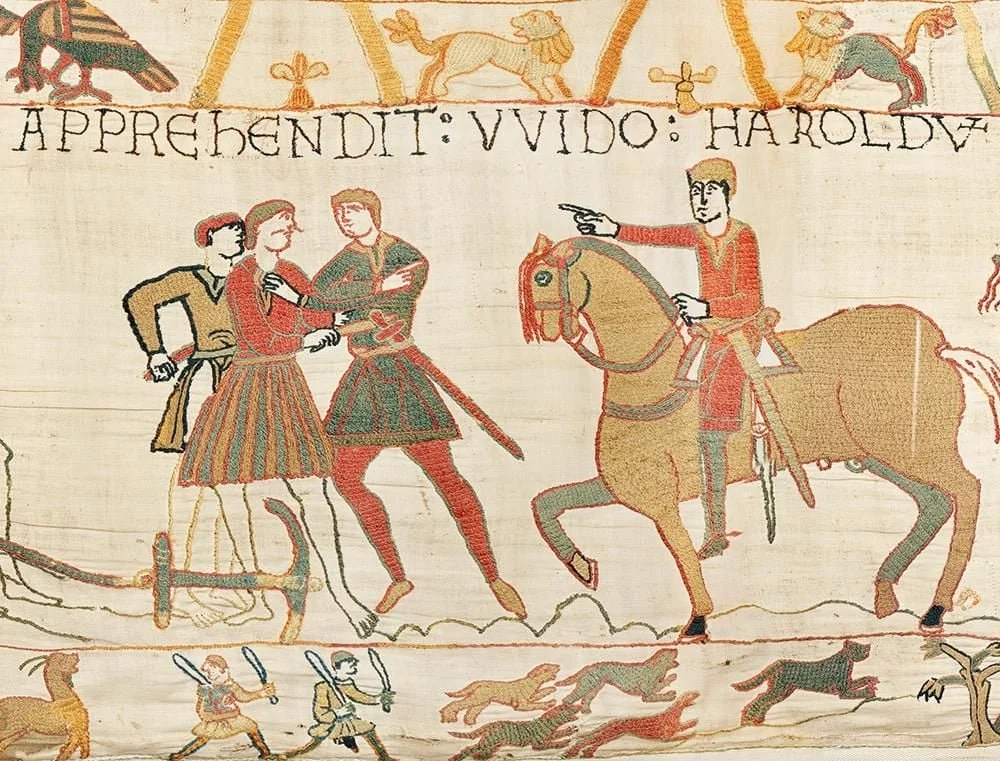
Guy of Ponthieu captures Harold after his landing in Normandy. Photo © La Fabrique de patrimoines en Normandie / Antoine Cazin. British Museum.
Over the past couple of months, a nationwide obsession with a Franco-British artefact from a thousand years ago has spread like a fire; for the first time in its existence, the Bayeux Tapestry is exhibited in England. For those who don’t know, the Bayeux Tapestry is a seventy metre long retelling of the events leading up to and including the Battle of Hastings, the defining battle in William, Duke of Normandy’s conquest of England in 1066. But let’s rewind a little bit. Who was involved and why?
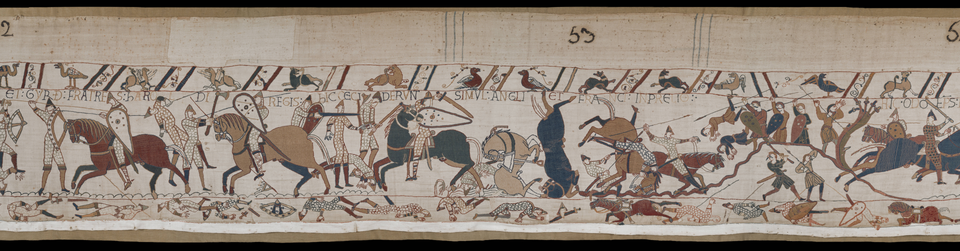
Université de Caen Normandie, Bayeux Tapestry Scene 53, CNRS · ENSICAEN d'après la campagne photographique 2017 de la Fabrique de patrimoines en Normandie. Wikimedia.
What, when, where, who?
England in 1066 was unlike what we see today. We had a king, but also a number of earls with regional power bases - and within this set-up a few colourful characters who changed the course of history. First, Edward the Confessor, King of England and son to Emma of Normandy (remember that; it is important). Next, Harold Godwinson, Earl of Wessex and Edward’s brother-in-law, and finally the two Norman brothers, William Duke of Normandy and Bishop Odo of Bayeux, Edward’s cousins on his mother’s side. Still with me? As Edward had no offspring, the natural question became who should inherit his throne. Upon his death, his council of advisors (the excellently named Witenagemot) chose Harold, and thereby outraged the Norman cousins who claimed that Edward had promised the throne to William — a motion apparently endorsed by Harold only a couple of years before. Robbed of this promise, William chose the only logical solution. War.
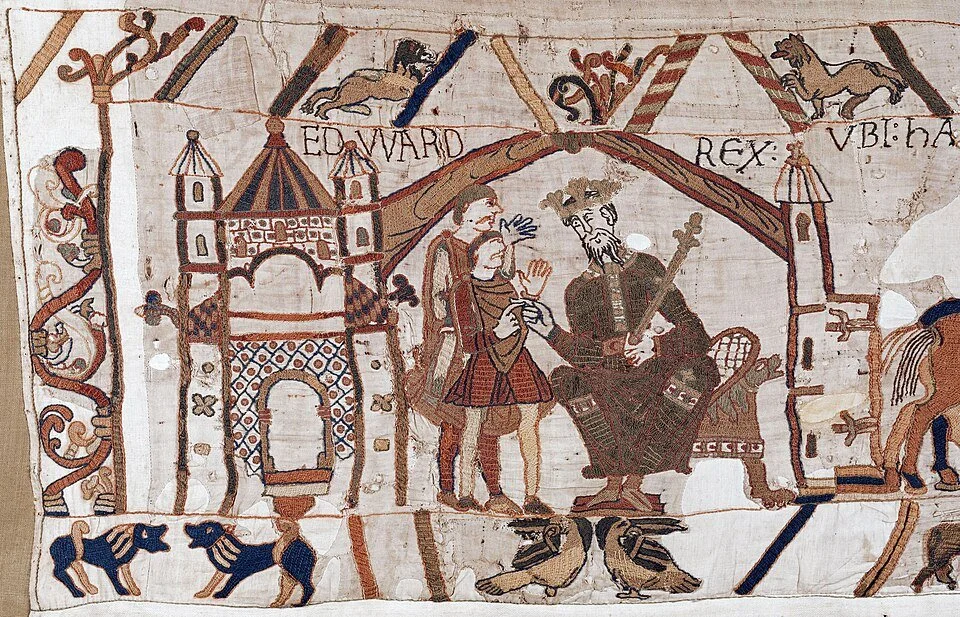
Université de Caen Normandie, Bayeux Tapestry Scene 1, CNRS · ENSICAEN d'après la campagne photographique 2017 de la Fabrique de patrimoines en Normandie. Wikimedia.
Stitches in Time
The Bayeux Tapestry chronicles this story in vibrant episodic scenes, starting with King Edward in conversation with his advisors over the succession. At first sight it’s a very male story, but there are some highly significant women behind the scenes, namely those who spent their days stitching life into these stories. Little is known about their lives: one theory is that they were Anglo-Saxon crafters perhaps employed in the church; another is that they were aristocratic women, in collaboration with William’s wife Matilda. There is no concrete evidence for either, but what we can say is that, balance of probability, this is a work about men, made by women.
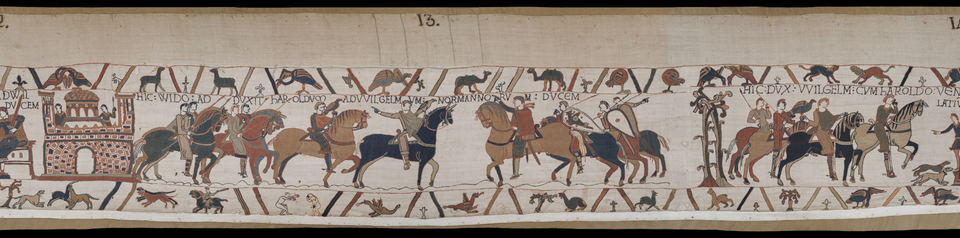
Université de Caen Normandie, Bayeux Tapestry Scene 13, CNRS · ENSICAEN d'après la campagne photographique 2017 de la Fabrique de patrimoines en Normandie. Wikimedia.
But how was the work divided up? What was the process? Was there a scheme they had to follow? How much freedom did they have? I particularly wonder about the borders top and bottom that sandwich the central frieze. These borders provide an abundance of visual pleasures: there are animals, some recognisable some not; random erotic scenes, almost like student doodles; and the dismembered bodies of the slain in the final battle sequence. Some motifs held symbolic meaning for the medieval mind, dragons, for instance, pop up time and again, likely foreshadowing or reflecting the danger coming to the British Isles.
So much mystery remains around the craft of the Bayeux Tapestry, but one thing can be said for certain — it is a masterful example of medieval English embroidery, second to none.
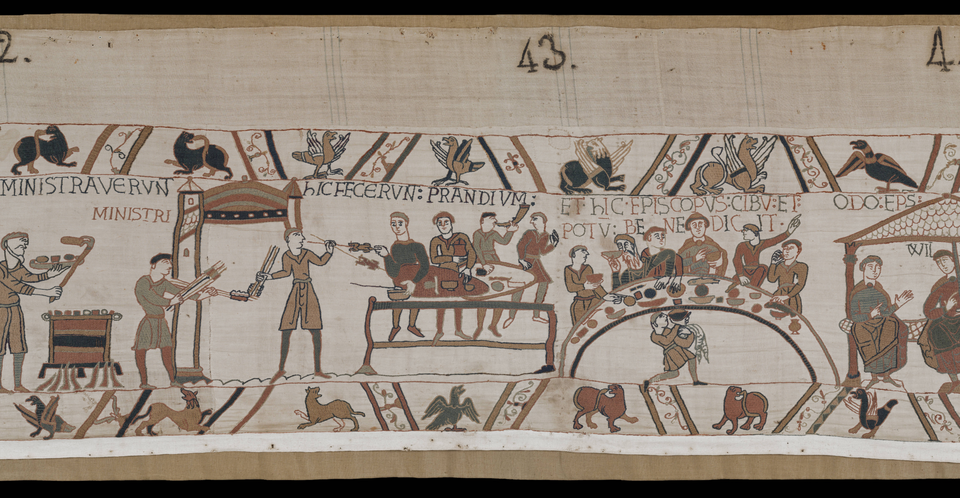
Université de Caen Normandie, Bayeux Tapestry Scene 43, CNRS · ENSICAEN d'après la campagne photographique 2017 de la Fabrique de patrimoines en Normandie. Wikimedia.
It Always Comes Back to Politics…
Probably produced in the first few decades after the conquest, the tapestry is an inherently political piece. Historians believe Bishop Odo was the most likely patron, partly because of a scene that appears to depict him in a strikingly similar composition to that of Jesus in the last supper. Odo and his brother weren’t on good terms at the time, so perhaps it was an exercise in regal brown-nosing or perhaps it was just a faithful’s act of reasserting the Normans’ right to rule in England.
Which brings us back to the Anglo-Saxon embroiderers. As we established earlier, the craftspeople were likely women, possibly from Canterbury in Kent, and therefore among the first to be conquered. In sewing these scenes, they were depicting their own defeat and the deaths of many brothers, sons and fathers. And while the commissioning of the tapestry may have been politically one-sided, the execution of it shows remarkable understanding of both sides in this epochal battle. To the victor the spoils of course, but the craftswomen have also captured all the sadness and trauma at the death of King Harold and the loss of their Anglo-Saxon world.
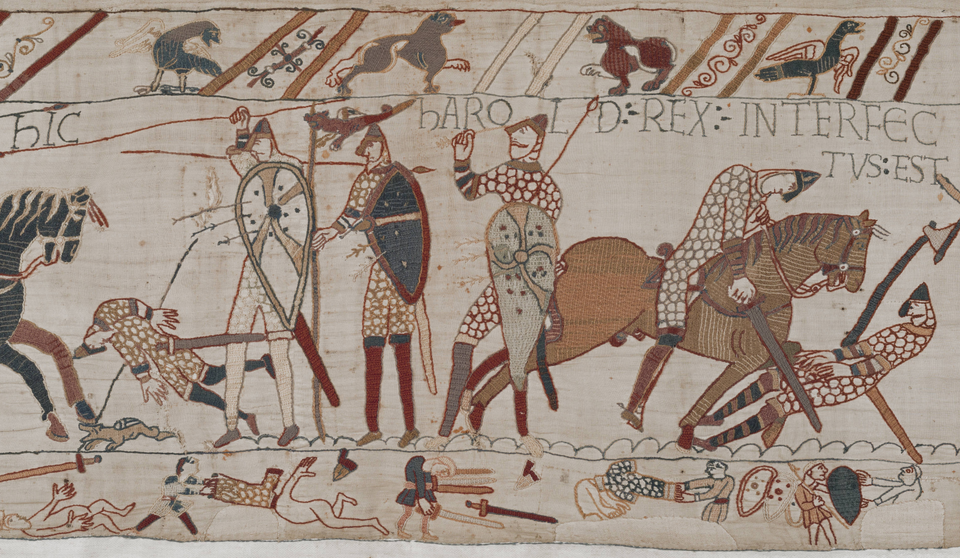
Université de Caen Normandie, Bayeux Tapestry Scene 58, CNRS · ENSICAEN d'après la campagne photographique 2017 de la Fabrique de patrimoines en Normandie. Wikimedia.
A thousand years on and the tapestry’s return to Britain has been heralded as a gesture of warm political cooperation; as French president Emmanuel Macron rather prosaically said, “a reminder of what our countries can do if they join forces.” The exhibition at the British Museum was opened with fanfare and a special viewing for the King, the governments of the UK and France, and notable dignitaries. And then it was open to the public… with a ticket, of course.
A Reminder
The experience of visiting the Bayeux Tapestry was unusual. I felt a fizzing excitement, as if I was about to see some sort of long lost treasure. We arrived at four-thirty, and joined the long snaking line to the front of the queue. Once in, we were taken through a long corridor and up some stairs with animated captions on the wall. As we got to the top, we had the opportunity to glance down at the tapestry from a balcony… it was quiet. Quieter than usual for an exhibition.
Each of us slotted into the most British line I have ever seen - quiet, respectful, and all with a single sense of purpose. And then we got to see the tapestry. It was like seeing a sovereign lying in state. We walked solemnly along its length, and were not allowed to dawdle or stop. Every so often a voice from above intoned, “please keep moving, do not stop!” So we did as we were told. I will be honest - it took a little of the magic out of it. There is so much detail in the tapestry that I would have liked to stop and pause and reflect. But thirty minutes along the seventy metre masterpiece and we were done.
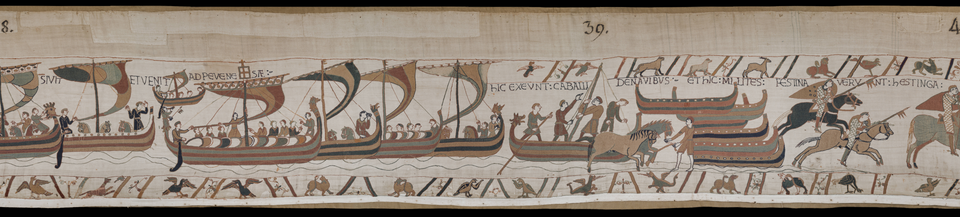
Université de Caen Normandie, Bayeux Tapestry Scene 39, CNRS · ENSICAEN d'après la campagne photographique 2017 de la Fabrique de patrimoines en Normandie. Wikimedia.
As I came away, I was struck by its reminder that Europe was built from the movement of people. Undeniably brutal, William of Normandy’s invasion of England laid the foundation for the country it is today. It turned us from a predominantly Anglo-Saxon country to one of mixed heritage, mixed language and mixed culture. In a time of mass movement of peoples around the world I can’t help but reflect on that today.
If you’d like to see more of the Bayeux Tapestry, the British Museum currently has an online experience to view the embroidery in its entirety.