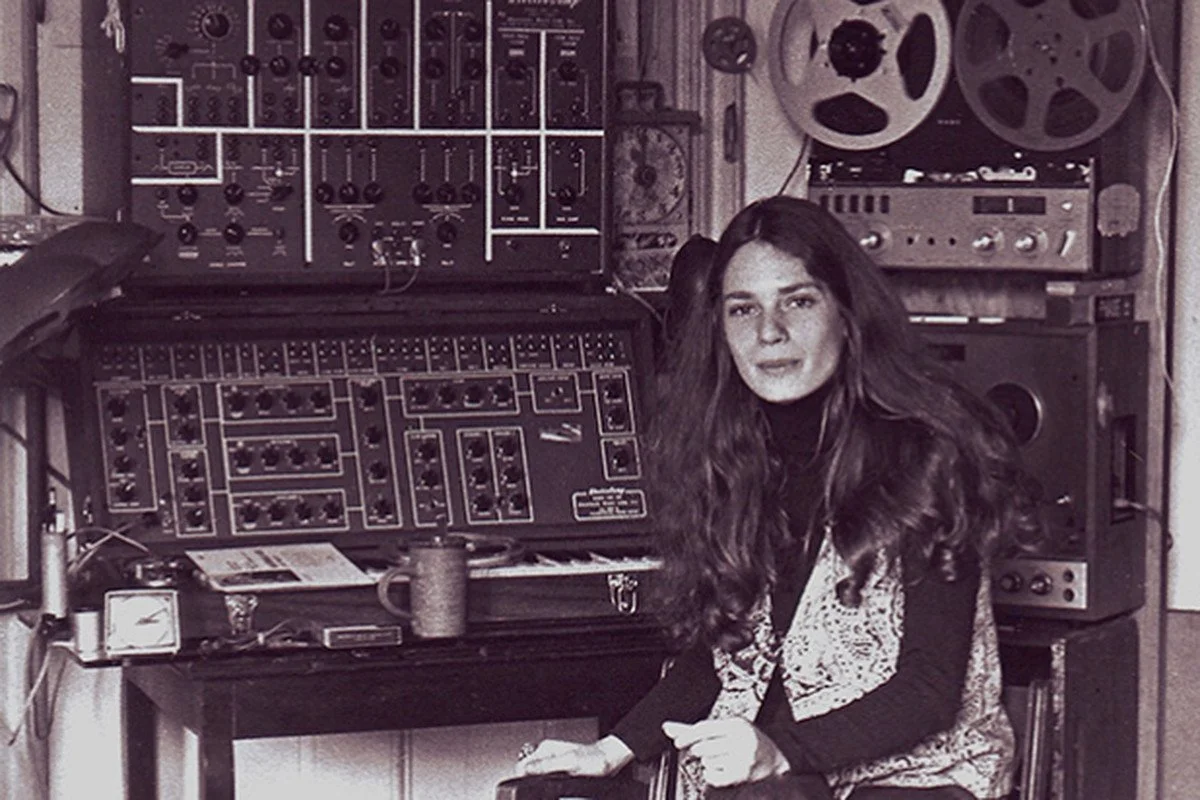
Photo of Laurie Spiegel by Stan Bratman, circa 1970. Wikimedia Commons.
The American composer Laurie Spiegel, born in 1945, was a pioneer in the development of electronic music. Using the earliest models of computers, Spiegel wrote her music during a time of great technological change – and her composing methods become ever more relevant to how we relate to technology today.
Computers looked very different in the mid-1970s when Spiegel began on her path as a composer. These earliest digital devices were cumbersome and complicated: at Bell Laboratories, where Spiegel worked, each computer filled an entire room and was so complicated that no single person knew all the steps to turn it on and off. Yet they were state of the art, expensive, and required training to use. Only very wealthy corporations could afford to own and operate them – banks, the government, the military. As a result, computers took on negative associations as the objects and instruments of bureaucracy: depersonalised, mechanised, and threatening, representing a new anti-human age. The music that Spiegel and her colleagues made using computers also gained a negative reputation, as they were accused of “depersonalising music” and turning something distinctly human, creative and joyful into an unfeeling mechanical process.
Spiegel, however, did not see her compositions this way. She instead understood computers to be tools that could help to create deeply personal music and new sounds that before could only be imagined. Her 1980 album The Expanding Universe was produced by pre-programming some musical elements such as melodies, rhythmic patterns and harmonic progressions, and linking these to an input such as a keyboard, number keypad, or even a 3D joystick. Once these elements were in place, Spiegel would use them to compose in real time – one hand on the input triggering the pre-written musical patterns in any sequence she wanted, the other changing the timbre. The result is music that is partly-predetermined and partly-spontaneous, and all personal: code written by Spiegel, brought to life by her touch.
Her work with technology resembles debates around music and generative AI. On the surface, the comparison seems appropriate: in both cases, a part of the creative process is taken over by a machine. But Spiegel is firm on how AI differs from her work: her code supports the musician, allowing them to realise their musical vision. AI, on the other hand, generates that music on its own, based on the patterns found in the millions of songs it has been fed. Spiegel’s attitude towards computers has always been to treat them as a collaborator, not a replacement: coding itself becomes an art, and her software must still be learned and controlled manually like an instrument. In Spiegel’s music, human and technology come together to help each other in service of the same thing: personal human expression.
Ultimately, we can take valuable insights from Spiegel’s approach to composing with computers. Art created with help from machines is not necessarily “dehumanising,” but the goal should always be humanity: as she has said, “It doesn’t matter what machines can generate on their own … You can’t replace human self-expression.” Spiegel’s methodology tells us that we will get so much more out of our relationship to technology if we treat it as a tool for human creativity, engage with how it is constructed, and think critically about just what we are using it for.
Spiegel went on to sell her software to the public. Music Mouse, first released in 1986, allows users to push notes and scales around the screen using a mouse – it is intuitive, creative and great fun… try it out for free, and see how Spiegel’s methodology works in practice!