Inside the Art Collections of a Cultural Icon: Yves Saint Laurent
12 June 2026
Over decades, some of history's most influential cultural figures, from fashion designers to music legends, assembled art collections that reflected their personal taste, intellectual curiosity, and unique way of seeing the world. Few collections embody this more completely than that of Yves Saint Laurent. The legendary French designer, who revolutionized women's fashion with the tuxedo suit and ready-to-wear luxury, was also one of the world's most passionate art collectors. Together with his lifelong partner, Pierre Bergé, he spent more than fifty years creating an extraordinary collection distinguished by both its originality and scale.
When Yves Saint Laurent passed away in 2008, the collection became the subject of one of the most important art sales held until that point. In February 2009, Christie's auctioned the collection at the Grand Palais in Paris. The three-day event, titled “The Sale of the Century,” attracted global attention and generated €373.9 million, setting a world record at the time for the most valuable private collection ever sold at auction. The objects came primarily from the couple's Paris apartment, Saint Laurent's office, and Château Gabriel, their country estate in Normandy, where they spent many weekends.
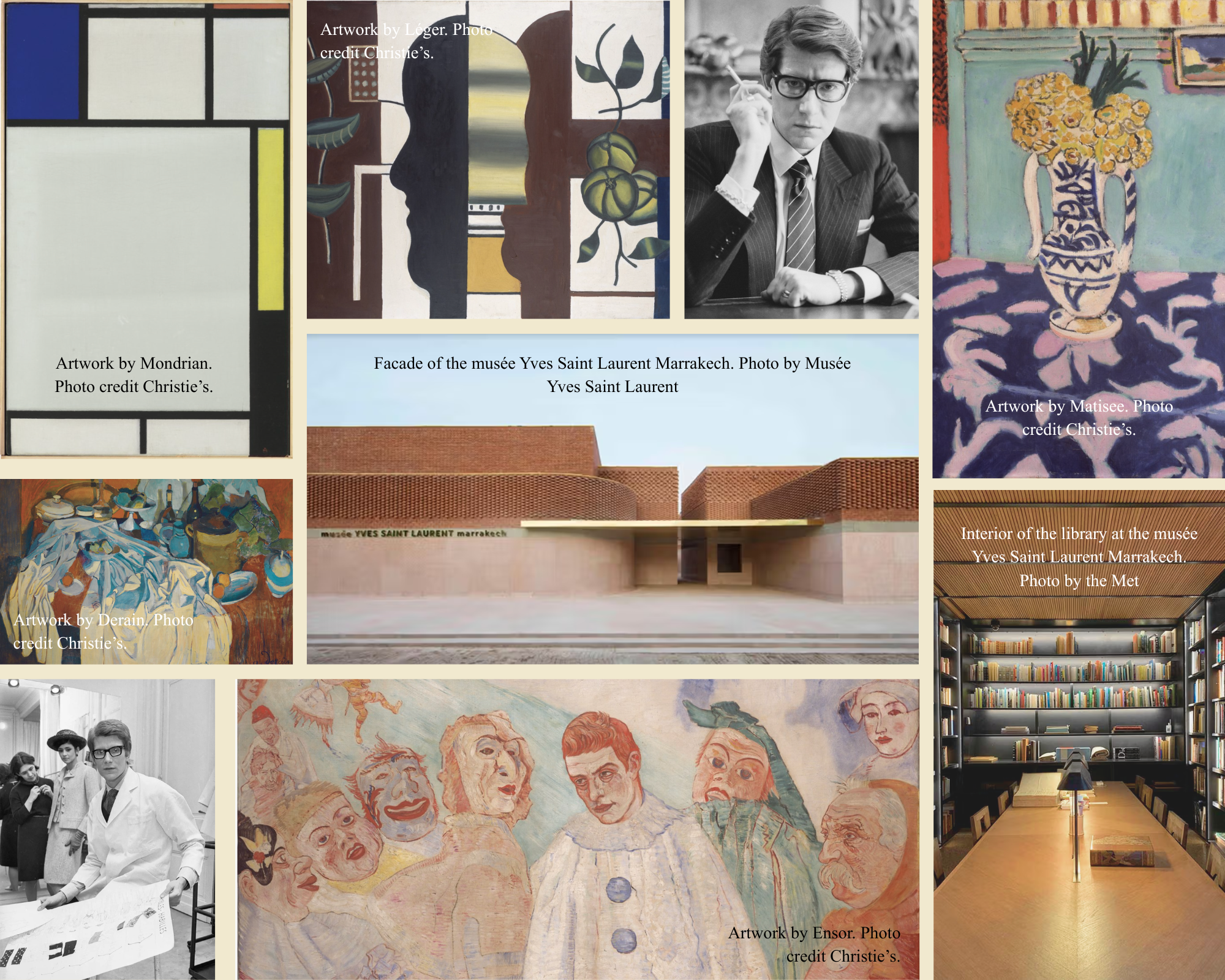
The sale offered art enthusiasts a rare glimpse into the private world of a fashion legend whose appreciation for art extended far beyond his achievements in fashion. Comprising 733 works spanning paintings, sculptures, decorative arts, furniture, books and tapestries, the collection brought together masterpieces by pioneering artists such as Pablo Picasso, Henri Matisse, Piet Mondrian, Constantin Brancusi, Marcel Duchamp, Paul Klee, Georges Braque, Frans Hals, and many others. Yet what made the collection remarkable was not simply the individual works it contained, but the way works from different centuries and artistic movements were arranged throughout the interiors in which Saint Laurent and Bergé lived. Following his passing, visitors and specialists described the spaces as almost magical, encountering masterpiece after masterpiece throughout the entrance hall, drawing room, music room, library, and private living spaces.
Among the highlights of the sale was Henri Matisse's Les Coucous, tapis bleu et rose (1911), which sold for €35.9 million. Three abstract paintings by Piet Mondrian significantly exceeded their estimates, achieving prices of €21.5 million, €14.4 million, and €7 million. Major institutions, including the Musée d'Orsay and the Centre Pompidou, also acquired works from the sale. Interestingly, not every work sold for millions. Some objects sold for only a few thousand euros, which reflected the eclectic nature of the collection, where personal treasures coexisted alongside museum-quality masterpieces. A portion of the proceeds from the sale was directed toward AIDS research. Yet the lasting legacy of the auction remains the collection itself, regarded as one of the most important private collections ever to come onto the art market, and a testament to how art can transform a home into a deeply personal expression of its owner's vision.